Carretié Luis
Facultad de Psicología, Universidad Autónoma de Madrid, 28049, Madrid, Spain,
Cogn Affect Behav Neurosci. 2014 Dec;14(4):1228-58. doi: 10.3758/s13415-014-0270-2.
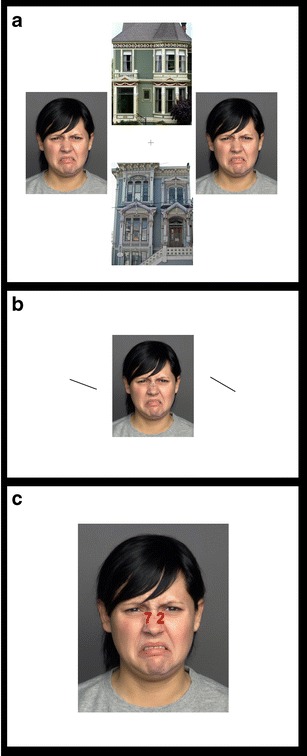
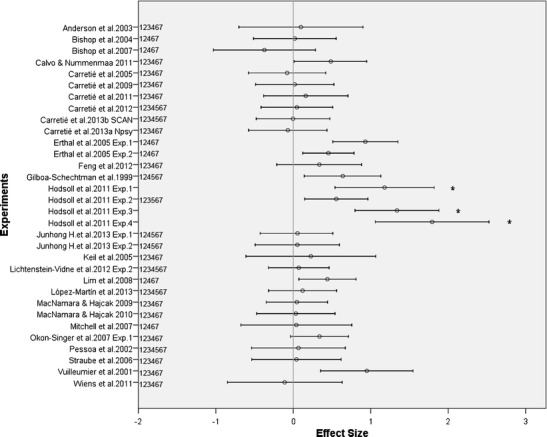
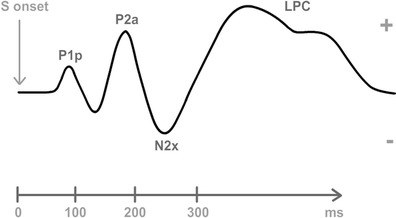
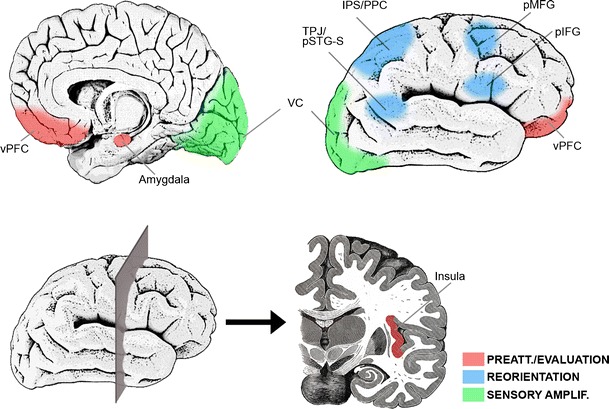
Current knowledge on the architecture of exogenous attention (also called automatic, bottom-up, or stimulus-driven attention, among other terms) has been mainly obtained from studies employing neutral, anodyne stimuli. Since, from an evolutionary perspective, exogenous attention can be understood as an adaptive tool for rapidly detecting salient events, reorienting processing resources to them, and enhancing processing mechanisms, emotional events (which are, by definition, salient for the individual) would seem crucial to a comprehensive understanding of this process. This review, focusing on the visual modality, describes 55 experiments in which both emotional and neutral irrelevant distractors are presented at the same time as ongoing task targets. Qualitative and, when possible, meta-analytic descriptions of results are provided. The most conspicuous result is that, as confirmed by behavioral and/or neural indices, emotional distractors capture exogenous attention to a significantly greater extent than do neutral distractors. The modulatory effects of the nature of distractors capturing attention, of the ongoing task characteristics, and of individual differences, previously proposed as mediating factors, are also described. Additionally, studies reviewed here provide temporal and spatial information-partially absent in traditional cognitive models-on the neural basis of preattention/evaluation, reorienting, and sensory amplification, the main subprocesses involved in exogenous attention. A model integrating these different levels of information is proposed. The present review, which reveals that there are several key issues for which experimental data are surprisingly scarce, confirms the relevance of including emotional distractors in studies on exogenous attention.
目前关于外源性注意(也被称为自动注意、自下而上的注意或刺激驱动的注意等)架构的知识,主要来自于使用中性、平淡刺激的研究。从进化的角度来看,外源性注意可被理解为一种适应性工具,用于快速检测显著事件、将处理资源重新导向这些事件并增强处理机制,因此情感事件(根据定义,对个体而言是显著的)对于全面理解这一过程似乎至关重要。本综述聚焦于视觉模态,描述了55项实验,在这些实验中,情感性和中性无关干扰物与正在进行的任务目标同时呈现。文中提供了对结果的定性描述,并在可能的情况下进行了元分析描述。最显著的结果是,行为和/或神经指标证实,情感性干扰物比中性干扰物更能显著吸引外源性注意。文中还描述了先前提出的作为中介因素的干扰物性质、正在进行的任务特征以及个体差异的调节作用。此外,这里综述的研究提供了传统认知模型中部分缺失的关于前注意/评估、重新定向和感觉放大(外源性注意涉及的主要子过程)神经基础的时间和空间信息。本文提出了一个整合这些不同层次信息的模型。本综述揭示了有几个关键问题的实验数据惊人地匮乏,证实了在关于外源性注意的研究中纳入情感性干扰物的相关性。