1 Division of Reproductive Health (DRH), National Center for Chronic Disease Prevention and Health Promotion, Centers for Disease Control and Prevention (CDC) , Atlanta, Georgia .
2 National Center for Emerging and Zoonotic Infectious Diseases , CDC, Atlanta, Georgia .
J Womens Health (Larchmt). 2017 Nov;26(11):1141-1145. doi: 10.1089/jwh.2017.6719.
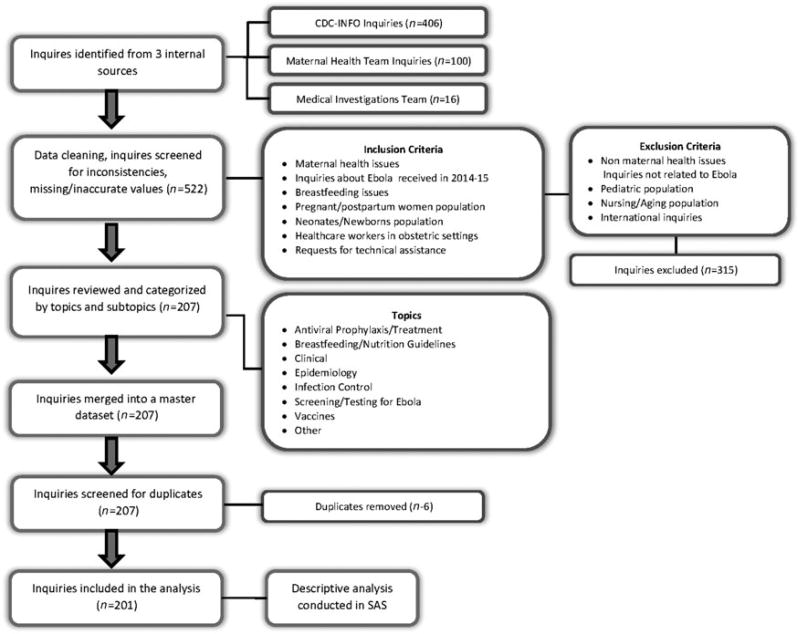
Previous outbreaks suggest that pregnant women with Ebola virus disease (EVD) are at increased risk for severe disease and death. Healthcare workers who treat pregnant women with EVD are at increased risk of body fluid exposure. Despite the absence of pregnant women with EVD in the United States, CDC activated the Maternal Health Team (MHT), a functional unit dedicated to emergency preparedness and response issues, on October 18, 2014. We describe major activities of the MHT. A high-priority MHT activity was to publish guiding principles early in the response. The MHT also prepared guidance documents, provided guidance and technical support for hospital preparedness, and addressed inquiries. We analyzed maternal health inquiries received through CDC-INFO, MHT, and CDC's Medical Investigations Team from August 2014 to December 2015. Internal call logs used to capture, monitor, and track inquiries for the three data sources were merged. Inquiries not related to maternal health issues and duplicates were removed. Each inquiry was categorized by route (email/phone), inquirer type, and topic. In total, 201 inquiries were received from clinicians, public health professionals, and the public. The predominant topic was related to infection control for high-risk situations such as labor and delivery. During the Ebola response, most inquiries were received via email rather than telephone, a notable shift compared to the H1N1 emergency response. Lessons learned during the H1N1 and Ebola responses are currently informing CDC's Zika Response, an unprecedented emergency response primarily focused on reproductive health issues.
先前的疫情爆发表明,患有埃博拉病毒病(EVD)的孕妇患重病和死亡的风险增加。治疗患有 EVD 的孕妇的医护人员面临体液暴露的风险增加。尽管在美国没有患有 EVD 的孕妇,但 CDC 于 2014 年 10 月 18 日启动了孕产妇健康团队(MHT),这是一个致力于应急准备和应对问题的职能单位。我们描述了 MHT 的主要活动。MHT 的一项高优先级活动是在应对初期发布指导原则。MHT 还编写了指导文件,为医院的准备工作提供了指导和技术支持,并解答了咨询。我们分析了 2014 年 8 月至 2015 年 12 月期间通过 CDC-INFO、MHT 和 CDC 医疗调查小组收到的孕产妇健康咨询。用于捕获、监测和跟踪三个数据源查询的内部呼叫日志被合并。删除了与孕产妇健康问题无关和重复的查询。每个查询都按路线(电子邮件/电话)、询问者类型和主题进行分类。总共收到了来自临床医生、公共卫生专业人员和公众的 201 条咨询。主要主题与高危情况(如分娩)的感染控制有关。在埃博拉疫情应对期间,与 H1N1 紧急情况相比,大多数查询是通过电子邮件而不是电话收到的,这是一个显著的转变。在 H1N1 和埃博拉疫情应对期间吸取的经验教训目前正在为 CDC 的寨卡疫情应对提供信息,这是一次前所未有的主要关注生殖健康问题的应急响应。