Okoh Sunday O, Iweriebor Benson C, Okoh Omobola O, Okoh Anthony I
SAMRC Microbial Water Quality Monitoring Centre, Applied and Environmental Microbiology Research Group (AEMREG), Department of Biochemistry and Microbiology, University of Fort Hare, Private Mail Bag X1314 Alice 5700, Eastern Cape, South Africa.
Pharmacogn Mag. 2017 Oct;13(Suppl 3):S392-S400. doi: 10.4103/pm.pm_106_17. Epub 2017 Oct 11.
is an annual herbaceous ethnomedicinal plant used in the treatment of a variety of communicable and noncommunicable diseases in the Amazon region.
The study aimed at profiling the bioactive constituents of the leaves and stem essential oils (LEO and SEO) of , their antibacterial and radical scavenging properties as probable lead constituents in the management of oxidative stress and infectious diseases. Materials and.
The EOs were obtained from the leaves and stem using modified Clevenger apparatus and characterized by a high-resolution gas chromatography-mass spectrometry, while the radicals scavenging and antibacterial effects on four oxidants and six reference bacteria strains were examined by spectrophotometric and agar diffusion techniques, respectively.
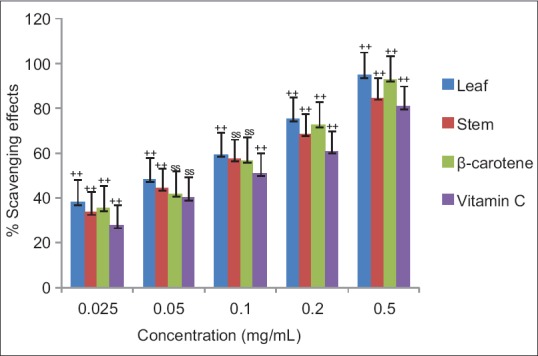
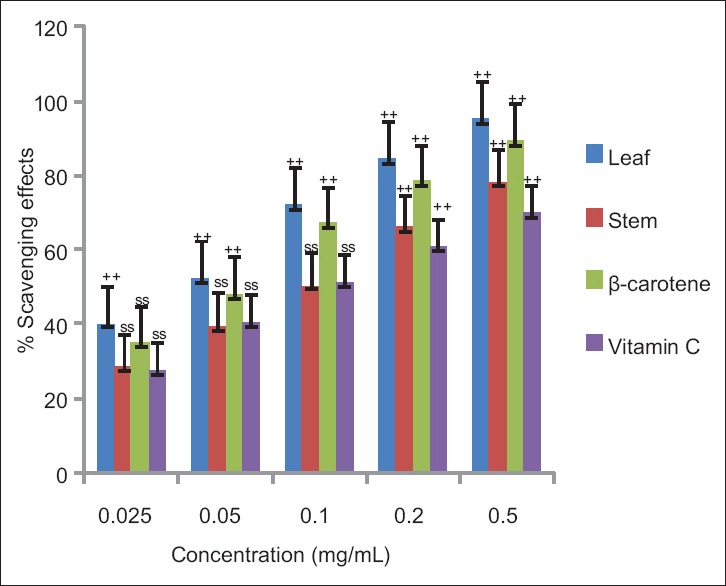
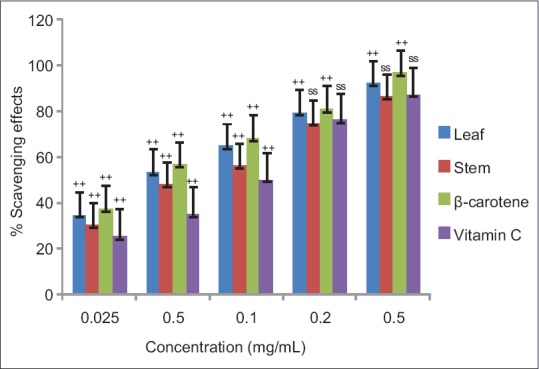
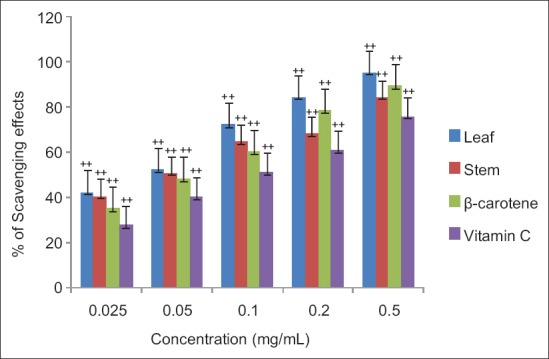
The EOs exhibited strong antibacterial activities against six bacteria ( [180], , , and ) strains. The SEO antibacterial activities were not significantly different ( < 0.05) from the LEO against most of the test bacteria with minimum inhibitory concentration ranging between 0.15 and 0.20 mg/mL for both EOs. The two oils were bactericidal at 0.20 mg/mL against while the minimum bactericidal concentration (0.15 mg/mL) of LEO against was lower than of SEO (0.20 mg/mL) after 24 h. The LEO IC value (1.67 mg/mL) revealed more radical scavenging activity than the SEO (2.83 mg/mL) and reference compounds against 2,2-diphenyl-1-picrylhydrazyl radical. The EOs also scavenged three other different radicals (2,2'-azino-bis (3-ethylbenzothiazoline-6-sulfonic acid) diammonium salt radical, lipid peroxyl radical, and nitric oxide radical) in concentration-dependent manner.
Our results suggest that apart from the indigenous uses of the plant extracts, the EO contains strong bioactive compounds with antibacterial and radicals scavenging properties and may be good alternative candidates in the search for novel potent antibiotics in this present era of increasing multidrug-resistant bacterial strains as well as effective antioxidants agents.
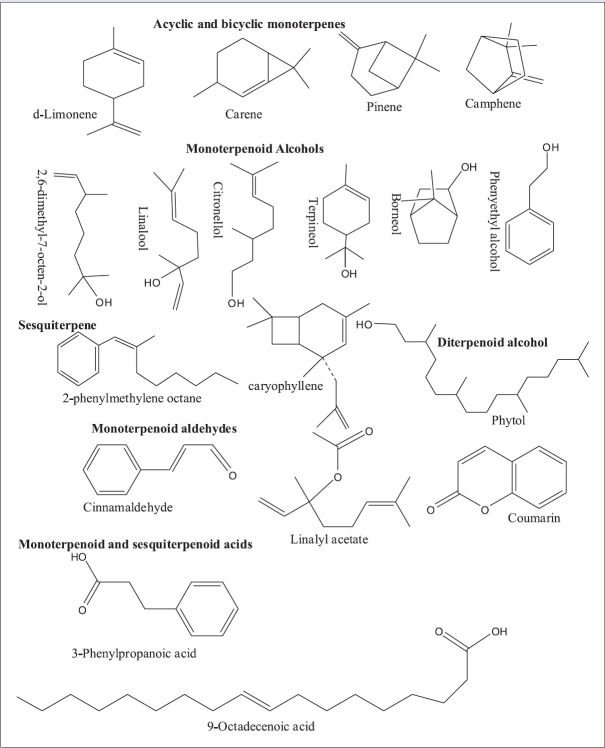
Established gas chromatography-mass spectrometry technique was applied to quantitatively and qualitatively analyze the volatile constituents in essential oil (EO)The Clinical and Laboratory Standards Institute (2014) guidelines were employed to evaluate the antibacterial effects of the EOsAmong the known prominent bioactive terpenoids, linalool 17.09%, limonene 14.25%, β-caryophyllene 12.52%, and linalyl acetate 10.15% were the main constituents of the EOs in this current studyThe leaf and stem EOs were bactericidal at a concentration below 0.23 mg/mL against three multidrug-resistant bacteria and significantly scavenged known free radicals reported to be associated with contagious and oxidative stress-related disorders. GC-MS: Gas chromatography-mass spectrometry, DPPH: 2,2-diphenyl-1-picrylhydrazyl, ABTS: 2,2-azino-bis (3-ethylbenzothiazoline-6-sulfonic acid) diammonium salt, DMSO: Dimethyl sulfoxide, LP: Lipid peroxide radical, NO: Nitric oxide radical, LEO: Leaf essential oil, SEO: Stem essential oil, RC: Reference compound, TBARS: Thiobarbituric acid.
[植物名称]是一种一年生草本民族药用植物,用于治疗亚马逊地区的多种传染病和非传染病。
本研究旨在分析[植物名称]叶和茎精油(LEO和SEO)的生物活性成分、它们的抗菌和自由基清除特性,作为氧化应激和传染病管理中可能的先导成分。材料和方法。
采用改良的克莱文杰装置从叶和茎中提取精油,并用高分辨率气相色谱 - 质谱联用仪进行表征,同时分别采用分光光度法和琼脂扩散技术检测其对四种氧化剂和六种参考细菌菌株的自由基清除和抗菌作用。
精油对六种细菌([细菌名称1]、[细菌名称2]、[细菌名称3]、[细菌名称4]、[细菌名称5]和[细菌名称6])菌株表现出较强的抗菌活性。对于大多数测试细菌,SEO的抗菌活性与LEO无显著差异(P < 0.05),两种精油的最低抑菌浓度在0.15至0.20mg/mL之间。两种精油在0.20mg/mL时对[细菌名称7]具有杀菌作用,24小时后LEO对[细菌名称8]的最低杀菌浓度(0.15mg/mL)低于SEO(0.20mg/mL)。LEO的IC值(1.67mg/mL)显示出比SEO(2.83mg/mL)和参考化合物对2,2 - 二苯基 - 1 - 苦基肼自由基更强的自由基清除活性。精油还以浓度依赖的方式清除其他三种不同的自由基(2,2'- 偶氮二异丁基脒二盐酸盐自由基、脂质过氧化自由基和一氧化氮自由基)。
我们的结果表明,除了该植物提取物的本土用途外,精油含有具有抗菌和自由基清除特性的强大生物活性化合物,在当今多重耐药细菌菌株不断增加的时代,可能是寻找新型有效抗生素以及有效抗氧化剂的良好替代候选物。
采用成熟的气相色谱 - 质谱联用技术对[植物名称]精油中的挥发性成分进行定量和定性分析。采用临床和实验室标准协会(2014年)指南评估精油的抗菌作用。在本研究中,已知的主要生物活性萜类化合物中,芳樟醇17.09%、柠檬烯14.25%、β - 石竹烯12.52%和乙酸芳樟酯10.15%是精油的主要成分。叶和茎精油在浓度低于0.23mg/mL时对三种多重耐药细菌具有杀菌作用,并能显著清除已知与传染性和氧化应激相关疾病有关的自由基。GC - MS:气相色谱 - 质谱联用仪,DPPH:2,2 - 二苯基 - 1 - 苦基肼,ABTS:2,2'- 偶氮二异丁基脒二盐酸盐,DMSO:二甲基亚砜,LP:脂质过氧化自由基,NO:一氧化氮自由基,LEO:叶精油