Molecular Oncology and Viral Pathology Group, Portuguese Oncology Institute of Porto, Rua Dr. António Bernardino Almeida, 4200-072 Porto, Portugal.
Department of Pathology, Portuguese Oncology Institute of Porto, Rua Dr. António Bernardino Almeida, 4200-072 Porto, Portugal.
World J Gastroenterol. 2017 Oct 28;23(40):7292-7302. doi: 10.3748/wjg.v23.i40.7292.
To determine the prevalence of Epstein-Barr virus (EBV)-associated gastric carcinomas in the North Region of Portugal and to study its clinicopathological characteristics.
We have performed a retrospective study including a total of 179 consecutive patients with gastric cancer (GC) submitted to gastrectomy during 2011 at the Portuguese Oncology Institute of Porto. Clinical and pathological data was collected from individual clinical records and inserted on a database with unique codification. Tumour tissues were collected from the institutional tumour bank. EBV was detected by hybridization for the detection of EBV-encoded small RNAs (EBERs) and EBV latent proteins (LMP1 and LMP2A) were detected by immunohistochemistry.
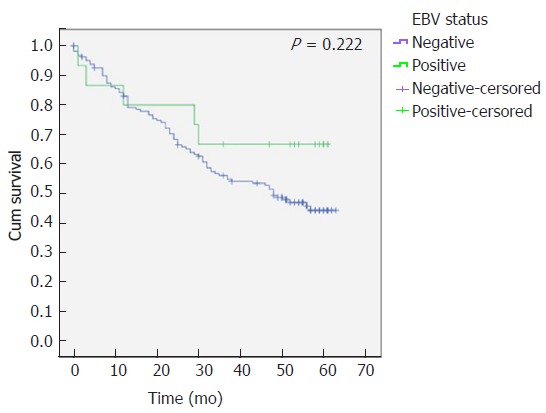
The analysis showed that EBV-associated gastric carcinomas (EBVaGC) represents 8.4% (15/179) of all GC cases, with a significant differential distribution among histological types ( < 0.001): 100% (3/3) of medullary carcinomas, 100% (1/1) of adenosquamous carcinoma, 8.7% (8/92) of tubular adenocarcinomas, 8.0% (2/25) of mixed carcinomas and 2% (1/51) in poorly cohesive carcinomas. The analysis revealed a higher predominance of EBVaGC in the upper third and middle (cardia, fundus and body) of the stomach ( = 0.041), a significant lower number of regional lymph nodes invasion ( = 0.025) and a tendency for better prognosis ( = 0.222). EBV latent protein expression revealed that all EBVaGC cases were LMP1-negative, nevertheless 6 cases (40%) expressed LPM2A, which reveals that these cases show a distinct EBV-Latency profile (latency II-like).
EBVaGC represents 8.4% of all GC in the North Region of Portugal. The EBV-infected patients have specific clinic-pathological features that should be further explored to develop new strategies of management and treatment.
确定葡萄牙北部地区 EBV 相关胃癌的流行率,并研究其临床病理特征。
我们进行了一项回顾性研究,纳入了 2011 年在葡萄牙肿瘤研究所进行胃切除术的 179 例连续胃癌患者。从个体临床记录中收集临床和病理数据,并插入具有唯一编码的数据库中。肿瘤组织从机构肿瘤库中收集。通过杂交检测 EBV,检测 EBV 编码的小 RNA(EBERs),通过免疫组织化学检测 EBV 潜伏蛋白(LMP1 和 LMP2A)。
分析显示,EBV 相关胃癌(EBVaGC)占所有 GC 病例的 8.4%(15/179),在组织学类型中存在显著差异分布(<0.001):3/3 例髓样癌、1/1 例腺鳞癌、8.7%(8/92)例管状腺癌、8.0%(2/25)例混合癌和 2%(1/51)例低黏附癌。分析显示,EBVaGC 在胃的中上三分之一(贲门、胃底和体部)更为常见(=0.041),区域淋巴结侵袭的数量明显较少(=0.025),且预后较好(=0.222)。EBV 潜伏蛋白表达显示,所有 EBVaGC 病例均为 LMP1 阴性,但 6 例(40%)表达 LPM2A,这表明这些病例表现出明显不同的 EBV 潜伏模式(潜伏 II 样)。
EBVaGC 占葡萄牙北部地区所有 GC 的 8.4%。感染 EBV 的患者具有特定的临床病理特征,应进一步探讨这些特征,以制定新的管理和治疗策略。