Li Ying, Li Xiao-Hui, Huang Xin, Yin Lu, Guo Cheng-Xian, Liu Chang, He Yong-Mei, Liu Xing, Yuan Hong
aDepartment of Health Management, The Third Xiangya Hospital bHealth Management Research Center, Central South University cDepartment of Pharmacology, School of Pharmaceutical Sciences, Central South University dPreventive Medicine, Medical School of Hunan Normal University, Changsha eState Key Laboratory of Cardiovascular Disease, Fuwai Hospital, National Center for Cardiovascular Disease, Peking Union Medical College & Chinese Academy of Medical Sciences, Beijing fCenter of Clinical Pharmacology, The Third Xiangya Hospital, Central South University, Changsha gSecond Department of Geriatric Medicine, Aerospace Center Hospital, Beijing, P. R. China.
Medicine (Baltimore). 2017 Nov;96(46):e8513. doi: 10.1097/MD.0000000000008513.
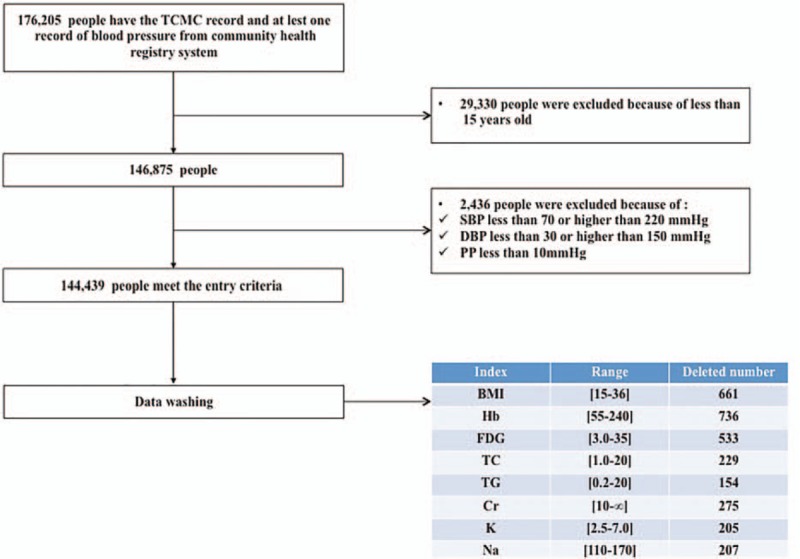
Traditional Chinese Medicine Constitution (TCMC) theory states that individuals with a biased TCMC are more likely to suffer from specific diseases. However, little is known regarding the influence of TCMC on susceptibility to hypertension. The aim of this study is to examine the possible relationship between TCMC and hypertension. Retrospective evaluation and observation were performed using the STROBE guidelines checklist. A large community-based cross-sectional study was conducted between 2009 and 2013 in Changsha, China. TCMC was assessed using a questionnaire that included 68 items. TCMC distributions and the associations of different TCMCs with hypertension risk were analyzed. In total, 144,439 subjects underwent evaluations of TCMC and blood pressure (BP). There were significant differences in the hypertension prevalence among the various TCMC groups (P < .01). An adjusted logistic regression model indicated that those with phlegm wetness, yin deficiency, blood stasis, or qi deficiency were more likely to have hypertension. Analysis of the clinical characteristics related to TCMC indicated that different TCMCs corresponded to different hypertension classifications using Western medicine criteria; for example, phlegm wetness with hypertension was similar to obesity-related hypertension. Our results suggest that phlegm wetness, yin deficiency, blood stasis, and qi deficiency have different effects on the prevalence of hypertension. More attention should be paid to TCMCs associated with susceptibility to hypertension, and corresponding preventive and therapeutic treatments should be developed according to different TCMCs.
中医体质理论认为,体质偏颇的个体更容易患特定疾病。然而,关于中医体质对高血压易感性的影响知之甚少。本研究旨在探讨中医体质与高血压之间可能存在的关系。采用STROBE指南清单进行回顾性评估和观察。2009年至2013年在中国长沙进行了一项基于社区的大型横断面研究。使用包含68个条目的问卷对中医体质进行评估。分析了中医体质分布以及不同中医体质与高血压风险的关联。共有144439名受试者接受了中医体质和血压评估。不同中医体质组的高血压患病率存在显著差异(P <.01)。调整后的逻辑回归模型表明,痰湿质、阴虚质、血瘀质或气虚质的人更易患高血压。对与中医体质相关的临床特征分析表明,按照西医标准,不同的中医体质对应不同的高血压分类;例如,痰湿质伴高血压类似于肥胖相关性高血压。我们的研究结果表明,痰湿质、阴虚质、血瘀质和气 虚质对高血压患病率有不同影响。应更加关注与高血压易感性相关的中医体质,并根据不同的中医体质制定相应的预防和治疗措施。