Alzahrani Khaled, Carley Fiona, Brahma Arun, Morley Debbie, Hillarby M Chantal
aDivision of Pharmacy and Optometry, School of Health Sciences, University of Manchester bManchester Royal Eye Hospital, Manchester, UK.
Medicine (Baltimore). 2017 Nov;96(46):e8563. doi: 10.1097/MD.0000000000008563.
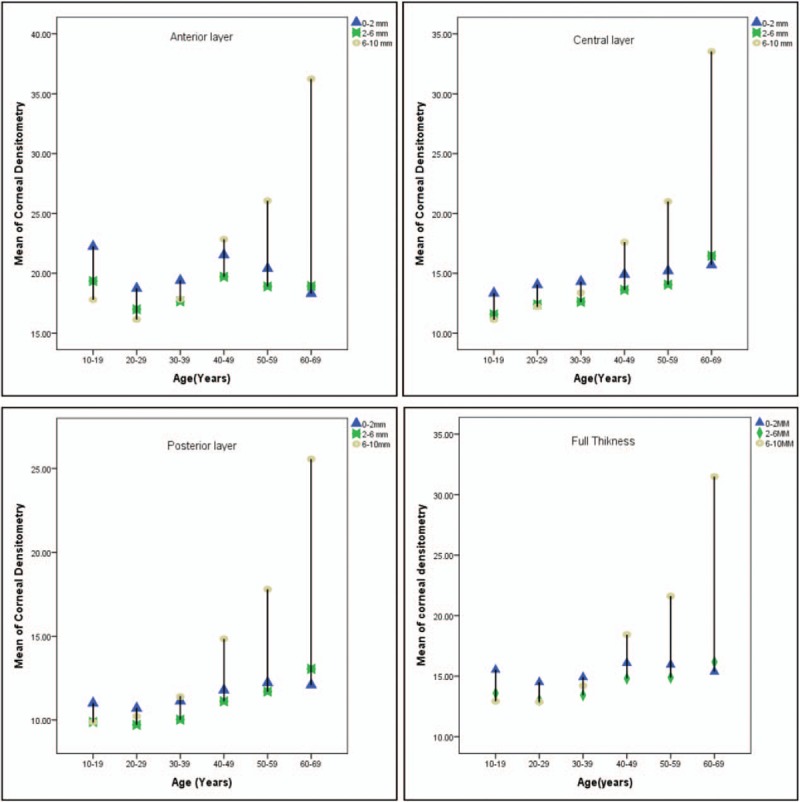
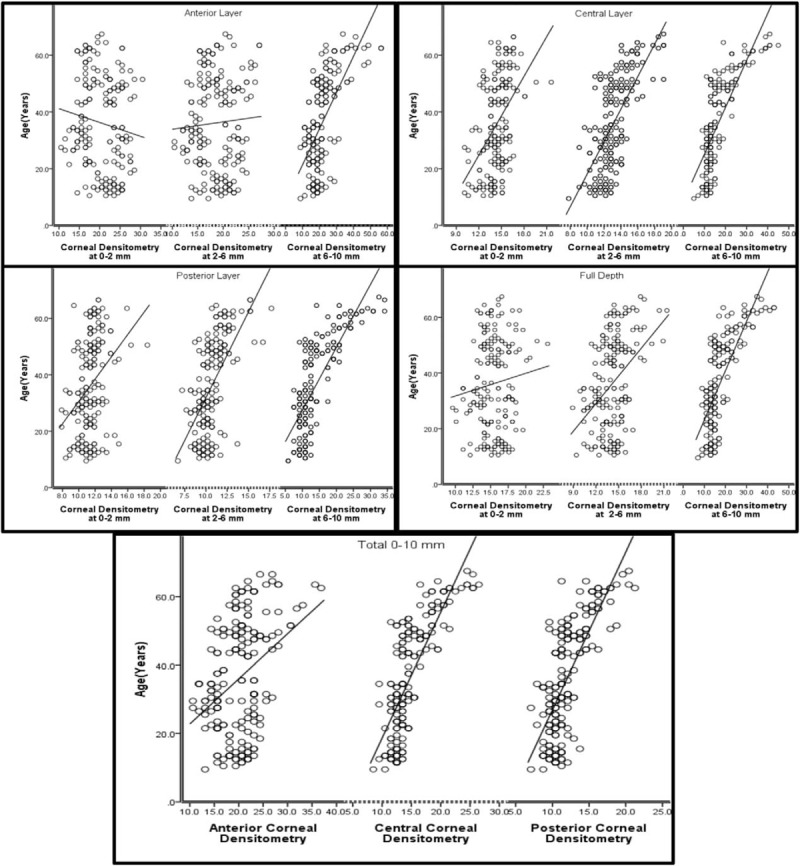
The aim of this study was to standardize and investigate the changes in corneal clarity with age. Densitometry software for the Oculus Pentacam was used to examine corneal clarity at different age groups.A total of 192 eyes from 97 healthy participants were included in this cohort comparative nonrandomized, cross-sectional study. An Oculus Pentcam was used to image the cornea of healthy participants grouped by age (between 10 and 70 years old). Data from the densitometry output have been used to determine clarity in concentric zones and different depths of the cornea.Corneal densitometry (CD) across all ages showed significant differences between groups when divided into the following layers: anterior, central, and posterior or divided into 0 to 2, 2 to 6, and 6 to 10 mm concentric zones (P < .05). The most striking decrease in clarity occurred with age in all 3 layers of the periphery (6-10 mm) (P < .05). In addition, we showed that the 10 to 19-year age group had lower clarity than the 20 to 30-age group (P < .05), and after 30 years, the cornea shows a steady progression of increased or decreased clarity.The values for CD, as well as for separate subdivisions based on layer and surface area, might provide a standard for use in further studies and clinical practice. This study established that relation between CD and age is differed when the cornea is divided into layers and zones. This study suggests that there are other factors that may play an essential role in corneal clarity as well as age.
本研究的目的是规范并调查角膜透明度随年龄的变化。使用Oculus Pentacam的密度测定软件检查不同年龄组的角膜透明度。本队列比较性非随机横断面研究纳入了97名健康参与者的192只眼睛。使用Oculus Pentcam对按年龄分组(10至70岁)的健康参与者的角膜进行成像。密度测定输出的数据已用于确定角膜同心区域和不同深度的透明度。当按以下层划分:前部、中央和后部,或划分为0至2、2至6和6至10毫米的同心区域时,各年龄组之间的角膜密度测定(CD)显示出显著差异(P<0.05)。周边所有三层(6至10毫米)的透明度随年龄增长下降最为显著(P<0.05)。此外,我们发现10至19岁年龄组的透明度低于20至30岁年龄组(P<0.05),30岁以后,角膜透明度呈现出增加或减少的稳定变化趋势。CD值以及基于层和表面积的单独细分值可能为进一步研究和临床实践提供一个标准。本研究确定,当将角膜分为层和区域时,CD与年龄之间的关系有所不同。本研究表明,除年龄外,可能还有其他因素在角膜透明度中起重要作用。