Yang Juanhua, Peng Jun, Zhang Dake, Zheng Liling, Mo Lei
Center for the Study of Applied Psychology and School of Psychology, South China Normal University, Guangzhou, China.
Department of Educational Psychology, Rutgers University, New Brunswick, NJ, United States of America.
PLoS One. 2017 Nov 16;12(11):e0186114. doi: 10.1371/journal.pone.0186114. eCollection 2017.
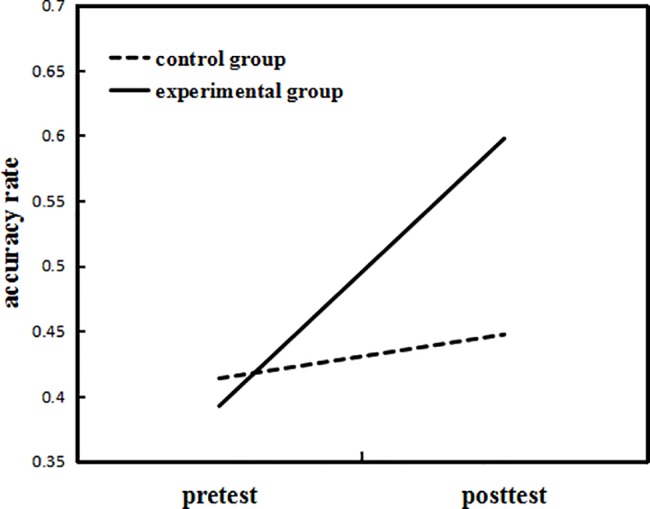
Most research on working memory (WM) training for children with developmental dyslexia (DD) has focused on western alphabetical languages. Moreover, most of these studies used a combination of training tasks targeting a variety of WM components, making it difficult to determine whether WM training generates a general improvement in overall reading, or improves specific cognitive skills corresponding to the WM components that are targeted in training. We tested the general and specific effects of WM training on the reading skills of 45 Chinese children with DD, grades 3 to 5. In Experiment 1, the experimental group received a program targeting the verbal WM component; in Experiment 2, the experimental group was trained with a program targeting visuospatial WM. In both experiments the control group played a placebo video game. In Experiment 1, the experimental group outperformed the control group on the visual rhyming task, which is highly correlated with verbal WM. In Experiment 2, the experimental group outperformed the control group on the orthographic awareness test, which is highly correlated with visuospatial WM. Furthermore, in both Experiment 1 and Experiment 2, the experimental groups outperformed the control groups on the fast word naming test, which is highly related to both visuospatial WM and verbal WM. Results indicated that WM training improved specific reading-related cognitive skills that are highly correlated with the specific WM components that were the target of training.
大多数针对发育性阅读障碍(DD)儿童的工作记忆(WM)训练研究都集中在西方字母语言上。此外,这些研究大多使用了针对多种WM成分的训练任务组合,这使得很难确定WM训练是否能全面提高整体阅读能力,还是能提高与训练中所针对的WM成分相对应的特定认知技能。我们测试了WM训练对45名三至五年级中国DD儿童阅读技能的总体和特定影响。在实验1中,实验组接受了针对言语WM成分的训练项目;在实验2中,实验组接受了针对视觉空间WM的训练项目。在两个实验中,对照组都玩了一款安慰剂视频游戏。在实验1中,实验组在与言语WM高度相关的视觉押韵任务上的表现优于对照组。在实验2中,实验组在与视觉空间WM高度相关的正字法意识测试中的表现优于对照组。此外,在实验1和实验2中,实验组在与视觉空间WM和言语WM都高度相关的快速单词命名测试中的表现也优于对照组。结果表明,WM训练提高了与训练所针对的特定WM成分高度相关的特定阅读相关认知技能。