Neufeld Zoltan, von Witt William, Lakatos Dora, Wang Jiaming, Hegedus Balazs, Czirok Andras
School of Mathematics and Physics, The University of Queensland, St. Lucia, Brisbane, Queensland, Australia.
Department of Biological Physics, Eotvos University, Budapest, Hungary.
PLoS Comput Biol. 2017 Nov 17;13(11):e1005818. doi: 10.1371/journal.pcbi.1005818. eCollection 2017 Nov.
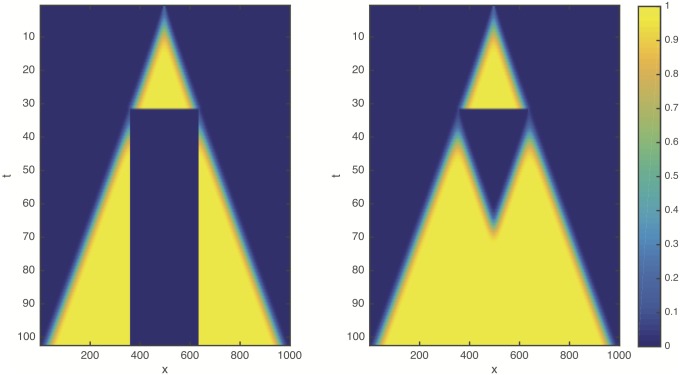
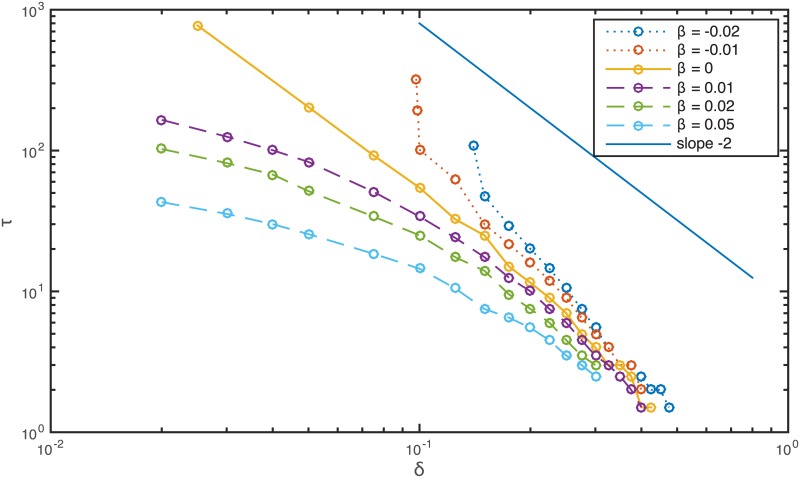
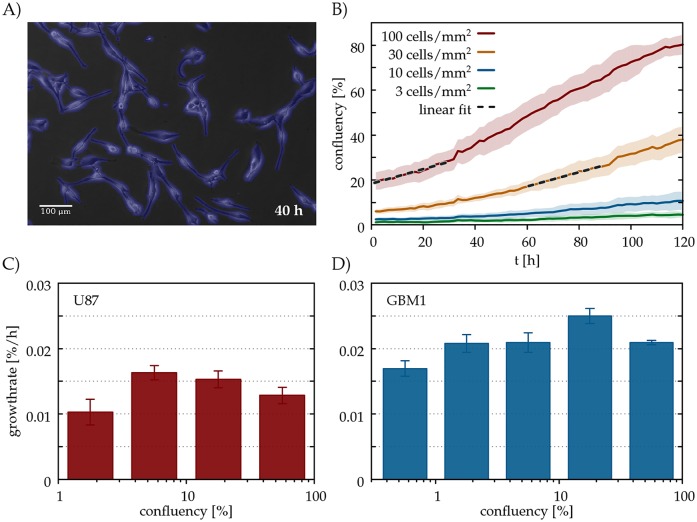
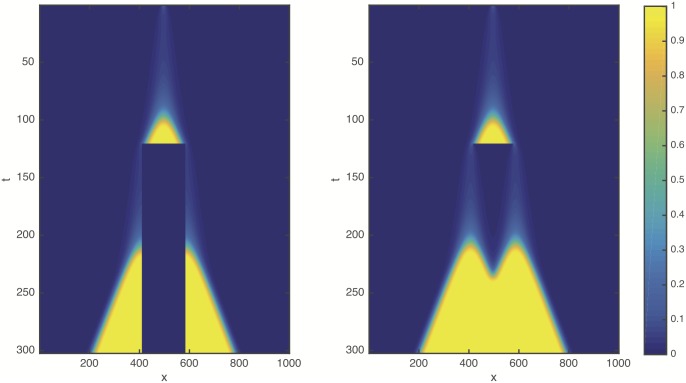
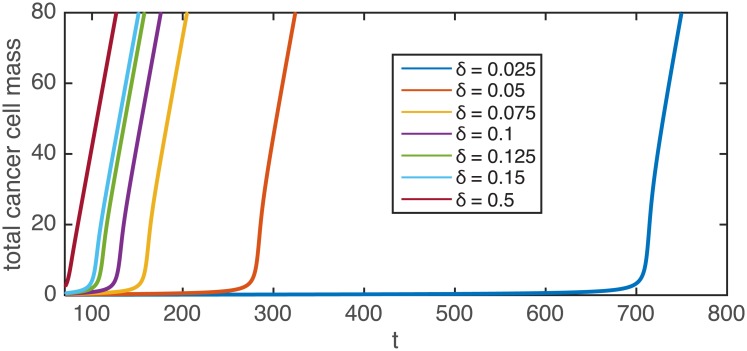
Resection of the bulk of a tumour often cannot eliminate all cancer cells, due to their infiltration into the surrounding healthy tissue. This may lead to recurrence of the tumour at a later time. We use a reaction-diffusion equation based model of tumour growth to investigate how the invasion front is delayed by resection, and how this depends on the density and behaviour of the remaining cancer cells. We show that the delay time is highly sensitive to qualitative details of the proliferation dynamics of the cancer cell population. The typically assumed logistic type proliferation leads to unrealistic results, predicting immediate recurrence. We find that in glioblastoma cell cultures the cell proliferation rate is an increasing function of the density at small cell densities. Our analysis suggests that cooperative behaviour of cancer cells, analogous to the Allee effect in ecology, can play a critical role in determining the time until tumour recurrence.
由于肿瘤细胞浸润到周围健康组织中,切除大部分肿瘤往往无法消除所有癌细胞。这可能导致肿瘤在后期复发。我们使用基于反应扩散方程的肿瘤生长模型来研究切除如何延迟侵袭前沿,以及这如何取决于剩余癌细胞的密度和行为。我们表明,延迟时间对癌细胞群体增殖动力学的定性细节高度敏感。通常假设的逻辑斯蒂型增殖会导致不切实际的结果,预测会立即复发。我们发现,在胶质母细胞瘤细胞培养中,在小细胞密度下,细胞增殖率是密度的增函数。我们的分析表明,癌细胞的协同行为类似于生态学中的阿利效应,在确定肿瘤复发时间方面可能起关键作用。