Valdés Leslie, Pérez Irela, de Ménorval Louis Charles, Altshuler Ernesto, Fossum Jon Otto, Rivera Aramis
Department of Pharmacy, Institute of Pharmacy and Food (IFAL), University of Havana, Havana, Cuba.
Institut Charles Gerhardt Montpellier, Equipe Agregats, Interface, et Materiaux pour l'Energie (AIME), Université Montpellier 2, Montpellier, France.
PLoS One. 2017 Nov 17;12(11):e0187879. doi: 10.1371/journal.pone.0187879. eCollection 2017.
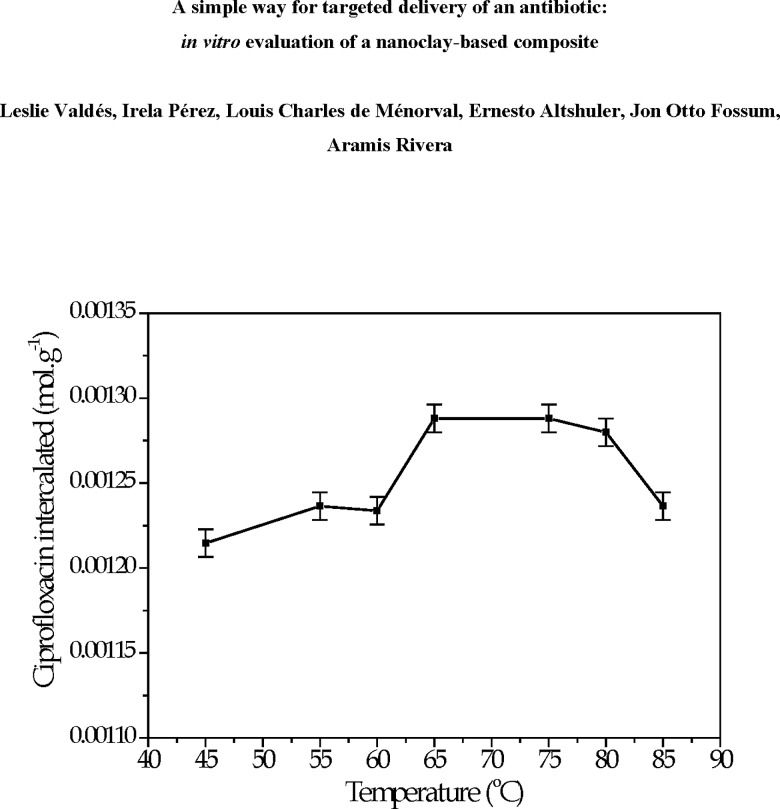
The sodium-modified form of fluorohectorite nanoclay (NaFh) is introduced as a potential drug carrier, demonstrating its ability for the controlled release of the broad-spectrum antibiotic Ciprofloxacin through in vitro tests. The new clay-drug composite is designed to target the local infections in the large intestine, where it delivers most of the incorporated drug thanks to its pH-sensitive behavior. The composite has been conceived to avoid the use of coating technology and to decrease the side-effects commonly associated to the burst-release of the ciprofloxacin at the stomach level. NaFh was obtained from lithium-fluorohectorite by ion exchange, and its lack of toxicity was demonstrated by in vivo studies. Ciprofloxacin hydrochloride (Cipro) was encapsulated into the clay at different values of the pH, drug initial concentration, temperature and time. Systematic studies by X-ray diffraction (XRD), infrared and visible spectrophotometry (FT-IR and UV-vis), and thermal analysis (TGA) indicated that the NaFh host exhibits a high encapsulation efficiency for Cipro, which reaches a 90% of the initial Cipro in solution at 65 oC, with initial concentration of drug in solution of 1.36 x 10⁻² mol L-1 at acid pH. XRD revealed that a true intercalation of Cipro takes place between clay layers. TG showed an increased thermal stability of the drug when intercalated into the clay, as compared to the "free" Cipro. IR suggested a strong clay-Cipro interaction via ketone group, as well as the establishment of hydrogen bonds between the two materials. In vitro drug release tests revealed that NaFh is a potentially efficient carrier to deliver Cipro in the large intestine, where the release process is mediated by more than just one mechanism.
氟锂蒙脱石纳米黏土的钠改性形式(NaFh)被作为一种潜在的药物载体引入,通过体外试验证明了其对广谱抗生素环丙沙星的控释能力。这种新型黏土-药物复合物旨在靶向大肠局部感染,由于其对pH敏感的特性,它能在大肠释放大部分包封的药物。该复合物的设计避免了使用包衣技术,并减少了通常与环丙沙星在胃部突发释放相关的副作用。NaFh通过离子交换从锂氟蒙脱石获得,体内研究证明了其无毒性。盐酸环丙沙星(Cipro)在不同的pH值、药物初始浓度、温度和时间下被包封到黏土中。通过X射线衍射(XRD)、红外和可见分光光度法(FT-IR和UV-vis)以及热分析(TGA)进行的系统研究表明,NaFh主体对Cipro具有较高的包封效率,在65℃时,对于酸性pH条件下初始浓度为1.36×10⁻²mol L⁻¹的溶液中的Cipro,包封效率达到初始Cipro的90%。XRD显示Cipro在黏土层间发生了真正的插层。TG表明,与“游离”的Cipro相比,药物插层到黏土中时热稳定性增加。IR表明通过酮基存在强烈的黏土-Cipro相互作用,以及两种材料之间形成了氢键。体外药物释放试验表明,NaFh是一种在大肠中递送Cipro的潜在有效载体,在大肠中释放过程由不止一种机制介导。