Veracyte, Inc., 6000 Shoreline Ct., Suite 300, South San Francisco, 94080, California, USA.
BMC Pulm Med. 2017 Nov 17;17(1):141. doi: 10.1186/s12890-017-0485-4.
Clinical guidelines specify that diagnosis of interstitial pulmonary fibrosis (IPF) requires identification of usual interstitial pneumonia (UIP) pattern. While UIP can be identified by high resolution CT of the chest, the results are often inconclusive, making surgical lung biopsy necessary to reach a definitive diagnosis (Raghu et al., Am J Respir Crit Care Med 183(6):788-824, 2011). The Envisia genomic classifier differentiates UIP from non-UIP pathology in transbronchial biopsies (TBB), potentially allowing patients to avoid an invasive procedure (Brown et al., Am J Respir Crit Care Med 195:A6792, 2017). To ensure patient safety and efficacy, a laboratory developed test (LDT) must meet strict regulatory requirements for accuracy, reproducibility and robustness. The analytical characteristics of the Envisia test are assessed and reported here.
The Envisia test utilizes total RNA extracted from TBB samples to perform Next Generation RNA Sequencing. The gene count data from 190 genes are then input to the Envisia genomic classifier, a machine learning algorithm, to output either a UIP or non-UIP classification result. We characterized the stability of RNA in TBBs during collection and shipment, and evaluated input RNA mass and proportions on the limit of detection of UIP. We evaluated potentially interfering substances such as blood and genomic DNA. Intra-run, inter-run, and inter-laboratory reproducibility of test results were also characterized.
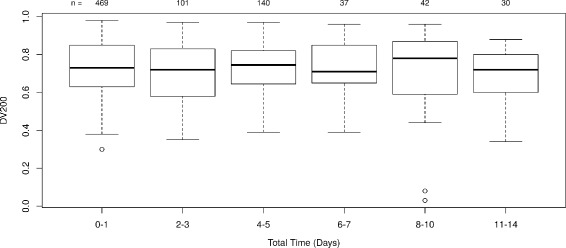
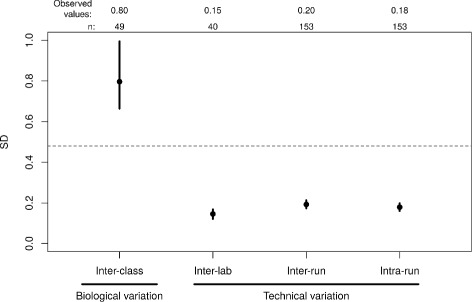
RNA content within TBBs preserved in RNAprotect is stable for up to 14 days with no detectable change in RNA quality. The Envisia test is tolerant to variation in RNA input (5 to 30 ng), with no impact on classifier results. The Envisia test can tolerate dilution of non-UIP and UIP classification signals at the RNA level by up to 60% and 20%, respectively. Analytical specificity studies utilizing UIP and non-UIP samples mixed with genomic DNA (up to 30% relative input) demonstrated no impact to classifier results. The Envisia test tolerates up to 22% of blood contamination, well beyond the level observed in TBBs. The test is reproducible from RNA extraction through to Envisia test result (standard deviation of 0.20 for Envisia classification scores on > 7-unit scale).
The Envisia test demonstrates the robust analytical performance required of an LDT. Envisia can be used to inform the diagnoses of patients with suspected IPF.
临床指南规定,间质性肺纤维化(IPF)的诊断需要确定普通型间质性肺炎(UIP)模式。虽然高分辨率胸部 CT 可以识别 UIP,但结果往往不确定,因此需要进行外科肺活检以明确诊断(Raghu 等人,Am J Respir Crit Care Med 183(6):788-824, 2011)。Envisia 基因组分类器可区分经支气管镜活检(TBB)中的 UIP 和非 UIP 病理,从而有可能使患者避免进行侵入性操作(Brown 等人,Am J Respir Crit Care Med 195:A6792, 2017)。为确保患者安全和疗效,实验室开发的检测(LDT)必须满足准确性、重现性和稳健性的严格监管要求。本文评估并报告了 Envisia 检测的分析特性。
Envisia 检测利用从 TBB 样本中提取的总 RNA 进行下一代 RNA 测序。然后将来自 190 个基因的基因计数数据输入到 Envisia 基因组分类器(一种机器学习算法)中,以输出 UIP 或非 UIP 分类结果。我们对 TBB 收集和运输过程中 RNA 的稳定性进行了特征描述,并评估了 UIP 检测限范围内的输入 RNA 质量和比例。我们还评估了血液和基因组 DNA 等可能的干扰物质。此外,还对检测结果的批内、批间和实验室间重现性进行了描述。
保存在 RNAprotect 中的 TBB 中的 RNA 含量在 14 天内稳定,RNA 质量无明显变化。Envisia 检测对 RNA 输入的变化具有耐受性(5 至 30ng),对分类器结果没有影响。Envisia 检测可耐受非 UIP 和 UIP 分类信号在 RNA 水平上分别高达 60%和 20%的稀释。利用混合了基因组 DNA 的 UIP 和非 UIP 样本进行的分析特异性研究(相对输入高达 30%)表明,分类器结果不受影响。Envisia 检测可耐受高达 22%的血液污染,远超过 TBB 中观察到的污染水平。从 RNA 提取到 Envisia 检测结果,检测具有重现性(Envisia 分类评分超过 7 个单位时,标准偏差为 0.20)。
Envisia 检测展现了 LDT 所需的稳健分析性能。Envisia 可用于为疑似 IPF 患者的诊断提供信息。