Institute of Child Development, University of Minnesota.
Department of Psychology, University of Minnesota.
Dev Psychol. 2018 Apr;54(4):689-702. doi: 10.1037/dev0000460. Epub 2017 Nov 20.
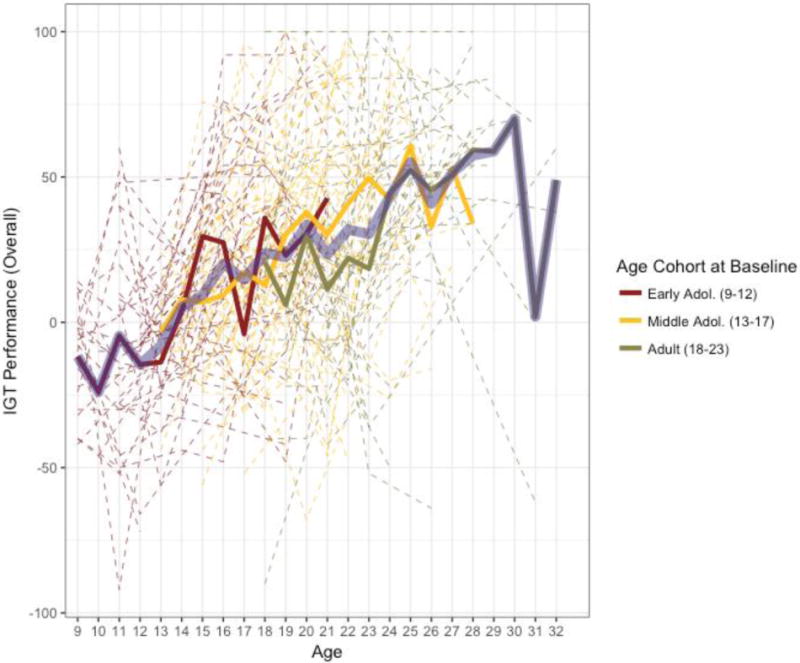
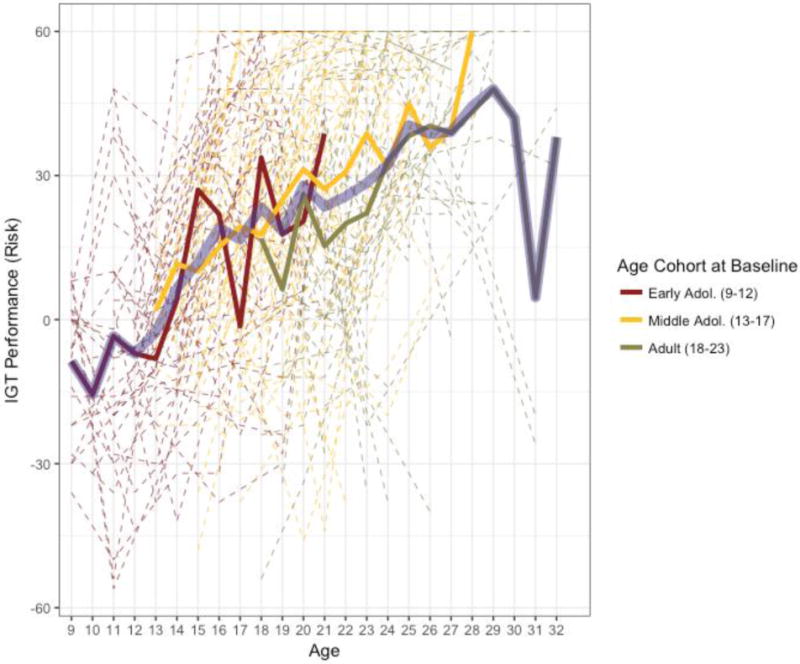
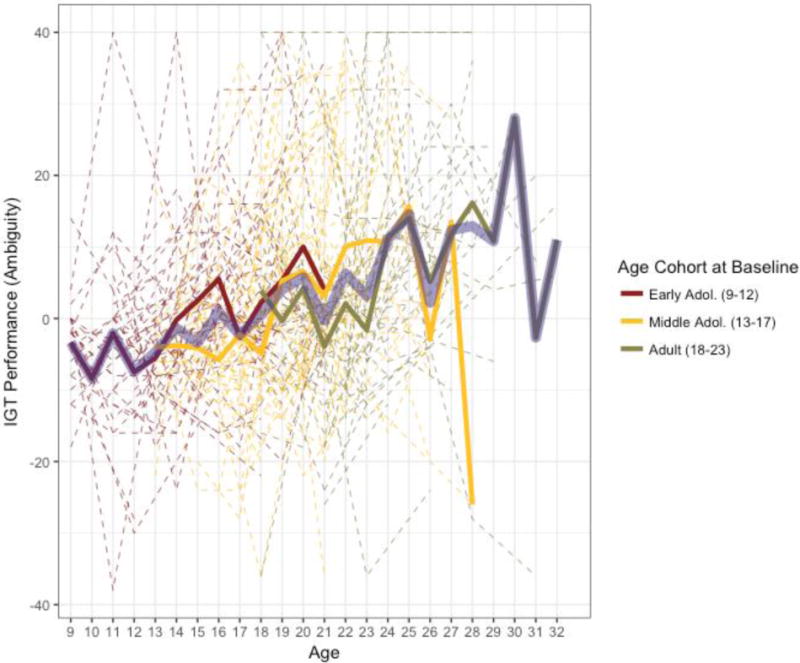
Many researchers have used the standard Iowa Gambling Task (IGT) to assess decision-making in adolescence given increased risk-taking during this developmental period. Most studies are cross-sectional and do not observe behavioral trajectories over time, limiting interpretation. This longitudinal study investigated healthy adolescents' and young adults' IGT performance across a 10-year span. A total of 189 individuals (aged 9-23 at baseline) completed a baseline session and were followed at 2-year intervals yielding 5 time-points. IGT deck contingencies were shuffled over time to reduce practice effects. IGT performance (good minus bad decisions) was measured at each assessment point and separated into 3 metrics: overall performance (all blocks), decision-making under ambiguity (blocks 1 and 2), and decision-making under risk (blocks 3, 4, and 5). Covariates included estimated intelligence and affective dispositions as measured by the Behavioral Inhibition and Activation System (BIS/BAS) Scales. A linear effect of age yielded the best fit when comparing linear and quadratic effects of age on overall IGT performance. Age and intelligence positively predicted overall performance, whereas affective approach tendencies (BAS) negatively predicted overall performance. Practice effects were observed and controlled for. Models of ambiguity and risk metrics yielded different patterns of significant predictors. Age predicted better performance and affective approach tendencies predicted worse performance for both metrics. Intelligence was a significant predictor for risk, but not ambiguity. This longitudinal study extends prior work by showing age-related improvements in reward-based decision-making and associating those improvements with cognitive and affective variables. Implications of the results for adolescent development are discussed. (PsycINFO Database Record
许多研究人员使用标准的爱荷华赌博任务(IGT)来评估青春期的决策制定,因为在这个发育阶段风险承担增加。大多数研究都是横断面的,没有观察到随时间的行为轨迹,限制了解释。这项纵向研究调查了健康青少年和年轻人在 10 年跨度内的 IGT 表现。共有 189 人(基线时年龄为 9-23 岁)完成了基线测试,并每隔 2 年进行一次随访,共进行了 5 次测试。IGT 牌组的条件随着时间的推移而变化,以减少练习效应。在每个评估点测量 IGT 表现(好决策减去坏决策),并分为 3 个指标:整体表现(所有牌组)、在模糊条件下的决策(第 1 和第 2 牌组)和在风险条件下的决策(第 3、4 和第 5 牌组)。协变量包括通过行为抑制和激活系统(BIS/BAS)量表测量的估计智力和情感倾向。当比较年龄对整体 IGT 表现的线性和二次效应时,年龄的线性效应产生了最佳拟合。年龄和智力正向预测整体表现,而情感接近倾向(BAS)负向预测整体表现。观察到并控制了练习效应。模糊和风险指标的模型产生了不同的显著预测因子模式。对于两个指标,年龄都预测了更好的表现,而情感接近倾向则预测了更差的表现。智力是风险的重要预测因子,但不是模糊的。这项纵向研究通过显示与年龄相关的奖励型决策的改进,并将这些改进与认知和情感变量相关联,扩展了先前的工作。讨论了结果对青少年发展的影响。(PsycINFO 数据库记录