Zhang Yingai, Wang Shunlan, Wen Xiaohong, Zhang Shufang, Yang Yijun
Central Laboratory, Haikou People's Hospital, Central South University Xiangya School of Medicine Affiliated Haikou Hospital, Haikou 570208, Hainan, China.
Department of Hepatobiliary Surgery, Haikou People's Hospital, Central South University Xiangya School of Medicine Affiliated Haikou Hospital, Haikou 570208, Hainan, China.
Oncotarget. 2017 Sep 12;8(49):86011-86019. doi: 10.18632/oncotarget.20846. eCollection 2017 Oct 17.
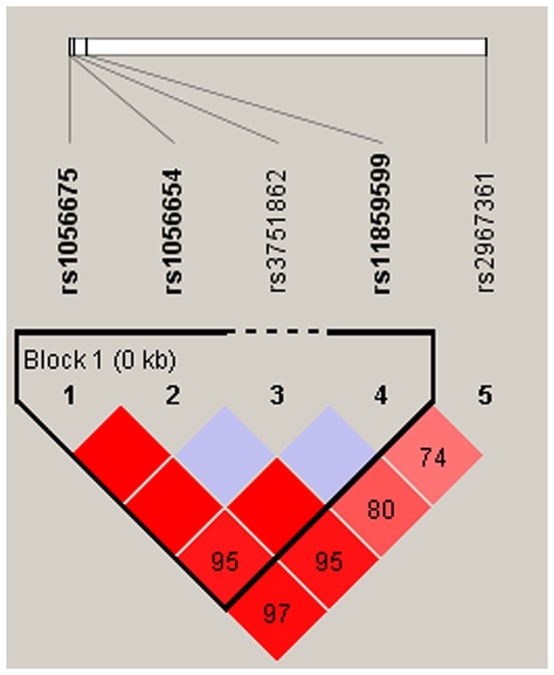
Hepatocellular carcinoma (HCC) is the dominant histologic type of primary liver cancer, and hepatitis B virus (HBV) infection is one of the major causes of HCC in the chronic HBV. Our study was investigated the association between the polymorphisms of and genes and the risk of HCC induced by HBV infection. A total of 490 subjects were divided into two groups: 248 HBV patients with HCC (Case group), and 242 HBV patients without HCC (Control group). Unconditional logistic regression analysis was used to evaluate the association. The genetic association analysis revealed variant of rs12621038 in gene had a significant association with increasing the risk of HBV-induced HCC based on the genotype, dominant and additive model (<0.05). Moreover, our results also showed that minor allele "C" of rs3751862 was prevalent in cases than controls (<0.05), and rs3751862 significantly increased the risk of HCC in chronic HBV carriers under genotype and dominant model (<0.05). In addition, the haplotype "T-G-G" in showed a harmful factor for the HBV-induced HCC (<0.05). The results suggested that and as the plausible candidate genes may predict the risk of HCC after chronic HBV infection in Chinese Han population, and further investigations in studies with a larger sample size and other races are needed to validate our findings. These data provide a theoretical foundation for future studies of this correlation between the polymorphisms of and genes and the HCC in chronic HBV carriers.
肝细胞癌(HCC)是原发性肝癌的主要组织学类型,而乙型肝炎病毒(HBV)感染是慢性HBV感染者发生HCC的主要原因之一。我们的研究调查了[具体基因1]和[具体基因2]基因多态性与HBV感染所致HCC风险之间的关联。总共490名受试者被分为两组:248例HBV相关HCC患者(病例组)和242例无HCC的HBV患者(对照组)。采用非条件逻辑回归分析来评估这种关联。基因关联分析显示,基于基因型、显性和加性模型,[具体基因1]基因中rs12621038的变异与HBV诱导的HCC风险增加显著相关(P<0.05)。此外,我们的结果还表明,rs3751862的次要等位基因“C”在病例组中的频率高于对照组(P<0.05),并且在基因型和显性模型下,rs3751862显著增加了慢性HBV携带者发生HCC的风险(P<0.05)。另外,[具体基因2]中的单倍型“T-G-G”对HBV诱导的HCC显示为有害因素(P<0.05)。结果表明,[具体基因1]和[具体基因2]作为可能的候选基因,可能预测中国汉族人群慢性HBV感染后发生HCC的风险,需要在更大样本量和其他种族的研究中进行进一步调查以验证我们的发现。这些数据为未来研究[具体基因1]和[具体基因2]基因多态性与慢性HBV携带者HCC之间的这种相关性提供了理论基础。