Herst Patries M, Rowe Matthew R, Carson Georgia M, Berridge Michael V
Cancer Cell Biology, Malaghan Institute of Medical Research, Wellington, New Zealand.
Department of Radiation Therapy, University of Otago, Wellington, New Zealand.
Front Endocrinol (Lausanne). 2017 Nov 3;8:296. doi: 10.3389/fendo.2017.00296. eCollection 2017.
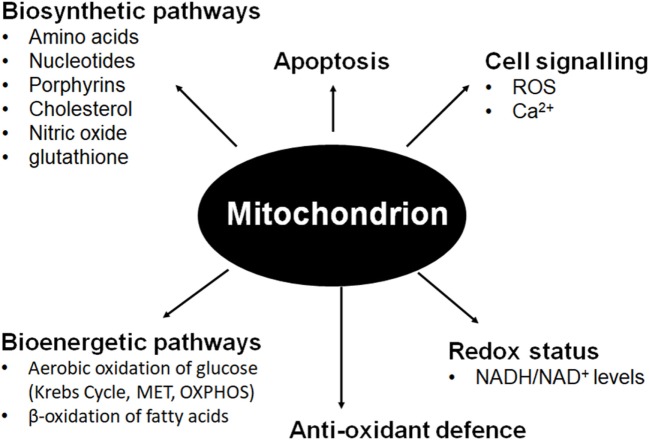
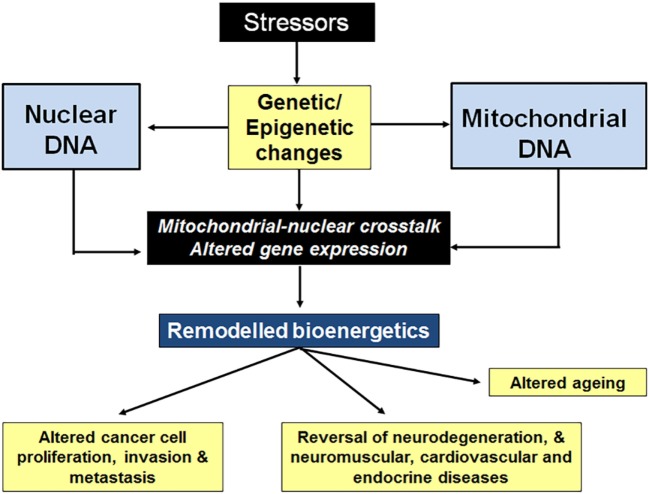
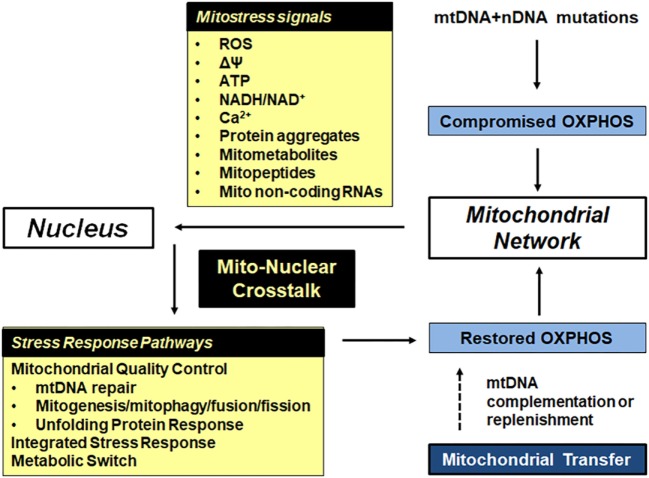
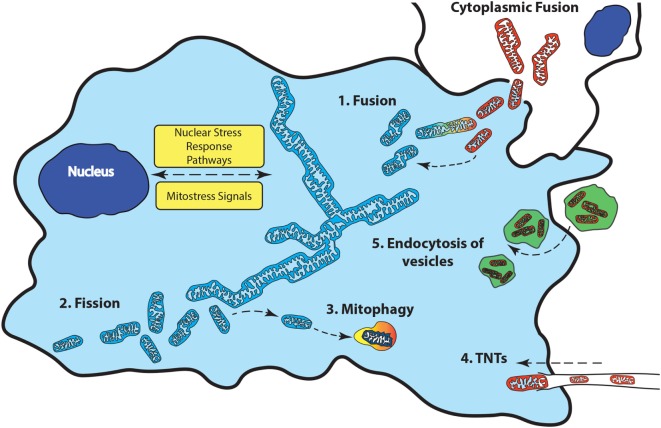
The ability to rapidly adapt cellular bioenergetic capabilities to meet rapidly changing environmental conditions is mandatory for normal cellular function and for cancer progression. Any loss of this adaptive response has the potential to compromise cellular function and render the cell more susceptible to external stressors such as oxidative stress, radiation, chemotherapeutic drugs, and hypoxia. Mitochondria play a vital role in bioenergetic and biosynthetic pathways and can rapidly adjust to meet the metabolic needs of the cell. Increased demand is met by mitochondrial biogenesis and fusion of individual mitochondria into dynamic networks, whereas a decrease in demand results in the removal of superfluous mitochondria through fission and mitophagy. Effective communication between nucleus and mitochondria (mito-nuclear cross talk), involving the generation of different mitochondrial stress signals as well as the nuclear stress response pathways to deal with these stressors, maintains bioenergetic homeostasis under most conditions. However, when mitochondrial DNA (mtDNA) mutations accumulate and mito-nuclear cross talk falters, mitochondria fail to deliver critical functional outputs. Mutations in mtDNA have been implicated in neuromuscular and neurodegenerative mitochondriopathies and complex diseases such as diabetes, cardiovascular diseases, gastrointestinal disorders, skin disorders, aging, and cancer. In some cases, drastic measures such as acquisition of new mitochondria from donor cells occurs to ensure cell survival. This review starts with a brief discussion of the evolutionary origin of mitochondria and summarizes how mutations in mtDNA lead to mitochondriopathies and other degenerative diseases. Mito-nuclear cross talk, including various stress signals generated by mitochondria and corresponding stress response pathways activated by the nucleus are summarized. We also introduce and discuss a small family of recently discovered hormone-like mitopeptides that modulate body metabolism. Under conditions of severe mitochondrial stress, mitochondria have been shown to traffic between cells, replacing mitochondria in cells with damaged and malfunctional mtDNA. Understanding the processes involved in cellular bioenergetics and metabolic adaptation has the potential to generate new knowledge that will lead to improved treatment of many of the metabolic, degenerative, and age-related inflammatory diseases that characterize modern societies.
细胞迅速调整其生物能量能力以适应快速变化的环境条件,这对正常细胞功能和癌症进展至关重要。这种适应性反应的任何丧失都可能损害细胞功能,使细胞更容易受到外部应激源的影响,如氧化应激、辐射、化疗药物和缺氧。线粒体在生物能量和生物合成途径中起着至关重要的作用,并且可以迅速调整以满足细胞的代谢需求。线粒体生物发生以及单个线粒体融合成动态网络可满足增加的需求,而需求减少则通过裂变和线粒体自噬去除多余的线粒体。细胞核与线粒体之间的有效通讯(线粒体 - 核相互作用),包括产生不同的线粒体应激信号以及应对这些应激源的核应激反应途径,在大多数情况下维持生物能量稳态。然而,当线粒体DNA(mtDNA)突变积累且线粒体 - 核相互作用出现故障时,线粒体无法提供关键的功能输出。mtDNA突变与神经肌肉和神经退行性线粒体疾病以及复杂疾病如糖尿病、心血管疾病、胃肠道疾病、皮肤疾病、衰老和癌症有关。在某些情况下,会采取诸如从供体细胞获取新线粒体等极端措施以确保细胞存活。本综述首先简要讨论线粒体的进化起源,并总结mtDNA突变如何导致线粒体疾病和其他退行性疾病。总结了线粒体 - 核相互作用,包括线粒体产生的各种应激信号以及细胞核激活的相应应激反应途径。我们还介绍并讨论了一小类最近发现的调节身体代谢的类激素线粒体肽。在严重线粒体应激条件下,线粒体已被证明可在细胞间转移,用受损和功能失调的mtDNA替代细胞中的线粒体。了解细胞生物能量学和代谢适应所涉及的过程有可能产生新知识,从而改善对许多现代社会中具有代表性的代谢、退行性和与年龄相关的炎症性疾病的治疗。