Casciaro Marco, Di Salvo Eleonora, Pace Elisabetta, Ventura-Spagnolo Elvira, Navarra Michele, Gangemi Sebastiano
School and Division of Allergy and Clinical Immunology, Department of Clinical and Experimental Medicine, Azienda Ospedaliera Universitaria Policlinico "G. Martino", University of Messina, Messina, Italy.
IBIM-CNR Institute of Biomedicine and Molecular Immunology, National Research Council, 90100 Palermo, Italy.
Immun Ageing. 2017 Nov 14;14:21. doi: 10.1186/s12979-017-0104-5. eCollection 2017.
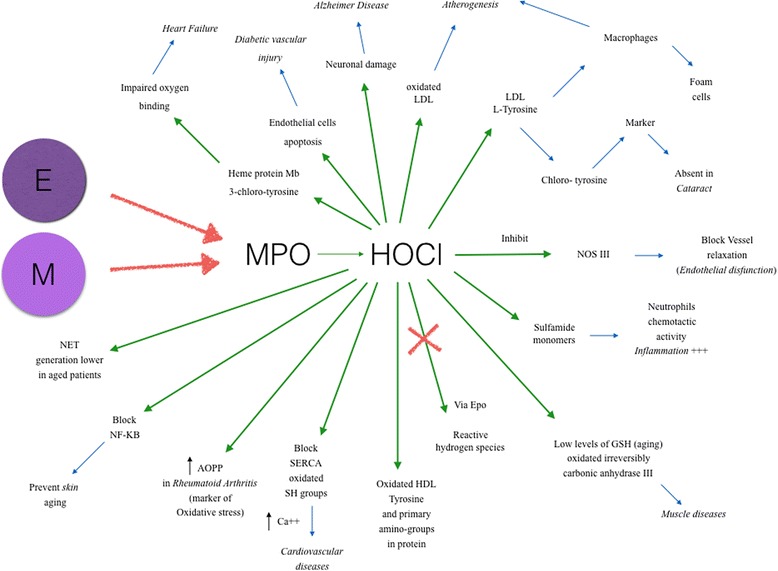
Aging is an agglomerate of biological long-lasting processes that result being inevitable. Main actors in this scenario are both long-term inflammation and oxidative stress. It has been proved that oxidative stress induce alteration in proteins and this fact itself is critically important in the pathophysiological mechanisms leading to diseases typical of aging. Among reactive species, chlorine ones such as hypochlorous acid (HOCl) are cytotoxic oxidants produced by activated neutrophils during chronic inflammation processes. HOCl can also cause damages by reacting with biological molecules. HOCl is generated by myeloperoxidase (MPO) and augmented serum levels of MPO have been described in acute and chronic inflammatory conditions in cardiovascular patients and has been implicated in many inflammatory diseases such as atherosclerosis, neurodegenerative conditions, and some cancers. Due to these data, we decided to conduct an up-to-date review evaluating chlorinative stress effects on every age-related disease linked; potential anti-oxidant countermeasures were also assessed. Results obtained associated HOCl generation to the aging processes and confirmed its connection with diseases like neurodegenerative and cardiovascular pathologies, atherosclerosis and cancer; chlorination was mainly linked to diseases where molecular (protein) alteration constitute the major suspected cause: i.e. inflammation, tissue lesions, DNA damages, apoptosis and oxidative stress itself. According data collected, a healthy lifestyle together with some dietary suggestion and/or the administration of nutracetical antioxidant integrators could balance the effects of chlorinative stress and, in some cases, slow down or prevent the onset of age-releated diseases.
衰老由一系列不可避免的长期生物学过程组成。在这一过程中,长期炎症和氧化应激是主要因素。业已证明,氧化应激会导致蛋白质发生改变,而这一事实本身在导致衰老相关疾病的病理生理机制中至关重要。在活性物质中,诸如次氯酸(HOCl)之类的含氯物质是慢性炎症过程中活化中性粒细胞产生的细胞毒性氧化剂。HOCl也可与生物分子发生反应从而造成损害。HOCl由髓过氧化物酶(MPO)产生,心血管疾病患者在急性和慢性炎症状态下,血清MPO水平会升高,并且MPO与许多炎症性疾病有关,如动脉粥样硬化、神经退行性疾病和某些癌症。基于这些数据,我们决定进行一项最新综述,评估氯化应激对每种与年龄相关疾病的影响;同时也评估了潜在的抗氧化对策。所获结果将HOCl的产生与衰老过程相关联,并证实其与神经退行性疾病、心血管疾病、动脉粥样硬化和癌症等疾病有关;氯化作用主要与分子(蛋白质)改变构成主要可疑病因的疾病相关,即炎症、组织损伤、DNA损伤、细胞凋亡以及氧化应激本身。根据收集到的数据,健康的生活方式以及一些饮食建议和/或服用营养抗氧化剂补充剂可以平衡氯化应激的影响,在某些情况下,减缓或预防与年龄相关疾病的发生。