Department of Anesthesiology, Saitama National Hospital, National Hospital Organization, Suwa2-1, Wako-city, Saitama, 351-0102, Japan.
Department of Hygiene and Public Health, Teikyo University School of Medicine, Kaga2-11-1, Itabashi-ku, Tokyo, 173-8605, Japan.
Environ Health Prev Med. 2017 Apr 4;22(1):32. doi: 10.1186/s12199-017-0626-7.
Accumulating evidence from medical workforce research indicates that poor work/life balance and increased work/home conflict induce psychological distress. In this study we aim to examine the existence of a priority gap between ideal and real lives, and its association with psychological burnout among academic professionals.
This cross-sectional survey, conducted in 2014, included faculty members (228 men, 102 women) at a single medical university in Tokyo, Japan. The outcome of interest was psychological burnout, measured with a validated inventory. Discordance between ideal- and real-life priorities, based on participants' responses (work, family, individual life, combinations thereof), was defined as a priority gap.
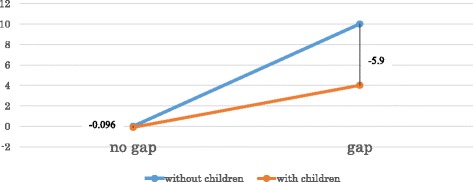
The majority (64%) of participants chose "work" as the greatest priority in real life, but only 28% chose "work" as the greatest priority in their conception of an ideal life. Priority gaps were identified in 59.5% of respondents. A stepwise multivariable general linear model demonstrated that burnout scores were associated positively with respondents' current position (P < 0.0018) and the presence of a priority gap (P < 0.0001), and negatively with the presence of social support (P < 0.0001). Among participants reporting priority gaps, burnout scores were significantly lower in those with children than in those with no children (P = 0.011); no such trend was observed in participants with no priority gap.
A gap in priorities between an ideal and real life was associated with an increased risk of burnout, and the presence of children, which is a type of "family" social support, had a mitigating effect on burnout among those reporting priority gaps.
越来越多的医学人力研究证据表明,工作与生活平衡不佳和工作与家庭冲突加剧会导致心理困扰。在这项研究中,我们旨在研究理想生活与现实生活之间是否存在优先事项差距,以及这种差距与学术专业人员心理倦怠的关系。
这是一项横断面调查,于 2014 年在日本东京的一所医学大学进行,共纳入 228 名男性和 102 名女性教员。研究的结局指标是心理倦怠,采用经过验证的量表进行测量。根据参与者的回答(工作、家庭、个人生活、三者的组合),将理想与现实生活中优先事项的差异定义为优先事项差距。
大多数(64%)参与者选择“工作”作为现实生活中的最大优先事项,但只有 28%的参与者选择“工作”作为他们心目中理想生活的最大优先事项。在 59.5%的受访者中发现了优先事项差距。逐步多元线性模型显示,倦怠评分与受访者的当前职位呈正相关(P < 0.0018),与存在优先事项差距呈正相关(P < 0.0001),与社会支持呈负相关(P < 0.0001)。在报告有优先事项差距的参与者中,有子女的参与者的倦怠评分明显低于无子女的参与者(P = 0.011);而在没有优先事项差距的参与者中则没有观察到这种趋势。
理想生活与现实生活之间的优先事项差距与倦怠风险增加有关,而孩子的存在(一种“家庭”社会支持)对报告有优先事项差距的参与者的倦怠有缓解作用。