Bertani T, Abbate M, Zoja C, Corna D, Perico N, Ghezzi P, Remuzzi G
Mario Negri Institute for Pharmacological Research, Bergamo, Italy.
Am J Pathol. 1989 Feb;134(2):419-30.
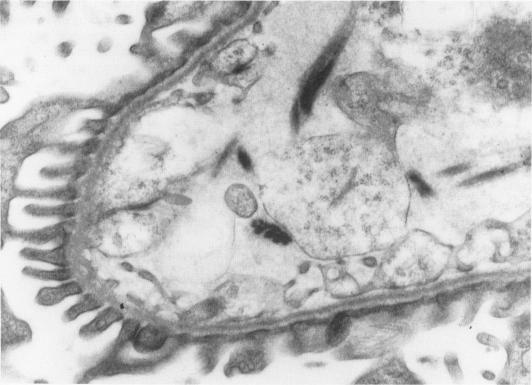
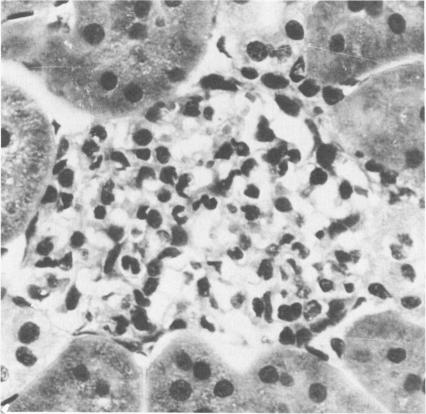
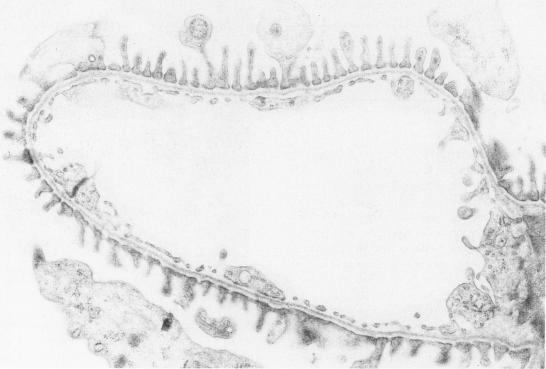
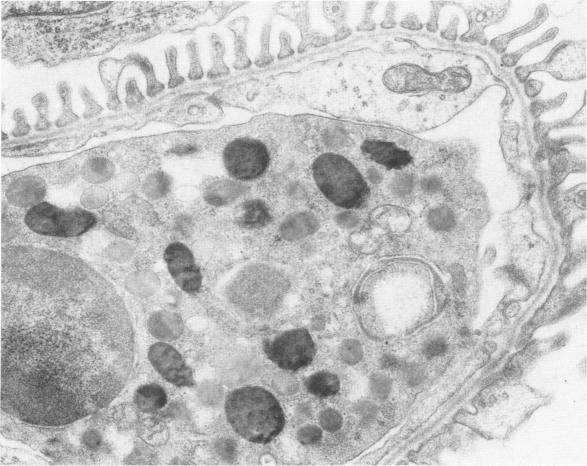
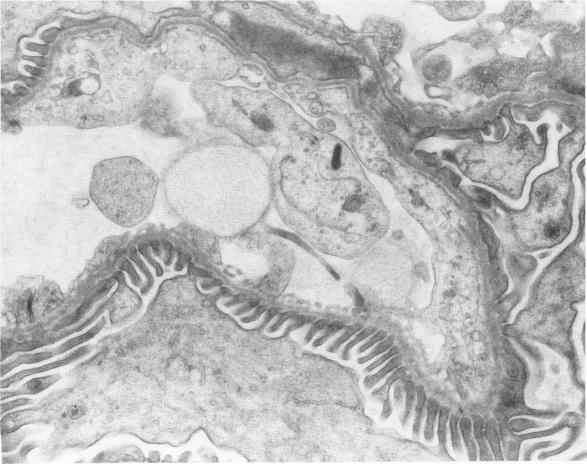
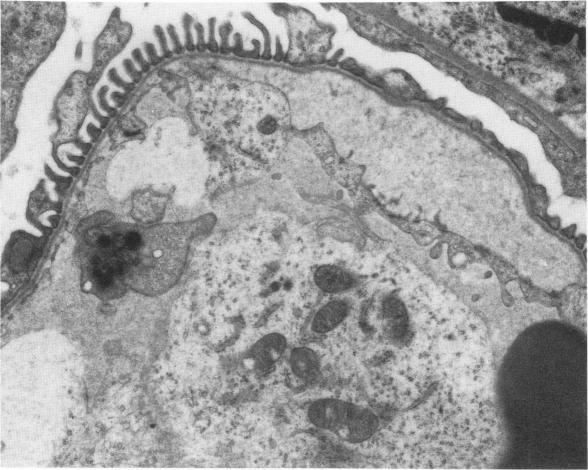
Tumor necrosis factor (TNF) is a polypeptide hormone produced by activated macrophages detectable in the circulation of experimental animals given endotoxin. Recent evidence strongly suggests that many of the deleterious effects of endotoxin in experimental animals are mediated by TNF. Because endotoxemia in experimental animals and humans is associated with glomerular damage the present investigation was designed to establish whether TNF directly induces glomerular functional and structural changes. Twenty-three rabbits were given human recombinant TNF at the doses of 0.08, 0.8, and 8.0 micrograms/kg/h as a continuous 5-hour intravenous infusion. Animals were killed at the end of the infusion. All rabbits given 0.8 and 8.0 micrograms/kg/h TNF developed anemia (Ht value decrease at 5 hours: 0.8 microgram/kg/h, 15%; 8.0 micrograms/kg/h, 16%); leukopenia (leukocyte count decrease at 5 hours: 0.8 micrograms/kg/h, 47%; 8.0 micrograms/kg/h, 59%); thrombocytopenia (platelet count decrease at 5 hours; 0.8 micrograms/kg/h, 45%; 8.0 micrograms/kg/h, 57%). Rabbits given 8.0 micrograms/kg/h also had renal failure (serum creatinine from 1.02 +/- 0.15 to 1.64 +/- 0.34 mg/dl). By light microscopy only occasional polymorphonuclear leukocytes in the glomerular capillaries were detectable in rabbits infused with 0.08 micrograms/kg/h TNF, whereas with 0.8 micrograms/kg/h TNF the presence of inflammatory cells in the glomerular capillaries was the prominent finding. With 8.0 micrograms/kg/h TNF beside leukocyte accumulation, fibrin was detected in the glomerular capillary lumens of two of eight animals. Electron microscopy found dose-dependent glomerular endothelial cell damage in animals given TNF with fibrinlike material in the capillary lumens. Glomerular changes induced by TNF were remarkably similar to those previously found in animals given endotoxin. Thus, TNF is likely to be the mediator of endotoxin-induced glomerular damage and can be regarded as a new mediator of macrophage-dependent damage in glomerulonephritis.
肿瘤坏死因子(TNF)是一种由活化巨噬细胞产生的多肽激素,在内毒素注射后的实验动物血液循环中可检测到。最近的证据有力地表明,内毒素在实验动物中的许多有害作用是由TNF介导的。由于实验动物和人类的内毒素血症与肾小球损伤有关,本研究旨在确定TNF是否直接诱导肾小球功能和结构变化。23只兔子以0.08、0.8和8.0微克/千克/小时的剂量持续5小时静脉输注人重组TNF。输注结束时处死动物。所有接受0.8和8.0微克/千克/小时TNF的兔子均出现贫血(5小时时血细胞比容值下降:0.8微克/千克/小时,15%;8.0微克/千克/小时,16%);白细胞减少(5小时时白细胞计数下降:0.8微克/千克/小时,47%;8.0微克/千克/小时,59%);血小板减少(5小时时血小板计数下降;0.8微克/千克/小时,45%;8.0微克/千克/小时,57%)。接受8.0微克/千克/小时TNF的兔子还出现肾衰竭(血清肌酐从1.02±0.15升至1.64±0.34毫克/分升)。通过光学显微镜,在输注0.08微克/千克/小时TNF的兔子中,仅偶尔可在肾小球毛细血管中检测到多形核白细胞,而在输注0.8微克/千克/小时TNF的兔子中,肾小球毛细血管中存在炎性细胞是主要发现。在接受8.0微克/千克/小时TNF的兔子中,除白细胞积聚外,在8只动物中的2只的肾小球毛细血管腔内检测到纤维蛋白。电子显微镜发现,给予TNF的动物中存在剂量依赖性的肾小球内皮细胞损伤,毛细血管腔内有纤维蛋白样物质。TNF诱导的肾小球变化与先前在内毒素注射动物中发现的变化非常相似。因此,TNF可能是内毒素诱导肾小球损伤的介质,可被视为肾小球肾炎中巨噬细胞依赖性损伤的新介质。