Kraehenmann Rainer, Pokorny Dan, Aicher Helena, Preller Katrin H, Pokorny Thomas, Bosch Oliver G, Seifritz Erich, Vollenweider Franz X
Department of Psychiatry, Psychotherapy and Psychosomatics, Psychiatric Hospital, University of Zurich, Zürich, Switzerland.
Neuropsychopharmacology and Brain Imaging Unit, Department of Psychiatry, Psychotherapy and Psychosomatics, Psychiatric Hospital, University of Zurich, Zürich, Switzerland.
Front Pharmacol. 2017 Nov 8;8:814. doi: 10.3389/fphar.2017.00814. eCollection 2017.
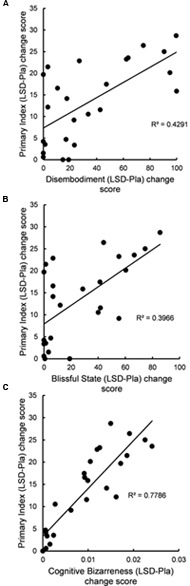
Stimulation of serotonin 2A (5-HT2A) receptors by lysergic acid diethylamide (LSD) and related compounds such as psilocybin has previously been shown to increase primary process thinking - an ontologically and evolutionary early, implicit, associative, and automatic mode of thinking which is typically occurring during altered states of consciousness such as dreaming. However, it is still largely unknown whether LSD induces primary process thinking under placebo-controlled, standardized experimental conditions and whether these effects are related to subjective experience and 5-HT2A receptor activation. Therefore, this study aimed to test the hypotheses that LSD increases primary process thinking and that primary process thinking depends on 5-HT2A receptor activation and is related to subjective drug effects. Twenty-five healthy subjects performed an audio-recorded mental imagery task 7 h after drug administration during three drug conditions: placebo, LSD (100 mcg orally) and LSD together with the 5-HT2A receptor antagonist ketanserin (40 mg orally). The main outcome variable in this study was primary index (PI), a formal measure of primary process thinking in the imagery reports. State of consciousness was evaluated using the Altered State of Consciousness (5D-ASC) rating scale. LSD, compared with placebo, significantly increased primary index ( < 0.001, Bonferroni-corrected). The LSD-induced increase in primary index was positively correlated with LSD-induced disembodiment ( < 0.05, Bonferroni-corrected), and blissful state ( < 0.05, Bonferroni-corrected) on the 5D-ASC. Both LSD-induced increases in primary index and changes in state of consciousness were fully blocked by ketanserin. LSD induces primary process thinking via activation of 5-HT2A receptors and in relation to disembodiment and blissful state. Primary process thinking appears to crucially organize inner experiences during both dreams and psychedelic states of consciousness.
此前研究表明,麦角酸二乙酰胺(LSD)及相关化合物(如裸盖菇素)对血清素2A(5-HT2A)受体的刺激会增强初级思维过程——这是一种在本体论和进化层面上较早出现的、隐性的、联想性的自动思维模式,通常出现在意识改变状态(如梦眠)期间。然而,在安慰剂对照的标准化实验条件下,LSD是否会诱发初级思维过程,以及这些效应是否与主观体验和5-HT2A受体激活有关,目前仍知之甚少。因此,本研究旨在验证以下假设:LSD会增强初级思维过程,且初级思维过程依赖于5-HT2A受体激活,并与主观药物效应相关。25名健康受试者在三种药物状态下(安慰剂、LSD(口服100微克)以及LSD与5-HT2A受体拮抗剂酮色林(口服40毫克)联用)服药7小时后进行了一项录音心理意象任务。本研究的主要结果变量是初级指数(PI),这是意象报告中对初级思维过程的一种正式测量方法。使用意识改变状态(5D-ASC)评定量表评估意识状态。与安慰剂相比,LSD显著提高了初级指数(<0.001,经Bonferroni校正)。LSD诱发的初级指数增加与5D-ASC上LSD诱发的脱离身体感(<0.05,经Bonferroni校正)和极乐状态(<0.05,经Bonferroni校正)呈正相关。酮色林完全阻断了LSD诱发的初级指数增加和意识状态变化。LSD通过激活5-HT2A受体并与脱离身体感和极乐状态相关,从而诱发初级思维过程。初级思维过程似乎在梦境和迷幻意识状态中对内心体验起着关键的组织作用。