
理解具有混沌微混合器的微流控装置中脂质纳米颗粒的形成机制。
Understanding the formation mechanism of lipid nanoparticles in microfluidic devices with chaotic micromixers.
作者信息
Maeki Masatoshi, Fujishima Yuka, Sato Yusuke, Yasui Takao, Kaji Noritada, Ishida Akihiko, Tani Hirofumi, Baba Yoshinobu, Harashima Hideyoshi, Tokeshi Manabu
机构信息
Division of Applied Chemistry, Faculty of Engineering, Hokkaido University, Kita-ku, Sapporo, Japan.
Graduate School of Chemical Sciences and Engineering, Hokkaido University, Kita-ku, Sapporo, Japan.
出版信息
PLoS One. 2017 Nov 28;12(11):e0187962. doi: 10.1371/journal.pone.0187962. eCollection 2017.
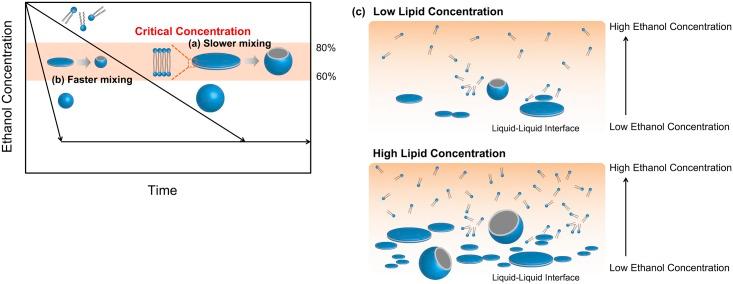
Lipid nanoparticles (LNPs) or liposomes are the most widely used drug carriers for nanomedicines. The size of LNPs is one of the essential factors affecting drug delivery efficiency and therapeutic efficiency. Here, we demonstrated the effect of lipid concentration and mixing performance on the LNP size using microfluidic devices with the aim of understanding the LNP formation mechanism and controlling the LNP size precisely. We fabricated microfluidic devices with different depths, 11 μm and 31 μm, of their chaotic micromixer structures. According to the LNP formation behavior results, by using a low concentration of the lipid solution and the microfluidic device equipped with the 31 μm chaotic mixer structures, we were able to produce the smallest-sized LNPs yet with a narrow particle size distribution. We also evaluated the mixing rate of the microfluidic devices using a laser scanning confocal microscopy and we estimated the critical ethanol concentration for controlling the LNP size. The critical ethanol concentration range was estimated to be 60-80% ethanol. Ten nanometer-sized tuning of LNPs was achieved for the optimum residence time at the critical concentration using the microfluidic devices with chaotic mixer structures. The residence times at the critical concentration necessary to control the LNP size were 10, 15-25, and 50 ms time-scales for 30, 40, and 50 nm-sized LNPs, respectively. Finally, we proposed the LNP formation mechanism based on the determined LNP formation behavior and the critical ethanol concentration. The precise size-controlled LNPs produced by the microfluidic devices are expected to become carriers for next generation nanomedicines and they will lead to new and effective approaches for cancer treatment.
脂质纳米颗粒(LNPs)或脂质体是纳米药物中使用最广泛的药物载体。LNPs的大小是影响药物递送效率和治疗效果的关键因素之一。在此,我们使用微流控装置展示了脂质浓度和混合性能对LNP大小的影响,旨在了解LNP的形成机制并精确控制LNP大小。我们制造了具有不同深度(11μm和31μm)混沌微混合器结构的微流控装置。根据LNP形成行为的结果,通过使用低浓度的脂质溶液和配备31μm混沌混合器结构的微流控装置,我们能够生产出迄今为止尺寸最小且粒径分布狭窄的LNPs。我们还使用激光扫描共聚焦显微镜评估了微流控装置的混合速率,并估计了控制LNP大小的临界乙醇浓度。估计临界乙醇浓度范围为60 - 80%乙醇。使用具有混沌混合器结构的微流控装置,在临界浓度下达到最佳停留时间时,实现了LNPs粒径10纳米级别的调控。对于30、40和50纳米尺寸的LNPs,控制其大小所需的在临界浓度下的停留时间分别为10、15 - 25和50毫秒时间尺度。最后,我们基于确定的LNP形成行为和临界乙醇浓度提出了LNP形成机制。微流控装置生产的精确尺寸可控的LNPs有望成为下一代纳米药物的载体,并将为癌症治疗带来新的有效方法。


 Zotero 插件