Institute of Geriatrics & Active Ageing, Tock Seng Hospital, Singapore 308433, Singapore
Khoo Teck Puat Hospital, Singapore 768828, Singapore
Int J Environ Res Public Health. 2017 Nov 24;14(12):1448. doi: 10.3390/ijerph14121448.
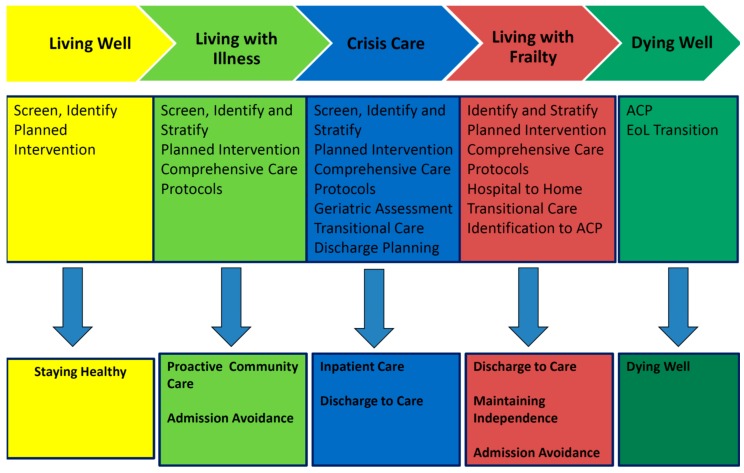
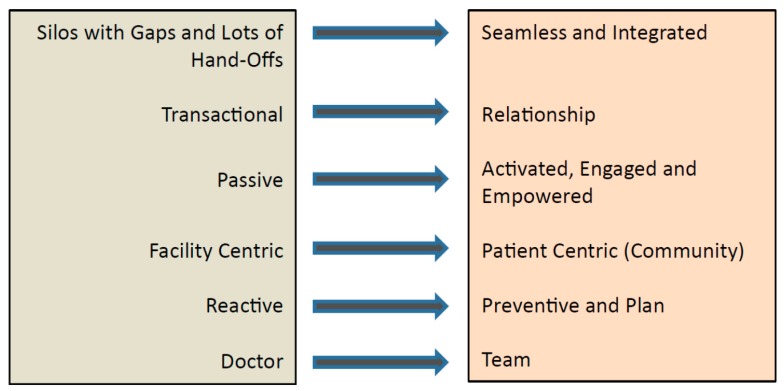
The beginning of the 21st century has seen health systems worldwide struggling to deliver quality healthcare amidst challenges posed by ageing populations. The increasing prevalence of frailty with older age and accompanying complexities in physical, cognitive, social and psychological dimensions renders the present of fragmented, facility-centric, doctor-based, and illness-centered care delivery as clearly unsustainable. In line with the public health framework for action in the World Health Organization's World Health and Ageing Report, meeting these challenges will require a systemic reform of healthcare delivery that is integrated, patient-centric, team-based, and health-centered. These reforms can be achieved through building partnerships and relationships that engage, empower, and activate patients and their support systems. To meet the challenges of population ageing, Singapore has reorganised its public healthcare into regional healthcare systems (RHSs) aimed at improving population health and the experience of care, and reducing costs. This paper will describe initiatives within the RHS frameworks of the National Health Group (NHG) and the Alexandra Health System (AHS) to forge a frailty-ready healthcare system across the spectrum, which includes the well healthy ("living well"), the well unhealthy ("living with illness"), the unwell unhealthy ("living with frailty"), and the end-of-life (EoL) ("dying well"). For instance, the AHS has adopted a community-centered population health management strategy in older housing estates such as Yishun to build a geographically-based care ecosystem to support the self-management of chronic disease through projects such as "wellness kampungs" and "share-a-pot". A joint initiative by the Lien Foundation and Khoo Teck Puat Hospital aims to launch dementia-friendly communities across the island by building a network comprising community partners, businesses, and members of the public. At the National Healthcare Group, innovative projects to address the needs of the frail elderly have been developed in the areas of: (a) admission avoidance through joint initiatives with long-term care facilities, nurse-led geriatric assessment at the emergency department and geriatric assessment clinics; (b) inpatient care, such as the Framework for Inpatient care of the Frail Elderly, orthogeriatric services, and geriatric surgical services; and (c) discharge to care, involving community transitional care teams and the development of community infrastructure for post-discharge support; and an appropriate transition to EoL care. In the area of EoL care, the National Strategy for Palliative Care has been developed to build an integrated system to: provide care for frail elderly with advance illnesses, develop advance care programmes that respect patients' choices, and equip healthcare professionals to cope with the challenges of EoL care.
21 世纪初,全球各国的卫生系统都在努力提供优质医疗服务,同时应对人口老龄化带来的挑战。随着年龄的增长,衰弱的发生率越来越高,身体、认知、社会和心理等方面的复杂性也随之增加,目前这种碎片化的、以医疗机构为中心、以医生为基础、以疾病为中心的医疗服务模式显然已无法持续。为了应对这些挑战,世界卫生组织在《世界卫生与老龄化报告》中提出了公共卫生行动框架,这一框架需要对医疗服务进行系统改革,实现一体化、以患者为中心、团队合作和以健康为中心。这些改革可以通过建立合作伙伴关系和人际关系来实现,这些关系可以使患者及其支持系统得到参与、授权和激活。为了应对人口老龄化的挑战,新加坡对其公共医疗体系进行了重组,建立了区域医疗系统(RHS),旨在改善人口健康和护理体验,并降低成本。本文将介绍新加坡全国保健集团(NHG)和亚历山大保健集团(AHS)的 RHS 框架内的各项举措,以在整个医疗保健领域打造一个应对衰弱问题的医疗体系,涵盖健康人群(“健康生活”)、非健康人群(“带病生存”)、不健康人群(“衰弱生存”)和临终人群(“安详离世”)。例如,AHS 在义顺等旧组屋区采取了以社区为中心的人口健康管理策略,建立了一个基于地理位置的护理生态系统,通过“健康村”和“共享锅”等项目,支持慢性病的自我管理。联昌基金会和邱德拔医院的一项联合倡议旨在通过建立一个由社区合作伙伴、企业和公众成员组成的网络,在全岛范围内推出对痴呆症友好的社区。在全国保健集团,针对脆弱老年人的需求,开展了以下创新项目:(a)通过与长期护理机构联合开展项目,在急诊室和老年评估诊所开展护士主导的老年评估,避免入住;(b)住院治疗,如《衰弱老年人住院护理框架》、矫形骨科服务和老年外科服务;(c)出院后的护理,包括社区过渡护理团队和为出院后支持而开发的社区基础设施;以及适当过渡到临终关怀。在临终关怀领域,制定了国家缓和医疗战略,以建立一个综合系统,为患有晚期疾病的脆弱老年人提供护理,制定尊重患者选择的预先护理计划,并使医疗保健专业人员能够应对临终关怀的挑战。