School of Chemistry, University of St Andrews, St Andrews, KY16 9ST, UK.
School of Engineering, Newcastle University, Newcastle-upon-Tyne, NE1 7RU, UK.
Nat Commun. 2017 Nov 30;8(1):1855. doi: 10.1038/s41467-017-01880-y.
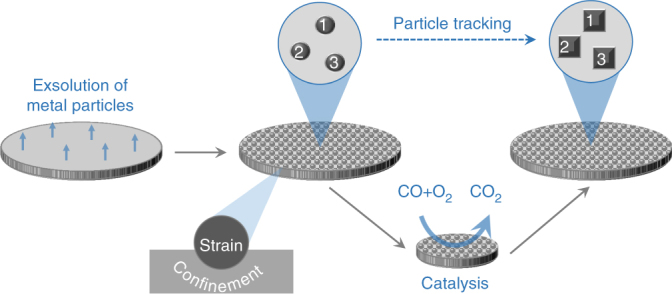
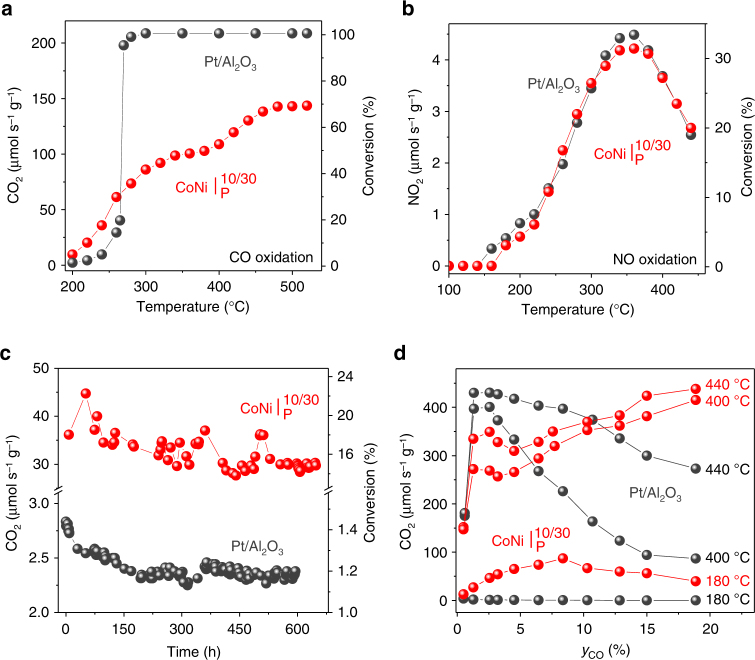
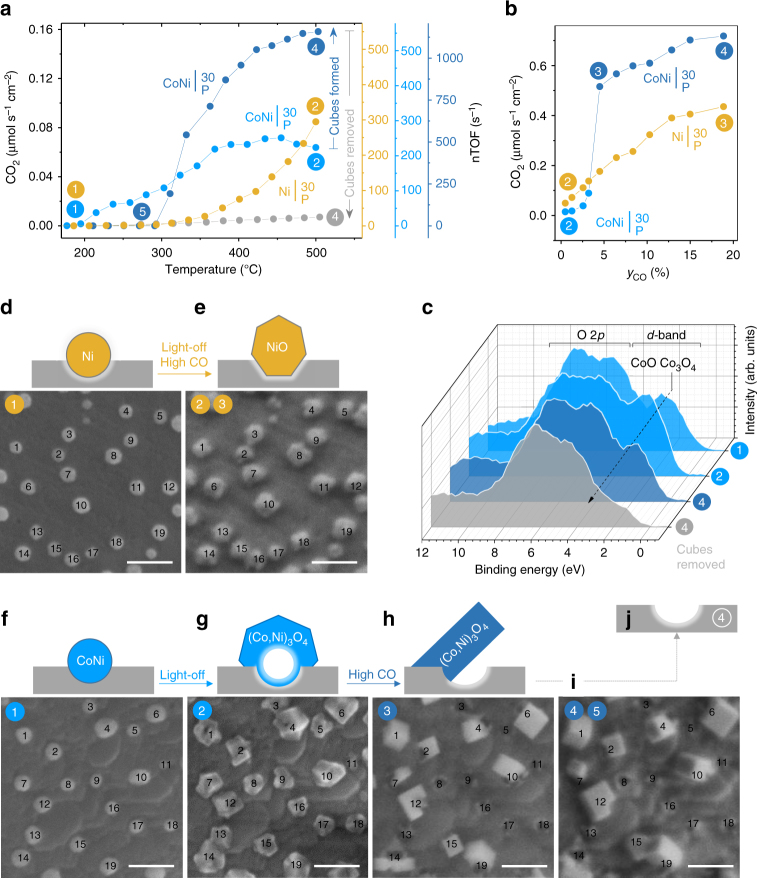
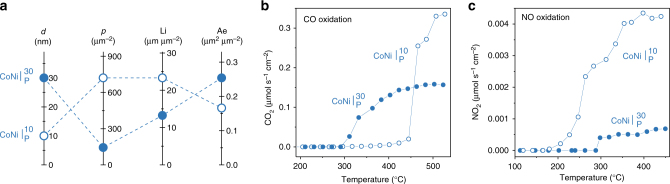
Metal nanoparticles prepared by exsolution at the surface of perovskite oxides have been recently shown to enable new dimensions in catalysis and energy conversion and storage technologies owing to their socketed, well-anchored structure. Here we show that contrary to general belief, exsolved particles do not necessarily re-dissolve back into the underlying perovskite upon oxidation. Instead, they may remain pinned to their initial locations, allowing one to subject them to further chemical transformations to alter their composition, structure and functionality dramatically, while preserving their initial spatial arrangement. We refer to this concept as chemistry at a point and illustrate it by tracking individual nanoparticles throughout various chemical transformations. We demonstrate its remarkable practical utility by preparing a nanostructured earth abundant metal catalyst which rivals platinum on a weight basis over hundreds of hours of operation. Our concept enables the design of compositionally diverse confined oxide particles with superior stability and catalytic reactivity.
通过在钙钛矿氧化物表面进行离解作用制备的金属纳米粒子由于其套接、牢固锚定的结构,最近在催化以及能量转化和存储技术方面显示出了新的维度。在这里,我们表明与普遍的看法相反,离解粒子在氧化时不一定会重新溶解回底层钙钛矿中。相反,它们可能会一直固定在其初始位置,从而可以对其进行进一步的化学转化,以极大地改变它们的组成、结构和功能,同时保持其初始空间排列。我们将这一概念称为点上化学,并通过跟踪各个纳米粒子在各种化学转化过程中的情况来举例说明。我们通过制备一种纳米结构的地球丰富金属催化剂来证明其显著的实际应用价值,该催化剂在数百小时的运行过程中,在重量基础上可与铂相媲美。我们的概念使具有优越稳定性和催化反应性的组成多样的受限氧化物颗粒的设计成为可能。