Campa Adriana, Baum Marianna K, Bussmann Hermann, Martinez Sabrina Sales, Farahani Mansour, van Widenfelt Erik, Moyo Sikhulile, Makhema Joseph, Essex Max, Marlink Richard
Department of Dietetics and Nutrition, Robert Stempel College of Public Health and Social Work, Florida International University, Miami, FL, USA.
Botswana Harvard AIDS Institute Partnership, Gaborone, Botswana.
Nutr Diet Suppl. 2017;2017(9):37-45. doi: 10.2147/NDS.S123545. Epub 2017 Jul 14.
Coinfection with active tuberculosis (TB) is one of the leading causes of death in people living with HIV (PLWH) in Africa. This investigation explores the role of micronutrient supplementation in preventing active TB in PLWH.
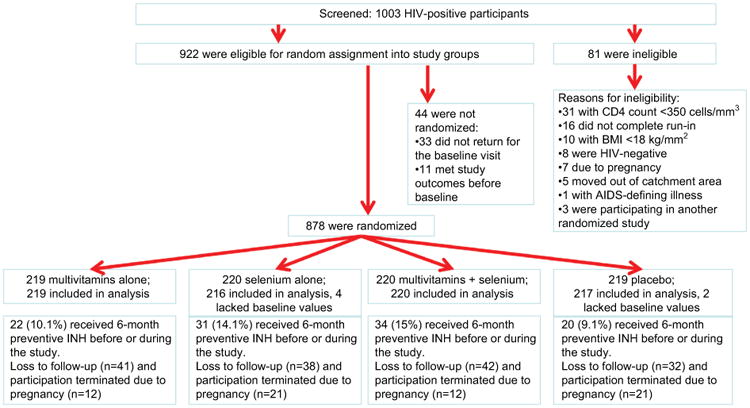
A randomized trial of nutritional supplementation was conducted among antiretroviral- naïve (without previous antiretroviral treatment [ART]) HIV-infected people in Botswana between 2004 and 2009. The study had a factorial design with four arms: the selenium (Se) alone arm, the multivitamins (MVT) alone arm that contained vitamin B complex and vitamins C and E, the combined Se+MVT group and the placebo group. Those participants with prior or current active TB were excluded, as were participants with advanced HIV disease (CD4 <250 cells/μL) or who had already qualified for ART. HIV-positive adults (N=878) were followed monthly for study pill dispensation, every 3 months for CD4 cell count and every 6 months for viral load during 24 months or until they were started on ART.
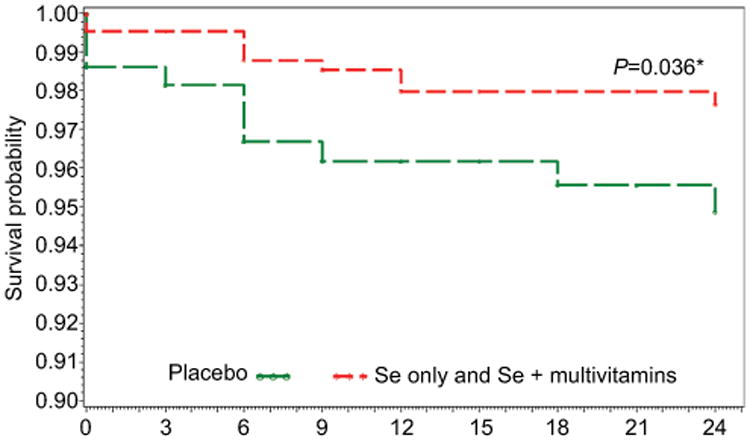
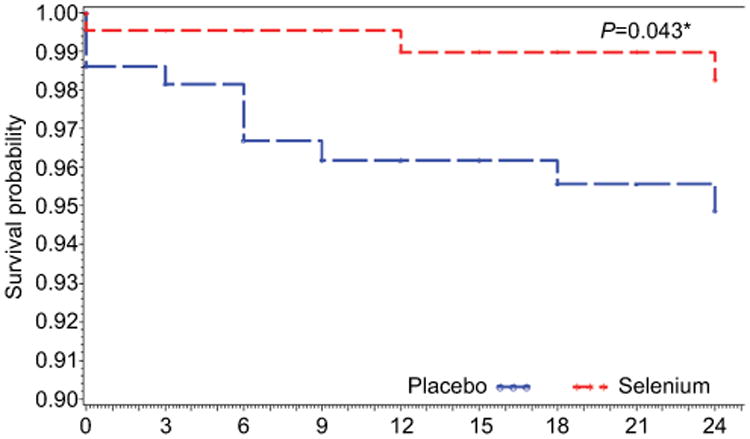
The participants' characteristics were not significantly different among the four groups at baseline. Supplementation with Se alone (hazard ratio =0.20, 95% confidence interval: 0.04, 0.95, =0.043) and the two combined SE groups (Se and Se+MVT) had significantly lower risk of developing incident TB disease compared with placebo in multivariate adjusted models (hazard ratio=0.32, 95% confidence interval: 0.11, 0.93, =0.036). Multivitamins alone did not affect the incidence of TB. Isoniazid preventive therapy was received by 12.2% of participants, a rate that was not significantly different among the four study arms (=0.122) and the newly diagnosed cases.
Se supplementation, alone and with MVT, decreased the incidence of TB disease in PLWH who were ART-naïve. Supplementation with these micronutrients should be considered in HIV infection, prior to ART, in areas where TB and malnutrition are endemic.
合并活动性结核病(TB)是非洲艾滋病病毒感染者(PLWH)的主要死因之一。本研究探讨了补充微量营养素在预防PLWH患活动性结核病方面的作用。
2004年至2009年期间,在博茨瓦纳对未接受过抗逆转录病毒治疗(无既往抗逆转录病毒治疗[ART])的HIV感染者进行了一项营养补充剂随机试验。该研究采用析因设计,分为四个组:单独补充硒(Se)组、含有复合维生素B以及维生素C和E的单独补充多种维生素(MVT)组、联合补充Se+MVT组和安慰剂组。排除既往或当前患有活动性结核病的参与者,以及患有晚期HIV疾病(CD4<250个细胞/μL)或已符合ART治疗条件的参与者。在24个月内或直至开始接受ART治疗期间,对HIV阳性成年人(N = 878)每月进行研究药物发放随访,每3个月进行CD4细胞计数,每6个月进行病毒载量检测。
四组参与者在基线时的特征无显著差异。在多变量调整模型中,与安慰剂相比,单独补充Se(风险比=0.20,95%置信区间:0.04,0.95,P = 0.043)以及两个联合补充Se的组(Se组和Se+MVT组)发生新发结核病的风险显著降低(风险比=0.32,95%置信区间:0.11,0.93,P = 0.036)。单独补充多种维生素对结核病发病率无影响。12.2%的参与者接受了异烟肼预防性治疗,该比例在四个研究组(P = 0.122)和新诊断病例中无显著差异。
单独补充Se以及联合补充Se和MVT可降低未接受ART治疗的PLWH患结核病的发病率。在结核病和营养不良流行的地区,对于HIV感染者,在开始ART治疗之前,应考虑补充这些微量营养素。