Department of Laboratory Medicine, Paracelsus Medical University, Salzburg, Austria.
University Institute of Clinical Chemistry, Inselspital, Bern University Hospital, University of Bern, Switzerland.
Biochem Med (Zagreb). 2018 Feb 15;28(1):010704. doi: 10.11613/BM.2018.010704. Epub 2017 Nov 24.
Although centrifugation is performed in almost every blood sample, recommendations on duration and g-force are heterogeneous and mostly based on expert opinions. In order to unify this step in a fully automated laboratory, we aimed to evaluate different centrifugation settings and their influence on the results of routine clinical chemistry analytes.
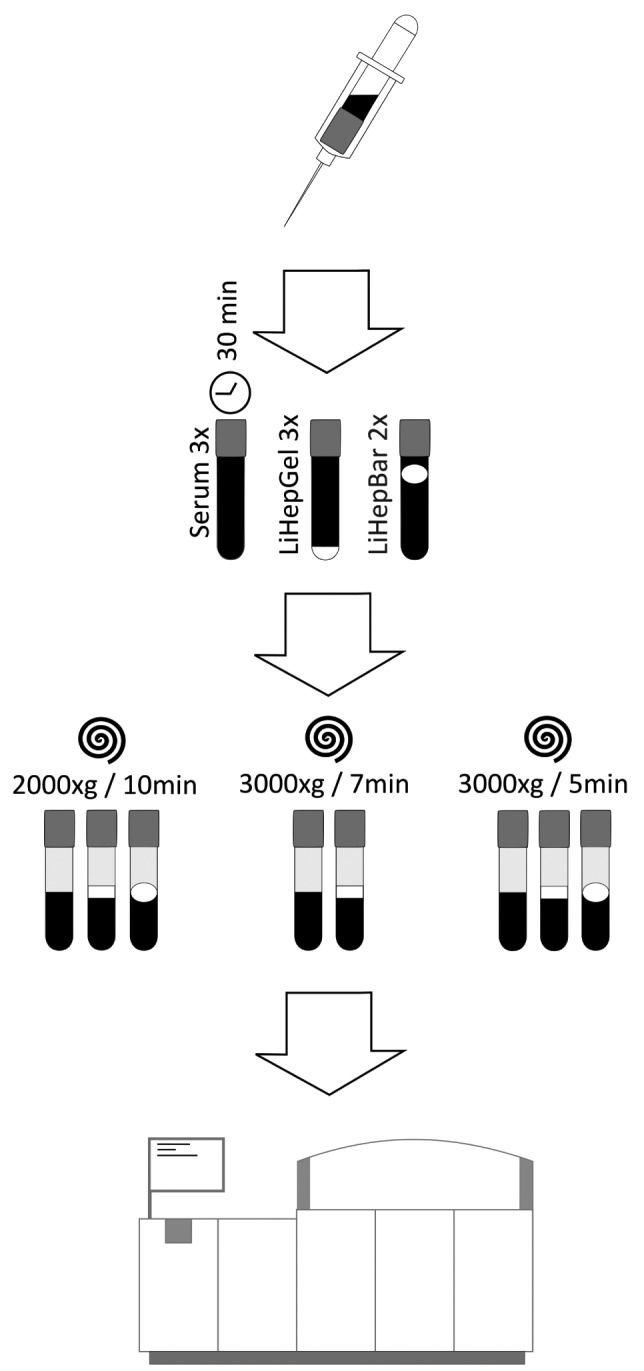
We collected blood from 41 healthy volunteers into BD Vacutainer PST II-heparin-gel- (LiHepGel), BD Vacutainer SST II-serum-, and BD Vacutainer Barricor heparin-tubes with a mechanical separator (LiHepBar). Tubes were centrifuged at 2000xg for 10 minutes and 3000xg for 7 and 5 minutes, respectively. Subsequently 60 and 21 clinical chemistry analytes were measured in plasma and serum samples, respectively, using a Roche COBAS instrument.
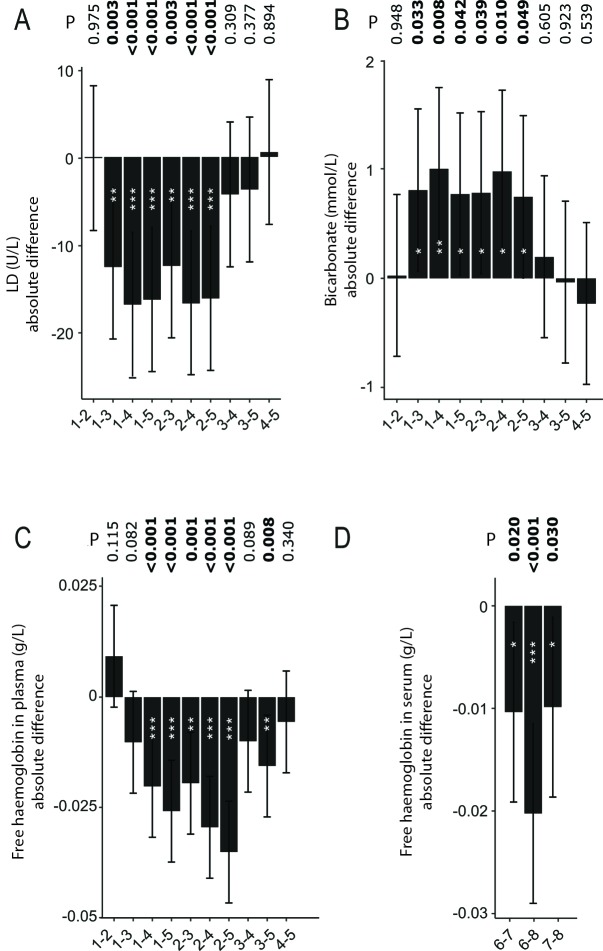
High sensitive Troponin T, pregnancy-associated plasma protein A, ß human chorionic gonadotropin and rheumatoid factor had to be excluded from statistical evaluation as many of the respective results were below the measuring range. Except of free haemoglobin (fHb) measurements, no analyte result was altered by the use of shorter centrifugation times at higher g-forces. Comparing LiHepBar to LiHepGel tubes at different centrifugation setting, we found higher lactate-dehydrogenase (LD) (P = 0.003 to < 0.001) and lower bicarbonate values (P = 0.049 to 0.008) in the latter.
Serum and heparin samples may be centrifuged at higher speed (3000xg) for a shorter amount of time (5 minutes) without alteration of the analytes tested in this study. When using LiHepBar tubes for blood collection, a separate LD reference value might be needed.
尽管几乎在每个血液样本中都进行离心,但关于离心持续时间和 g 力的建议是不同的,并且主要基于专家意见。为了在全自动实验室中统一这一步骤,我们旨在评估不同的离心设置及其对常规临床化学分析物结果的影响。
我们从 41 名健康志愿者中采集血液,分别使用 BD Vacutainer PST II-肝素凝胶(LiHepGel)、BD Vacutainer SST II-血清和 BD Vacutainer Barricor 肝素管(LiHepBar)与机械分离管。将管在 2000xg 下离心 10 分钟,在 3000xg 下分别离心 7 分钟和 5 分钟。随后,使用罗氏 COBAS 仪器分别测量血浆和血清样本中的 60 和 21 种临床化学分析物。
高敏肌钙蛋白 T、妊娠相关血浆蛋白 A、β人绒毛膜促性腺激素和类风湿因子必须排除在统计评估之外,因为许多相应的结果低于测量范围。除游离血红蛋白(fHb)测量外,在使用较高 g 力较短离心时间时,没有分析物结果发生改变。在不同的离心设置下比较 LiHepBar 与 LiHepGel 管时,我们发现后者的乳酸脱氢酶(LD)更高(P = 0.003 至 <0.001),碳酸氢盐值更低(P = 0.049 至 0.008)。
血清和肝素样本可以在较高速度(3000xg)下离心较短时间(5 分钟),而不会改变本研究中测试的分析物。当使用 LiHepBar 管采集血液时,可能需要单独的 LD 参考值。