Wirestam Lina, Frodlund Martina, Enocsson Helena, Skogh Thomas, Wetterö Jonas, Sjöwall Christopher
Rheumatology/Division of Neuro and Inflammation Sciences, Department of Clinical and Experimental Medicine, Linköping University, Linköping, Sweden.
Lupus Sci Med. 2017 Jul 28;4(1):e000225. doi: 10.1136/lupus-2017-000225. eCollection 2017.
The variety of disease phenotypes among patients with SLE challenges the identification of new biomarkers reflecting disease activity and/or organ damage. Osteopontin (OPN) is an extracellular matrix protein with immunomodulating properties. Although raised levels have been reported, the pathogenic implications and clinical utility of OPN as a biomarker in SLE are far from clear. Thus, the aim of this study was to characterise OPN in SLE.
Sera from 240 well-characterised adult SLE cases classified according to the American College of Rheumatology (ACR) and/or the Systemic Lupus International Collaborating Clinics (SLICC) criteria, and 240 population-based controls were immunoassayed for OPN. The SLE Disease Activity Index 2000 (SLEDAI-2K) was used to evaluate disease activity and the SLICC/ACR Damage Index (SDI) to detect damage accrual.
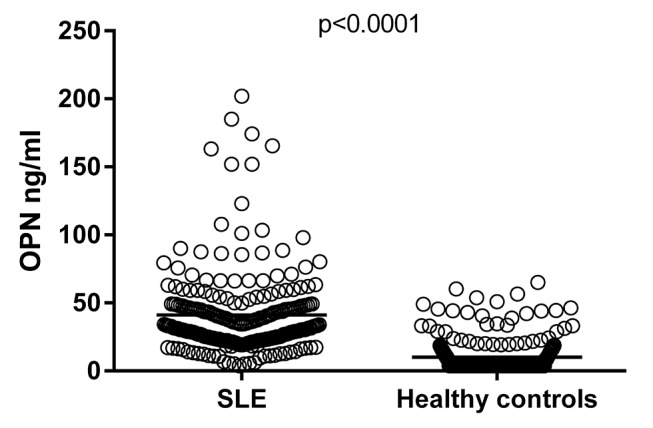
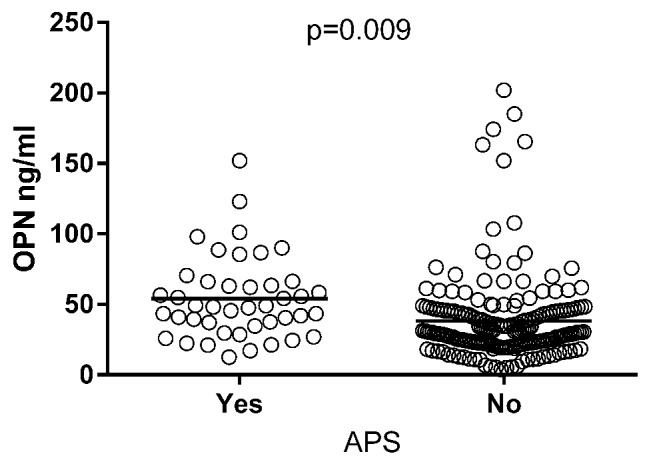
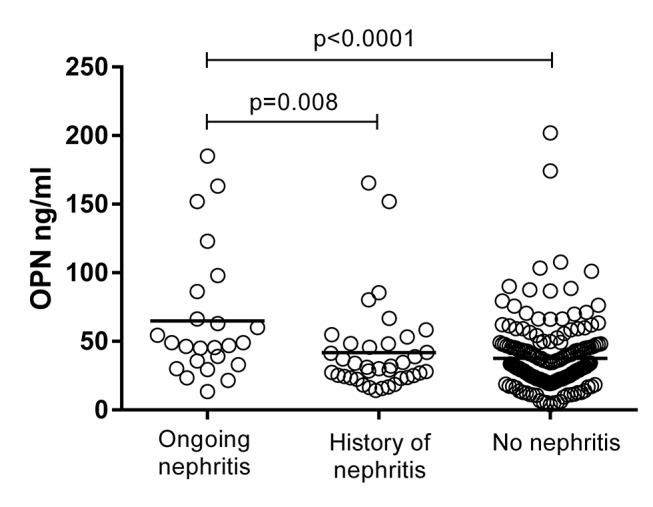
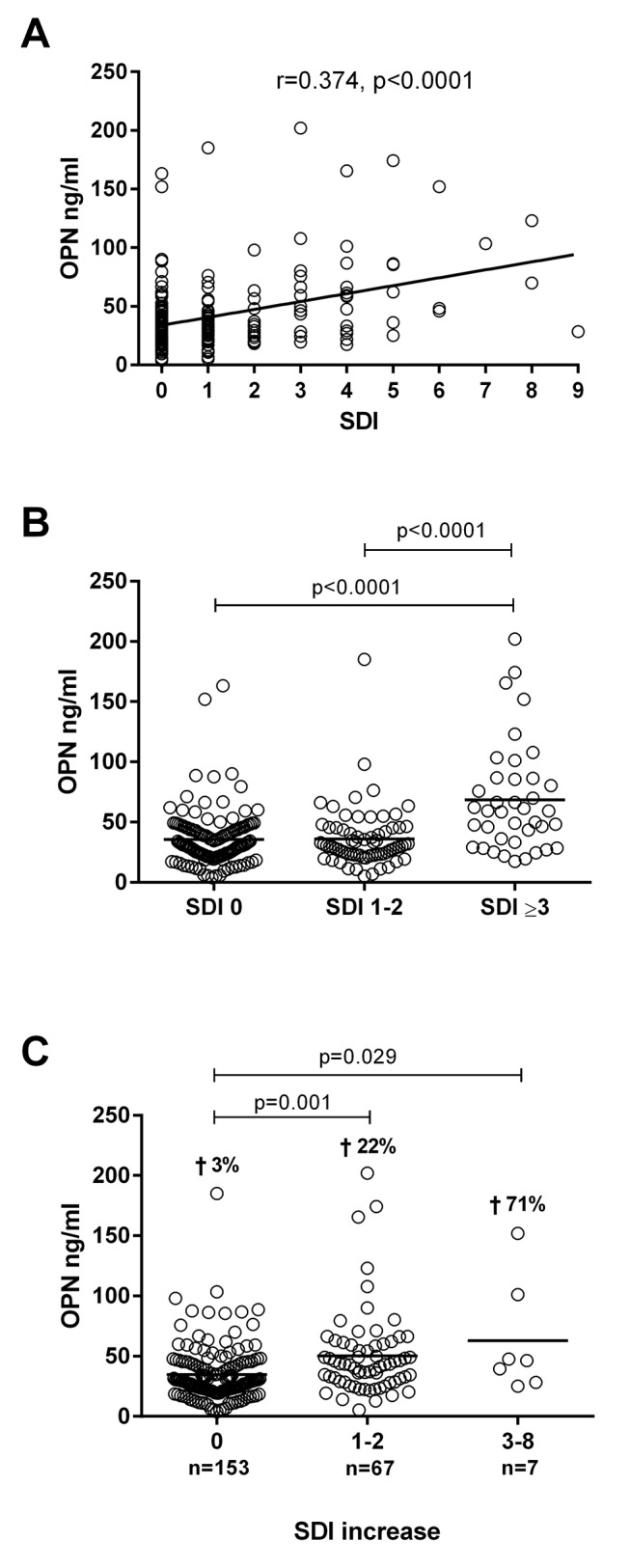
Serum OPN levels were in average raised fourfold in SLE cases compared with the controls (p<0.0001). OPN correlated with SLEDAI-2K, especially in patients with a disease duration of <12 months (r=0.666, p=0.028). OPN was highly associated with SDI (p<0.0001), especially in the renal (p<0.0001), cardiovascular (p<0.0001) and malignancy (p=0.012) domains. Finally, OPN associated with coherent antiphospholipid syndrome (APS; p=0.009), and both clinical and laboratory criteria of APS had significant positive impact on OPN levels.
In this cross-sectional study, circulating OPN correlates with disease activity in recent-onset SLE, reflects global organ damage and associates with APS. Longitudinal studies to dissect whether serum OPN also precedes and predicts future organ damage are most warranted.
系统性红斑狼疮(SLE)患者疾病表型的多样性对识别反映疾病活动和/或器官损伤的新生物标志物构成挑战。骨桥蛋白(OPN)是一种具有免疫调节特性的细胞外基质蛋白。尽管已有报道其水平升高,但OPN作为SLE生物标志物的致病意义和临床应用尚不清楚。因此,本研究旨在对SLE中的OPN进行特征描述。
对根据美国风湿病学会(ACR)和/或系统性红斑狼疮国际协作诊所(SLICC)标准分类的240例特征明确的成年SLE患者以及240例基于人群的对照者的血清进行OPN免疫测定。采用SLE疾病活动指数2000(SLEDAI - 2K)评估疾病活动度,采用SLICC/ACR损伤指数(SDI)检测损伤累积情况。
与对照组相比,SLE患者血清OPN水平平均升高四倍(p<0.0001)。OPN与SLEDAI - 2K相关,尤其是在病程<12个月的患者中(r = 0.666,p = 0.028)。OPN与SDI高度相关(p<0.0001),尤其是在肾脏(p<0.0001)、心血管(p<0.0001)和恶性肿瘤(p = 0.012)领域。最后,OPN与抗磷脂综合征(APS)相关(p = 0.009),APS的临床和实验室标准均对OPN水平有显著的正向影响。
在本横断面研究中,循环OPN与新发SLE的疾病活动相关,反映整体器官损伤并与APS相关。最有必要进行纵向研究以剖析血清OPN是否也先于并预测未来的器官损伤。