Canidate Shantrel, Hart Mark
Social and Behavioral Sciences Program, College of Public Health and Health Professions, University of Florida, Gainesville, FL, United States.
J Med Internet Res. 2017 Dec 1;19(12):e365. doi: 10.2196/jmir.6740.
The number of adults using the Internet to obtain health information is on the rise. An estimated 66% of the adults reportedly use the Internet to obtain health information related to a specific disease (ie, human immunodeficiency virus and acquired immunodeficiency syndrome, HIV/AIDS). Previous research has demonstrated that health information seekers use the Internet to seek answers to stigma-laden questions from health avatars.
The objective of this study was to identify patterns in the choice of avatar among health information seekers (patients or public health workers) using the Internet to obtain HIV/AIDS information and to describe the demographic characteristics (age, gender, and ethnicity) of health information seekers to determine whether they preferred an avatar that was similar to their own gender and ethnicity.
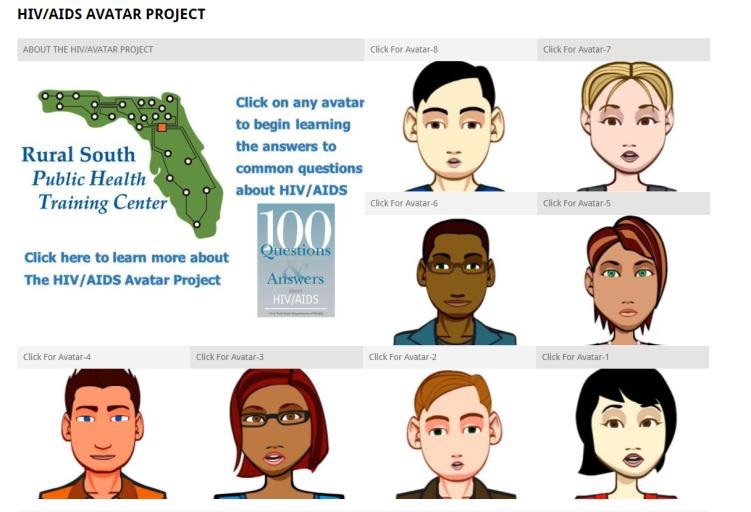
The Rural South Public Health Training Center (RSPHTC) partnered with the New York State Department of Health to create the HIV/AIDS Avatar project. The avatar project was created to serve as an educational resource for public health workers by providing relevant and accurate information about HIV/AIDS. First, the user was instructed to choose one of the 8 avatars that voiced responses to 100 common questions and answers about HIV/AIDS. Next, the website gave users the option to complete a brief 3-question demographic survey. Finally, the demographic characteristics of each user were compared with the chosen avatar to determine whether they preferred an avatar that was similar to their own gender and ethnicity.
The avatar project website was loaded with 800 videos that included the answers to the top 100 questions about HIV/AIDS voiced by 8 avatars. A total of 1119 Web-based health information seekers completed the demographic survey upon accessing the website. Of these, 55.14% (617/1119) users were female. A total of 49.96% (559/1119) users were aged between 30 and 49 years. The ethnicity of the user and the avatar was found to have the strongest connection. All the users choose the female avatar matching their own ethnicity, followed by the male avatar. Additionally, the white female avatar was chosen the most by all users regardless of the age group or gender.
Web-based health information seekers using the Internet to access medical research information may feel more comfortable receiving the answers to HIV stigma-laden questions from avatars, rather than receiving information directly from a health care provider. Additionally, providers seeking to utilize avatars to deliver interventions in health care settings may benefit from offering individuals choices in how they receive health information. Having the ability to choose whom you seek information from may lead to an increase in knowledge and awareness and could motivate HIV-positive individuals to seek care.
使用互联网获取健康信息的成年人数量正在增加。据估计,66%的成年人使用互联网获取与特定疾病(即人类免疫缺陷病毒和获得性免疫缺陷综合征,HIV/AIDS)相关的健康信息。先前的研究表明,寻求健康信息的人利用互联网向健康虚拟形象寻求带有污名化问题的答案。
本研究的目的是确定使用互联网获取HIV/AIDS信息的健康信息寻求者(患者或公共卫生工作者)在选择虚拟形象方面的模式,并描述健康信息寻求者的人口统计学特征(年龄、性别和种族),以确定他们是否更喜欢与自己性别和种族相似的虚拟形象。
美国南部农村公共卫生培训中心(RSPHTC)与纽约州卫生部合作创建了HIV/AIDS虚拟形象项目。创建该虚拟形象项目是为了通过提供有关HIV/AIDS的相关准确信息,作为公共卫生工作者的教育资源。首先,用户被指示从8个虚拟形象中选择一个,这些形象会对100个关于HIV/AIDS的常见问题和答案进行语音回复。接下来,网站让用户选择完成一份简短的包含3个问题的人口统计学调查。最后,将每个用户的人口统计学特征与所选的虚拟形象进行比较,以确定他们是否更喜欢与自己性别和种族相似的虚拟形象。
虚拟形象项目网站加载了800个视频,其中包括8个虚拟形象对100个关于HIV/AIDS的常见问题的答案。共有1119名基于网络的健康信息寻求者在访问该网站时完成了人口统计学调查。其中,55.14%(617/1119)的用户为女性。共有49.96%(559/1119)的用户年龄在30至49岁之间。发现用户与虚拟形象的种族联系最为紧密。所有用户都选择了与自己种族匹配的女性虚拟形象,其次是男性虚拟形象。此外,无论年龄组或性别如何,白人女性虚拟形象被所有用户选择的次数最多。
使用互联网获取医学研究信息的基于网络的健康信息寻求者,可能会觉得从虚拟形象那里获得关于HIV污名化问题的答案比直接从医疗保健提供者那里获得信息更自在。此外,寻求利用虚拟形象在医疗保健环境中提供干预措施的提供者,可能会从为个人提供获取健康信息方式的选择中受益。有能力选择向谁寻求信息可能会增加知识和意识,并可能促使HIV阳性个体寻求治疗。
