Departamento de Ecología, Facultad de Ciencias Biológicas, Pontificia Universidad Católica de Chile, Alameda, 340 C.P., 6513677, Santiago, Chile.
Instituto de Ecología y Biodiversidad (IEB), Las Palmeras, 3425, Santiago, Chile.
Sci Rep. 2017 Dec 1;7(1):16815. doi: 10.1038/s41598-017-17070-1.
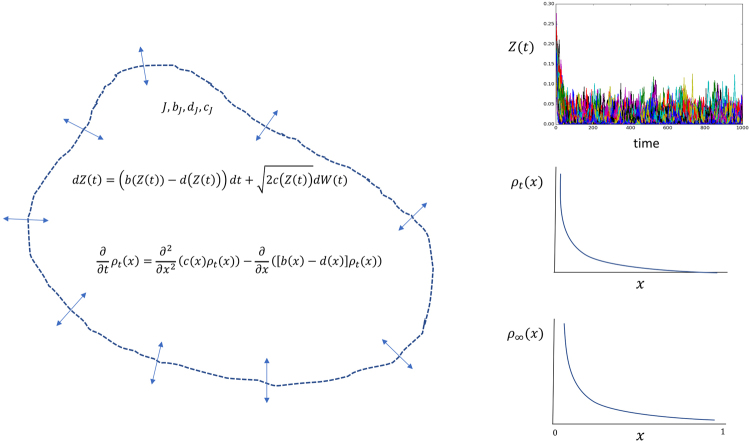
The frequency of genes in interconnected populations and of species in interconnected communities are affected by similar processes, such as birth, death and immigration. The equilibrium distribution of gene frequencies in structured populations is known since the 1930s, under Wright's metapopulation model known as the island model. The equivalent distribution for the species frequency (i.e. the species proportional abundance distribution (SPAD)), at the metacommunity level, however, is unknown. In this contribution, we develop a stochastic model to analytically account for this distribution (SPAD). We show that the same as for genes SPAD follows a beta distribution, which provides a good description of empirical data and applies across a continuum of scales. This stochastic model, based upon a diffusion approximation, provides an alternative to neutral models for the species abundance distribution (SAD), which focus on number of individuals instead of proportions, and demonstrate that the relative frequency of genes in local populations and of species within communities follow the same probability law. We hope our contribution will help stimulate the mathematical and conceptual integration of theories in genetics and ecology.
相互关联的种群中基因的频率和相互关联的群落中物种的频率受到类似的过程的影响,如出生、死亡和移民。自 20 世纪 30 年代以来,在赖特的称为岛屿模型的复合种群模型下,已知结构种群中基因频率的平衡分布。然而,在集合群落水平上,物种频率的等效分布(即物种比例丰度分布(SPAD))是未知的。在本研究中,我们开发了一个随机模型来对其进行分析(SPAD)。我们表明,与基因一样,SPAD 遵循 beta 分布,该分布为经验数据提供了很好的描述,并适用于一系列连续的尺度。这个基于扩散近似的随机模型为物种丰度分布(SAD)的中性模型提供了替代方法,中性模型侧重于个体数量而不是比例,并表明局部种群中基因的相对频率和群落中物种的相对频率遵循相同的概率定律。我们希望我们的贡献将有助于激发遗传学和生态学理论的数学和概念整合。