Institute for Sport, Physical Activity and Leisure, Headingley Campus, Leeds Beckett University, Leeds, West Yorkshire, LS6 3QS, UK.
Eur J Appl Physiol. 2018 Feb;118(2):283-290. doi: 10.1007/s00421-017-3768-9. Epub 2017 Dec 1.
This study evaluated whether glycogen-associated water is a protected entity not subject to normal osmotic homeostasis. An investigation into practical and theoretical aspects of the functionality of this water as a determinant of osmolality, dehydration, and glycogen concentration was undertaken.
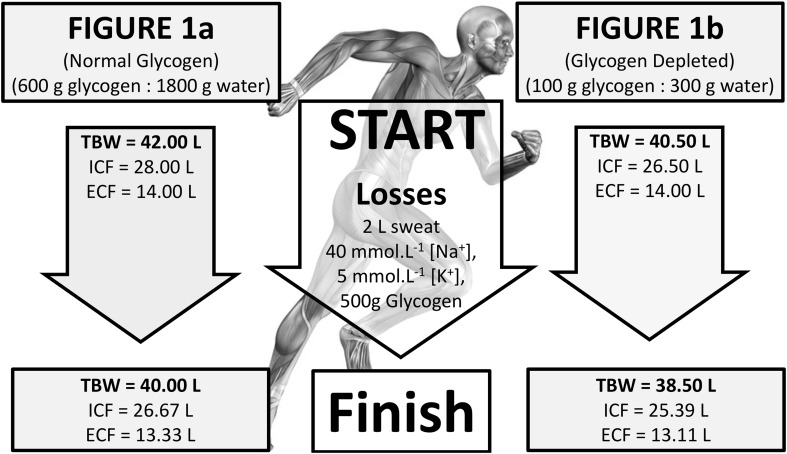
In vitro experiments were conducted to determine the intrinsic osmolality of glycogen-potassium phosphate mixtures as would be found intra-cellularly at glycogen concentrations of 2% for muscle and 5 and 10% for liver. Protected water would not be available to ionic and osmotic considerations, whereas free water would obey normal osmotic constraints. In addition, the impact of 2 L of sweat loss in situations of muscle glycogen repletion and depletion was computed to establish whether water associated with glycogen is of practical benefit (e.g., to increase "available total body water").
The osmolality of glycogen-potassium phosphate mixtures is predictable at 2% glycogen concentration (predicted 267, measured 265.0 ± 4.7 mOsmol kg) indicating that glycogen-associated water is completely available to all ions and is likely part of the greater osmotic system of the body. At higher glycogen concentrations (5 and 10%), there was a small amount of glycogen water (~ 10-20%) that could be considered protected. However, the majority of the glycogen-associated water behaved to normal osmotic considerations. The theoretical exercise of selective dehydration (2 L) indicated a marginal advantage to components of total body water such as plasma volume (1.57% or 55 mL) when starting exercise glycogen replete.
Glycogen-associated water does not appear to be a separate reservoir and is not able to uniquely replete water loss during dehydration.
本研究评估了糖原相关水是否是一种不受正常渗透平衡影响的保护实体。本研究对这种水作为渗透压、脱水和糖原浓度决定因素的功能的实际和理论方面进行了调查。
进行了体外实验,以确定糖原-磷酸钾混合物的固有渗透压,类似于细胞内 2%的肌肉糖原浓度和 5%和 10%的肝脏糖原浓度。受保护的水将不受离子和渗透的影响,而游离水将遵守正常的渗透限制。此外,还计算了肌肉糖原补充和消耗情况下 2 升汗液流失的影响,以确定与糖原相关的水是否具有实际益处(例如,增加“可用总身体水”)。
在 2%的糖原浓度下,糖原-磷酸钾混合物的渗透压是可预测的(预测 267,测量值 265.0±4.7 mOsmol kg),表明糖原相关水完全可用于所有离子,并且可能是身体更大渗透系统的一部分。在更高的糖原浓度(5%和 10%)下,有一小部分糖原水(~10-20%)可以被认为是受保护的。然而,大部分与糖原相关的水表现出正常的渗透考虑。选择性脱水(2 升)的理论练习表明,当开始运动时,糖原补充的情况下,总身体水分的成分(如血浆体积)有微小的优势(1.57%或 55 毫升)。
糖原相关水似乎不是一个单独的储层,并且在脱水期间无法独特地补充水分损失。