Li Donghao, Zheng Jimin, Hu Yiting, Hou Hongtao, Hao Shurong, Liu Na, Wang Yuzhen
Department of Gastroenterology, Affiliated Hospital of Hebei University of Engineering, Handan 056038, China.
Department of Gastroenterology, Hebei General Hospital, Shijiazhuang 050051, China.
Pharmacogn Mag. 2017 Oct-Dec;13(52):677-682. doi: 10.4103/pm.pm_584_16. Epub 2017 Nov 13.
To investigate the effect of berberine (BBR) on intestinal barrier function in nonalcoholic fat liver disease (NAFLD) in rats.
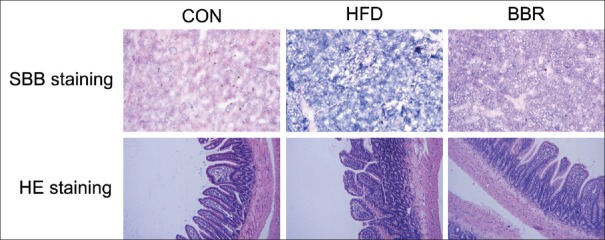
Rats were divided into three groups: normal diet group (control group [CON group]), high-fat diet feeding group (HFD group), and HFD with BBR group. After 8 weeks of HFD feeding, rats in the BBR group were given BBR intragastrically at a dose of 150 mg/kg daily for 4 weeks. The same volume of normal saline was given to the CON and HFD groups. Liver index was detected, and Sudan black B staining was used to study fatty degeneration, also the expression level of occluding and intestinal flora was analyzed.
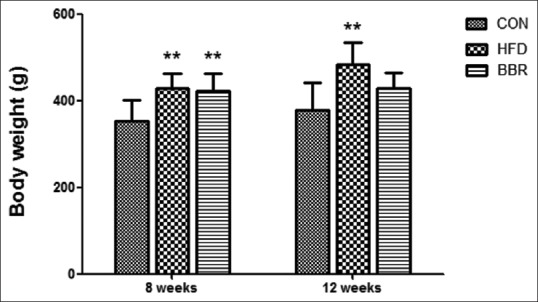
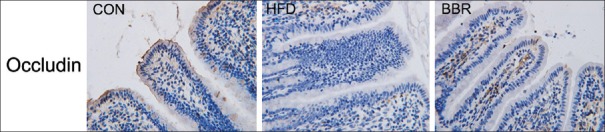
BBR administration significantly reduced HFD-induced increase in body weight (CON group: 379.83 ± 61.51 g, HFD group: 485.24 ± 50.15 g, and BBR group: 428.60 ± 37.37 g). It obviously alleviated the HFD-induced liver fatty degeneration and histopathological changes of intestinal mucosa according to liver index low-density lipoprotein-cholesterol, high-density lipoprotein-cholesterol, and total cholesterol ( < 0.05). The triglyceride, alanine transaminase, and aspartate aminotransferase levels were greatly elevated after BBR treatment ( < 0.05); while endotoxin, intestinal fatty acid-binding protein, and tumor necrosis factor-α were significantly reduced ( < 0.05). Moreover, we found that BBR could obviously elevate the level of occludin and decrease the level of and upregulate the level of bacteroides.
BBR provides significant protection in NAFLD through ameliorating intestinal barrier function.
Berberine (BBR), an alkaloid that can be isolated from many plants, has been medically used for its wide range of antimicrobial and anti-inflammatory effectsThis is a study of BBR on liver function and intestinal barrier function in nonalcoholic fat liver disease (NAFLD)BBR treatment for NAFLD could significantly restore the liver function and provide significant protection in NAFLD through ameliorating intestinal barrier function. BBR: Berberine, NAFLD: Nonalcoholic fat liver disease, ALT: Alanine transaminase, AST: Aspartate aminotransferase, TG: Triglyceride, I-FABP: Intestinal-fatty acid-binding protein, IBD: Inflammatory bowel disease.
探讨小檗碱(BBR)对大鼠非酒精性脂肪性肝病(NAFLD)肠屏障功能的影响。
将大鼠分为三组:正常饮食组(对照组[CON组])、高脂饮食喂养组(HFD组)和高脂饮食加BBR组。高脂饮食喂养8周后,BBR组大鼠每天按150mg/kg的剂量灌胃给予BBR,持续4周。CON组和HFD组给予相同体积的生理盐水。检测肝脏指数,采用苏丹黑B染色研究脂肪变性,同时分析闭合蛋白和肠道菌群的表达水平。
给予BBR显著降低了高脂饮食诱导的体重增加(CON组:379.83±61.51g,HFD组:485.24±50.15g,BBR组:428.60±37.37g)。根据肝脏指数、低密度脂蛋白胆固醇、高密度脂蛋白胆固醇和总胆固醇,BBR明显减轻了高脂饮食诱导的肝脏脂肪变性和肠黏膜组织病理学变化(P<0.05)。BBR治疗后甘油三酯、丙氨酸转氨酶和天冬氨酸转氨酶水平显著升高(P<0.05);而内毒素、肠脂肪酸结合蛋白和肿瘤坏死因子-α显著降低(P<0.05)。此外,我们发现BBR可明显提高闭合蛋白水平,降低……水平,并上调拟杆菌水平。
BBR通过改善肠屏障功能对NAFLD提供显著保护。
小檗碱(BBR)是一种可从多种植物中分离得到的生物碱,因其广泛的抗菌和抗炎作用而被用于医学。这是一项关于BBR对非酒精性脂肪性肝病(NAFLD)肝功能和肠屏障功能影响的研究。BBR治疗NAFLD可显著恢复肝功能,并通过改善肠屏障功能对NAFLD提供显著保护。BBR:小檗碱,NAFLD:非酒精性脂肪性肝病,ALT:丙氨酸转氨酶,AST:天冬氨酸转氨酶,TG:甘油三酯,I-FABP:肠脂肪酸结合蛋白,IBD:炎症性肠病。