Tang Jennifer H, Kopp Dawn M, Stuart Gretchen S, O'Shea Michele, Stanley Christopher C, Hosseinipour Mina C, Miller William C, Mwale Mwawi, Kaliti Stephen, Bonongwe Phylos, Rosenberg Nora E
UNC Project-Malawi, 100 Mzimba Road, Private Bag A-104, Lilongwe, Malawi.
Department of Obstetrics & Gynecology, University of North Carolina, 101 Manning Drive, CB #7570, Chapel Hill, NC 27599-7570 USA.
Contracept Reprod Med. 2016 Aug 10;1:13. doi: 10.1186/s40834-016-0026-1. eCollection 2016.
Long-acting reversible contraception (LARC) can assist women with birth spacing and reduce unintended pregnancies. Sub-Saharan Africa has low uptake of the two available methods of LARC, the subdermal implant and intrauterine contraception (IUC). Our primary objectives were to: 1) calculate the incidence of LARC use among postpartum Malawian women, and 2) assess if LARC knowledge and intent to use LARC were associated with LARC uptake.
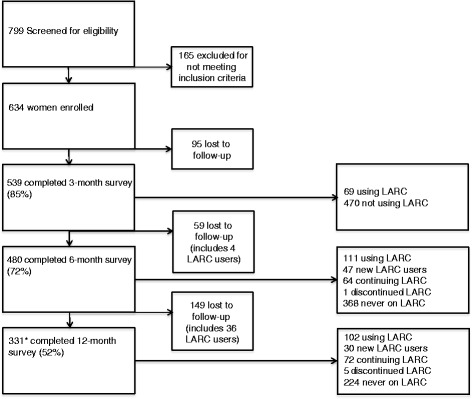
This study was a prospective cohort study of 634 postpartum women who were recruited from the postpartum ward of Bwaila Hospital in Lilongwe, Malawi. Study participants completed a baseline survey in the postpartum ward. Follow-up telephone surveys about contraceptive use were conducted at 3, 6, and 12 months postpartum. Cox proportional hazards regression analysis was performed to evaluate if implant knowledge and intent to use implant were associated with implant uptake.
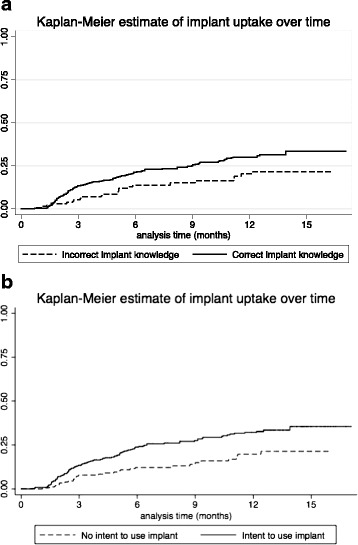
One hundred thirty-seven implant and 10 IUC placements were reported over 12 months of follow-up; given the low rate of IUC uptake, further analysis was only done for implant uptake. The incidence rate for implant uptake was 35.6 per 100 person-years (95 % CI 30.0, 42.2). Correct implant knowledge (adjusted HR = 1.69; 95 % CI 1.06, 2.68) and intent to use implant (adjusted HR 1.95; 95 % CI 1.28, 2.98) were both associated with implant uptake.
More women reported implant use than IUC use in our study. Correct implant knowledge and intent to use implant were both associated with implant uptake, with a stronger association for intent. Interventions to increase LARC uptake should focus on improving LARC knowledge and removing barriers to LARC.
Clinical Trial Registration #: NCT01893021.
长效可逆避孕法(LARC)有助于女性实现生育间隔并减少意外怀孕。在撒哈拉以南非洲地区,皮下植入剂和宫内节育器(IUC)这两种可用的LARC方法的使用率较低。我们的主要目标是:1)计算马拉维产后妇女使用LARC的发生率,以及2)评估LARC知识和使用LARC的意愿是否与LARC的使用有关。
本研究是一项前瞻性队列研究,对从马拉维利隆圭市Bwaila医院产后病房招募的634名产后妇女进行了研究。研究参与者在产后病房完成了基线调查。在产后3个月、6个月和12个月进行了关于避孕使用情况的随访电话调查。进行Cox比例风险回归分析,以评估植入剂知识和使用植入剂的意愿是否与植入剂的使用有关。
在12个月的随访中,报告了137例植入剂放置和10例IUC放置;鉴于IUC的使用率较低,仅对植入剂的使用进行了进一步分析。植入剂使用的发生率为每100人年35.6例(95%可信区间30.0,42.2)。正确的植入剂知识(调整后风险比=1.69;95%可信区间1.06,2.68)和使用植入剂的意愿(调整后风险比1.95;95%可信区间1.28,2.98)均与植入剂的使用有关。
在我们的研究中,报告使用植入剂的女性多于使用IUC的女性。正确的植入剂知识和使用植入剂的意愿均与植入剂的使用有关,意愿的关联更强。增加LARC使用的干预措施应侧重于提高LARC知识并消除LARC的障碍。
临床试验注册号:NCT01893021。