Sato Junko, Kanazawa Akio, Hatae Chie, Makita Sumiko, Komiya Koji, Shimizu Tomoaki, Ikeda Fuki, Tamura Yoshifumi, Ogihara Takeshi, Mita Tomoya, Goto Hiromasa, Uchida Toyoyoshi, Miyatsuka Takeshi, Ohmura Chie, Watanabe Takehito, Kobayashi Kiyoe, Miura Yoshiko, Iwaoka Manami, Hirashima Nao, Watada Hirotaka
Department of Metabolism & Endocrinology, Juntendo University Graduate School of Medicine, Bunkyo-ku, Tokyo, Japan.
Department of Diabetes, Endocrinology and Metabolism, Juntendo University Shizuoka Hospital, Izunokuni-shi, Shizuoka, Japan.
PLoS One. 2017 Dec 4;12(12):e0188892. doi: 10.1371/journal.pone.0188892. eCollection 2017.
BACKGROUND & AIMS: Recently, we conducted a prospective randomized controlled trial (RCT) showing that a 6-month 130g/day low-carbohydrate diet (LCD) reduced HbA1c and BMI more than a calorie restricted diet (CRD). [1] To assess whether the benefits of the LCD persisted after the intensive intervention, we compared HbA1c and BMI between the LCD and CRD groups at 1 year after the end of the 6-month RCT.
Following the end of the 6-month RCT, patients were allowed to manage their own diets with periodic outpatient visits. One year later, we analyzed clinical and nutrition data.
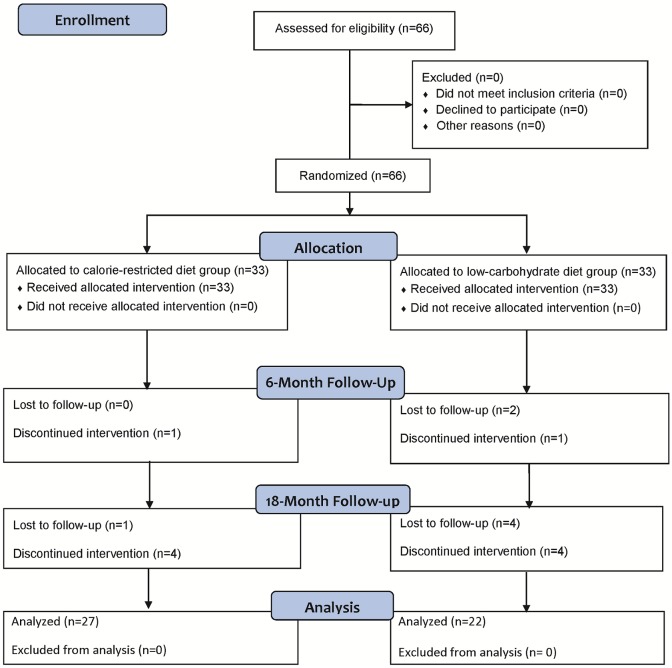
Of the 66 participants in the original study, 27 in the CRD group and 22 in the LCD group completed this trial. One year after the end of the original RCT, the carbohydrate intake was comparable between the groups (215 [189-243]/day in the CRD group and 214 (176-262) g/day in the LCD group). Compared with the baseline data, HbA1c and BMI were decreased in both groups (CRD: HbA1c -0.4 [-0.9 to 0.3] % and BMI -0.63 [-1.20 to 0.18] kg/m2; LCD: HbA1c -0.35 [-1.0 to 0.35] % and BMI -0.77 [-1.15 to -0.12] kg/m2). There were no significant differences in HbA1c and BMI between the groups.
One year after the diet therapy intervention, the beneficial effect of the LCD on reduction of HbA1c and BMI did not persist in comparison with CRD. However, combining the data of both groups, significant improvements in HbA1c and BMI from baseline were observed. Although the superiority of the LCD disappeared 1 year after the intensive intervention, these data suggest that well-constructed nutrition therapy programs, both CRD and LCD, were equally effective in improving HbA1c for at least 1 year.
University Hospital Medical Information Network (UMIN) ID000010663.
最近,我们进行了一项前瞻性随机对照试验(RCT),结果显示,与热量限制饮食(CRD)相比,为期6个月、每日130克的低碳水化合物饮食(LCD)能更有效地降低糖化血红蛋白(HbA1c)水平和体重指数(BMI)。[1] 为评估强化干预结束后LCD的益处是否持续存在,我们比较了6个月RCT结束后1年时LCD组和CRD组之间的HbA1c水平和BMI。
6个月RCT结束后,允许患者自行管理饮食,并定期门诊随访。1年后,我们分析了临床和营养数据。
在原研究的66名参与者中,CRD组27人、LCD组22人完成了本试验。在原RCT结束1年后,两组间碳水化合物摄入量相当(CRD组为215[189 - 243]克/天,LCD组为214[176 - 262]克/天)。与基线数据相比,两组的HbA1c水平和BMI均有所下降(CRD组:HbA1c下降0.4[-0.9至0.3]%,BMI下降0.63[-1.20至0.18]千克/平方米;LCD组:HbA1c下降0.35[-1.0至0.35]%,BMI下降0.77[-1.15至 - 0.12]千克/平方米)。两组间HbA1c水平和BMI无显著差异。
饮食治疗干预1年后,与CRD相比,LCD对降低HbA1c水平和BMI的有益作用未持续存在。然而,综合两组数据,可观察到HbA1c水平和BMI较基线有显著改善。尽管强化干预1年后LCD的优势消失,但这些数据表明,精心构建的营养治疗方案,无论是CRD还是LCD,在改善HbA1c水平方面至少1年内同样有效。
大学医院医学信息网络(UMIN)ID000010663。