The Roslin Institute and Royal (Dick) School of Veterinary Studies, University of Edinburgh, Midlothian EH25 9RG, UK.
Mol Med Rep. 2018 Feb;17(2):2100-2106. doi: 10.3892/mmr.2017.8163. Epub 2017 Nov 27.
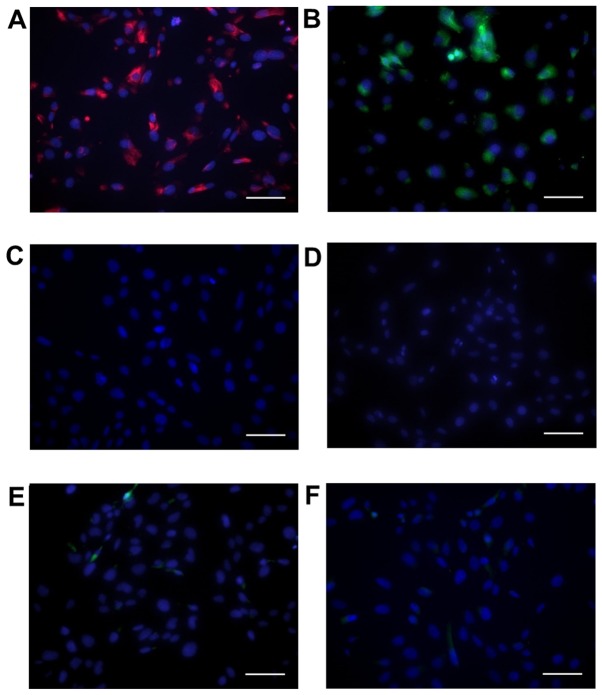
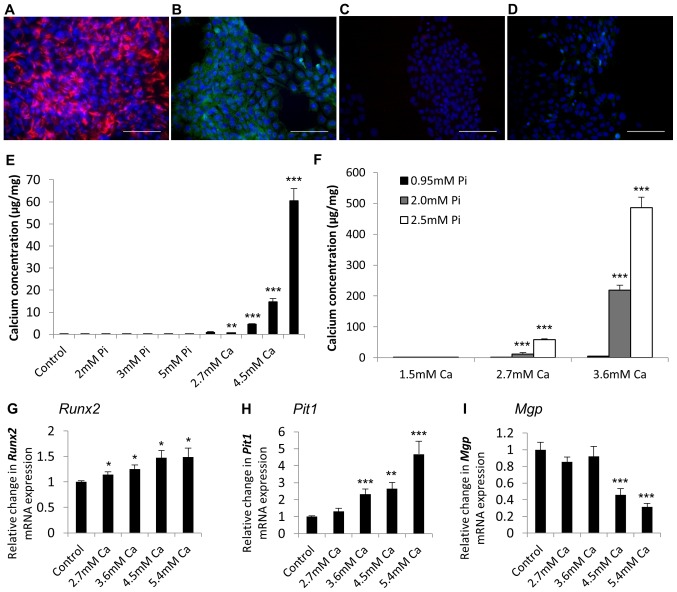
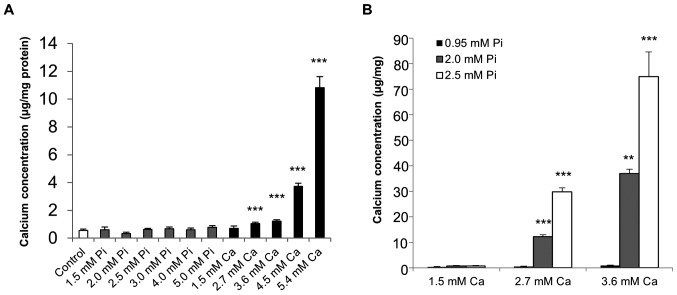
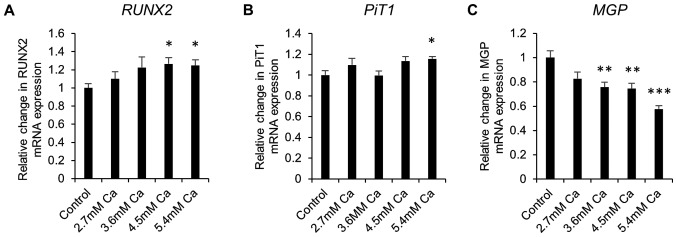
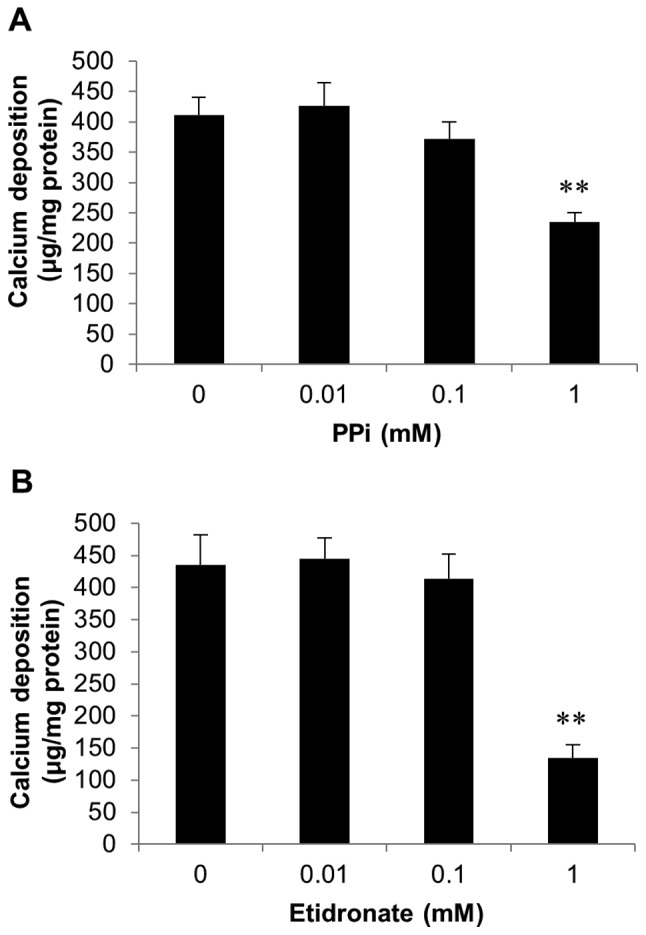
Calcific aortic valve disease (CAVD) involves progressive valve leaflet thickening and severe calcification, impairing leaflet motion. The in vitro calcification of primary rat, human, porcine and bovine aortic valve interstitial cells (VICs) is commonly employed to investigate CAVD mechanisms. However, to date, no published studies have utilised cell lines to investigate this process. The present study has therefore generated and evaluated the calcification potential of immortalized cell lines derived from sheep and rat VICs. Immortalised sheep (SAVIC) and rat (RAVIC) cell lines were produced by transduction with a recombinant lentivirus encoding the Simian virus (SV40) large and small T antigens (sheep), or large T antigen only (rat), which expressed markers of VICs (vimentin and α‑smooth muscle actin). Calcification was induced in the presence of calcium (Ca; 2.7 mM) in SAVICs (1.9 fold; P<0.001) and RAVICs (4.6 fold; P<0.01). Furthermore, a synergistic effect of calcium and phosphate was observed (2.7 mM Ca/2.0 mM Pi) on VIC calcification in the two cell lines (P<0.001). Analysis of SAVICs revealed significant increases in the mRNA expression of two key genes associated with vascular calcification in cells cultured under calcifying conditions, runt related transcription factor‑2 (RUNX2;1.3 fold; P<0.05 in 4.5 mM Ca) and sodium‑dependent phosphate transporter‑1 (PiT1; 1.2 fold; P<0.05 in 5.4 mM Ca). A concomitant decrease in the expression of the calcification inhibitor matrix Gla protein (MGP) was noted at 3.6 mM Ca (1.3 fold; P<0.01). Assessment of RAVICs revealed alterations in Runx2, Pit1 and Mgp mRNA expression levels (P<0.01). Furthermore, a significant reduction in calcification was observed in SAVICs following treatment with established calcification inhibitors, pyrophosphate (1.8 fold; P<0.01) and etidronate (3.2 fold; P<0.01). Overall, the present study demonstrated that the use of immortalised sheep and rat VIC cell lines is a convenient and cost effective system to investigate CAVD in vitro, and will make a useful contribution to increasing current understanding of the pathophysiological process.
钙化性主动脉瓣疾病 (CAVD) 涉及瓣叶进行性增厚和严重钙化,从而损害瓣叶运动。通常使用原代大鼠、人、猪和牛主动脉瓣膜间质细胞 (VICs) 的体外钙化来研究 CAVD 机制。然而,迄今为止,尚无研究利用细胞系来研究这一过程。因此,本研究生成并评估了源自绵羊和大鼠 VIC 的永生化细胞系的钙化潜力。通过转导含有编码猿猴病毒 (SV40) 大、小 T 抗原的重组慢病毒(绵羊),或仅大 T 抗原(大鼠),来产生永生化绵羊 (SAVIC) 和大鼠 (RAVIC) 细胞系,这些细胞系表达 VICs 的标志物(波形蛋白和α-平滑肌肌动蛋白)。在 SAVICs(增加 1.9 倍;P<0.001)和 RAVICs(增加 4.6 倍;P<0.01)中,在存在钙 (Ca; 2.7 mM) 的情况下诱导钙化。此外,在两种细胞系中观察到钙和磷酸盐的协同作用(2.7 mM Ca/2.0 mM Pi)对 VIC 钙化的影响(P<0.001)。对 SAVICs 的分析显示,在培养条件下,与血管钙化相关的两个关键基因的 mRNA 表达显著增加,即 runt 相关转录因子 2 (RUNX2; 在 4.5 mM Ca 时增加 1.3 倍;P<0.05) 和钠依赖性磷酸盐转运蛋白 1 (PiT1; 在 5.4 mM Ca 时增加 1.2 倍;P<0.05)。在 3.6 mM Ca 时,观察到钙化抑制剂基质 Gla 蛋白 (MGP) 的表达降低(降低 1.3 倍;P<0.01)。对 RAVICs 的评估显示,Runx2、Pit1 和 Mgp mRNA 表达水平发生改变(P<0.01)。此外,在 SAVICs 中,使用已建立的钙化抑制剂焦磷酸盐(降低 1.8 倍;P<0.01)和依替膦酸(降低 3.2 倍;P<0.01)处理后,钙化明显减少。总的来说,本研究表明,使用永生化绵羊和大鼠 VIC 细胞系是一种方便且具有成本效益的体外研究 CAVD 的系统,将为增加对病理生理过程的现有理解做出有用贡献。