Wood Robert, Mitra Debanjali, de Courcy Jonathan, Iyer Shrividya
Real World Evidence, Adelphi Real World, Manchester, UK.
Global Outcomes and Evidence, Pfizer Inc, New York, USA.
ESMO Open. 2017 Aug 22;2(3):e000227. doi: 10.1136/esmoopen-2017-000227. eCollection 2017.
Patient-reported pain severity and related impact in advanced/metastatic breast cancer (ABC/MBC) are not well documented. The objective of this study was to assess pain and general health status in hormone receptor-positive (HR+)/human epidermal growth factor receptor 2-negative (HER2-) ABC/MBC.
Data were collected in the USA and Europe in a real-world, cross-sectional study. Patients were recruited at oncology practices and completed validated questionnaires; pain severity and interference were assessed using the Brief Pain Inventory (BPI) and general health status using the EuroQoL-5D (EQ-5D-3L). Descriptive statistics were generated for the overall cohort, and stratified by type of therapy and sites of metastases. Differences between patient groups were assessed via the Mann-Whitney Wilcoxon test. The relationship between pain scores and general health status was assessed using Kruskal-Wallis tests.
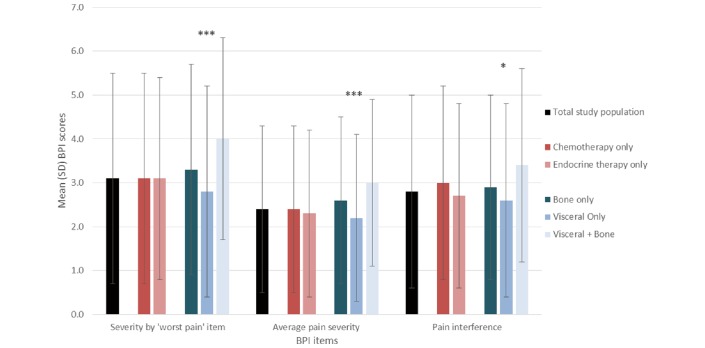
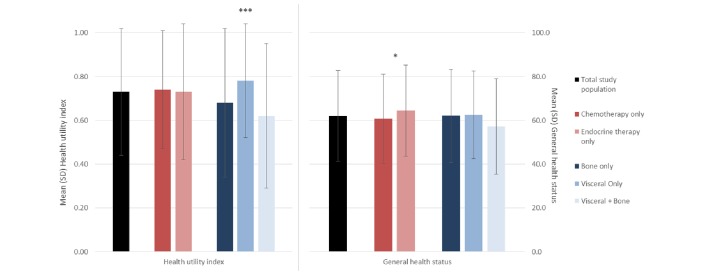
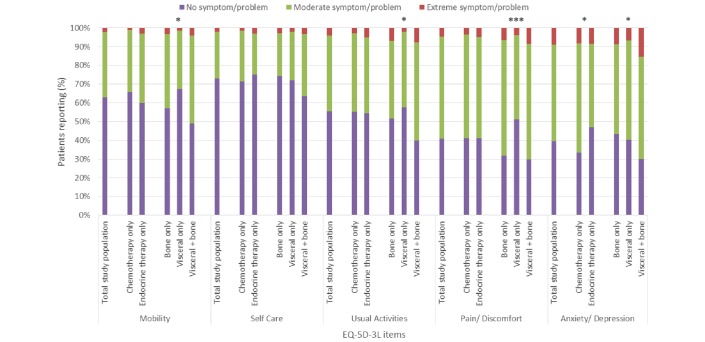
Overall, 173 oncologists and 739 patients participated. The majority of patients rated their worst pain, average pain and pain interference as mild (59%, 77% and 70%, respectively). Most patients (>90%) reported no problems or moderate problems for all items of the EQ-5D-3L. Current treatment had no significant associations with pain severity or interference. Patients on chemotherapy reported significantly higher proportions of moderate/extreme levels of anxiety/depression (66.7%) and significantly lower general health status (60.7) compared with those on endocrine therapy (53.1% and 64.4, respectively). Pain severity and interference, all EQ-5D-3L items except self-care and the EQ-5D-3L health utility index were also significantly associated with sites of metastases, with greater impact in patients with visceral and bone metastases than those with bone only or visceral only metastases. Significant associations were observed between pain and health status, with increased pain severity and pain interference associated with worse health utility and general health status.
There is a clear unmet need for treatments that can reduce pain and preserve health status in patients with HR+/HER2- ABC/MBC.
晚期/转移性乳腺癌(ABC/MBC)患者报告的疼痛严重程度及相关影响尚无充分记录。本研究的目的是评估激素受体阳性(HR+)/人表皮生长因子受体2阴性(HER2-)ABC/MBC患者的疼痛及总体健康状况。
在美国和欧洲进行了一项真实世界的横断面研究以收集数据。患者在肿瘤治疗机构招募并完成经过验证的问卷;使用简明疼痛量表(BPI)评估疼痛严重程度和干扰情况,使用欧洲五维健康量表(EQ-5D-3L)评估总体健康状况。对整个队列进行描述性统计,并按治疗类型和转移部位分层。通过曼-惠特尼-威尔科克森检验评估患者组之间的差异。使用克鲁斯卡尔-沃利斯检验评估疼痛评分与总体健康状况之间的关系。
总体而言,173名肿瘤学家和739名患者参与了研究。大多数患者将其最严重疼痛、平均疼痛和疼痛干扰评为轻度(分别为59%、77%和70%)。大多数患者(>90%)报告在EQ-5D-3L的所有项目中没有问题或有中度问题。当前治疗与疼痛严重程度或干扰无显著关联。与接受内分泌治疗的患者相比(分别为53.1%和64.4),接受化疗的患者报告中度/重度焦虑/抑郁水平的比例显著更高(66.7%),总体健康状况显著更低(60.7)。疼痛严重程度和干扰、除自我护理外的所有EQ-5D-3L项目以及EQ-5D-3L健康效用指数也与转移部位显著相关,与仅有骨转移或仅有内脏转移的患者相比,内脏和骨转移患者的影响更大。在疼痛与健康状况之间观察到显著关联,疼痛严重程度和疼痛干扰增加与健康效用和总体健康状况较差相关。
对于能够减轻HR+/HER2- ABC/MBC患者疼痛并维持其健康状况的治疗方法,显然存在未满足的需求。