Dai Lu, Mukai Hideyuki, Lindholm Bengt, Heimbürger Olof, Barany Peter, Stenvinkel Peter, Qureshi Abdul Rashid
Division of Renal Medicine and Baxter Novum, Department of Clinical Sciences, Intervention and Technology, Karolinska Institutet, Stockholm, Sweden.
Renal Department, First Affiliated Teaching Hospital, Tianjin University of Traditional Chinese Medicine, Tianjin, China.
PLoS One. 2017 Dec 6;12(12):e0186659. doi: 10.1371/journal.pone.0186659. eCollection 2017.
The value of subjective global assessment (SGA) as nutritional assessor of protein-energy wasting (PEWSGA) in chronic kidney disease (CKD) patients depends on its mortality predictive capacity. We investigated associations of PEWSGA with markers of nutritional status and all-cause mortality in CKD patients.
In 1031 (732 CKD1-5 non-dialysis and 299 dialysis) patients, SGA and body (BMI), lean (LBMI) and fat (FBMI) body mass indices, % handgrip strength (% HGS), serum albumin, and high sensitivity C-reactive protein (hsCRP) were examined at baseline. The five-year all-cause mortality predictive strength of baseline PEWSGA and during follow-up were investigated.
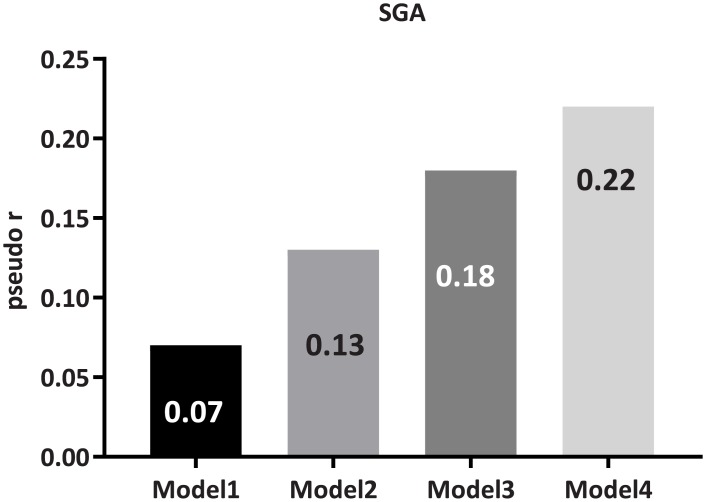
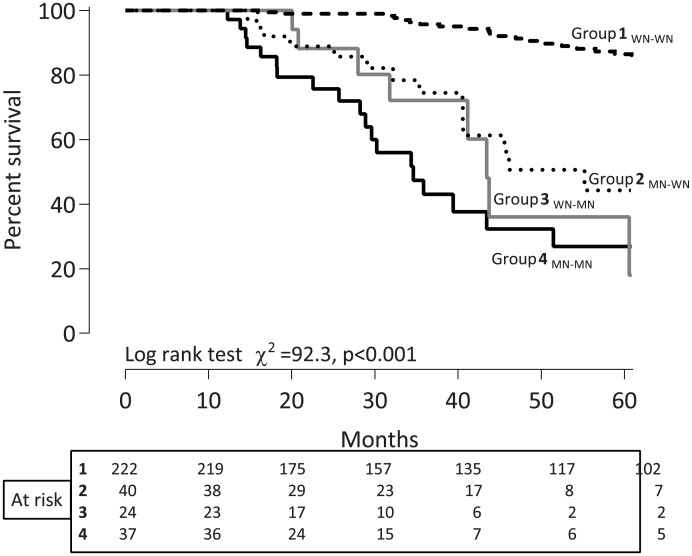
PEWSGA was present in 2% of CKD1-2, 16% of CKD3-4, 31% of CKD5 non-dialysis and 44% of dialysis patients. Patients with PEWSGA (n = 320; 31%) had higher hsCRP and lower BMI, LBMI, FBMI, %HGS and serum albumin. But, using receiver operating characteristics-derived cutoffs, these markers could not classify (by kappa statistic) or explain variations of (by multinomial logistic regression analysis) presence of PEWSGA. In generalized linear models, SGA independently predicted mortality after adjustments of multiple confounders (RR: 1.17; 95% CI: 1.11-1.23). Among 323 CKD5 patients who were re-assessed after median 12.6 months, 222 (69%) remained well-nourished, 37 (11%) developed PEWSGA de novo, 40 (12%) improved while 24 (8%) remained with PEWSGA. The latter independently predicted mortality (RR: 1.29; 95% CI: 1.13-1.46).
SGA, a valid assessor of nutritional status, is an independent predictor of all-cause mortality both in CKD non-dialysis and dialysis patients that outperforms non-composite nutritional markers as prognosticator.
主观全面评定法(SGA)作为慢性肾脏病(CKD)患者蛋白质能量消耗(PEW)的营养评估方法,其价值取决于其对死亡率的预测能力。我们研究了CKD患者中PEW的SGA与营养状况标志物及全因死亡率之间的关联。
在1031例患者(732例CKD1 - 5期非透析患者和299例透析患者)中,于基线时检测SGA、身体质量指数(BMI)、瘦体重指数(LBMI)、脂肪质量指数(FBMI)、握力百分比(%HGS)、血清白蛋白和高敏C反应蛋白(hsCRP)。研究了基线时及随访期间PEW的SGA对五年全因死亡率的预测强度。
PEW的SGA在2%的CKD1 - 2期患者、16%的CKD3 - 4期患者、31%的CKD5期非透析患者和44%的透析患者中存在。存在PEW的SGA的患者(n = 320;31%)hsCRP较高,而BMI、LBMI、FBMI、%HGS和血清白蛋白较低。但是,使用受试者工作特征曲线得出的临界值,这些标志物无法(通过kappa统计量)对PEW的SGA进行分类,也无法(通过多项逻辑回归分析)解释其存在的差异。在广义线性模型中经多个混杂因素调整后,SGA可独立预测死亡率(风险比:1.17;95%置信区间:1.11 - 1.23)。在323例CKD5期患者中,中位随访12.6个月后重新评估,222例(69%)仍营养良好,37例(11%)新发PEW的SGA,40例(12%)情况改善,24例(8%)仍存在PEW的SGA。后者可独立预测死亡率(风险比:1.29;95%置信区间:1.13 - 1.46)。
SGA作为营养状况的有效评估方法,是CKD非透析患者和透析患者全因死亡率的独立预测指标,作为预后指标优于非综合营养标志物。