Wang Yin-Ying, Bai Hong, Zhang Run-Zhi, Yan Hong, Ning Kang, Zhao Xing-Ming
Institute of Science and Technology for Brain-Inspired Intelligence (ISTBI), Fudan University, Shanghai 200433, China.
Department of Computer Science and Technology, Tongji University, Shanghai 201804, China.
Oncotarget. 2017 Sep 30;8(55):93957-93968. doi: 10.18632/oncotarget.21398. eCollection 2017 Nov 7.
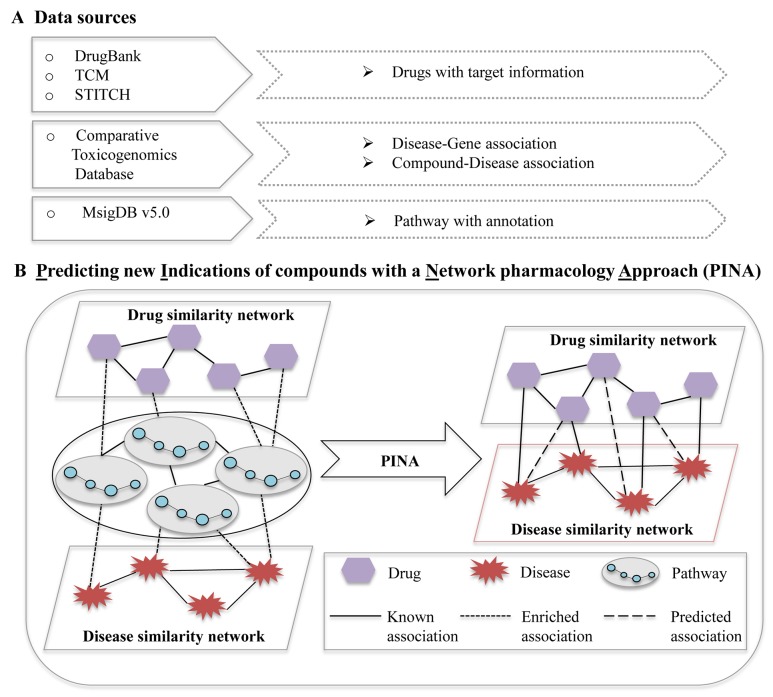
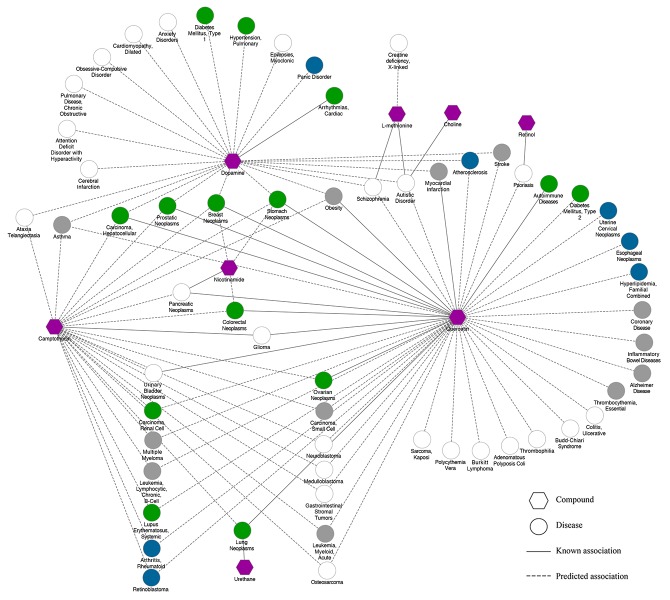
With the ever increasing cost and time required for drug development, new strategies for drug development are highly demanded, whereas repurposing old drugs has attracted much attention in drug discovery. In this paper, we introduce a new network pharmacology approach, namely PINA, to predict potential novel indications of old drugs based on the molecular networks affected by drugs and associated with diseases. Benchmark results on FDA approved drugs have shown the superiority of PINA over traditional computational approaches in identifying new indications of old drugs. We further extend PINA to predict the novel indications of Traditional Chinese Medicines (TCMs) with Liuwei Dihuang Wan (LDW) as a case study. The predicted indications, including immune system disorders and tumor, are validated by expert knowledge and evidences from literature, demonstrating the effectiveness of our proposed computational approach.
随着药物研发成本的不断增加和所需时间的延长,对新的药物研发策略的需求极为迫切,而旧药新用在药物发现领域已备受关注。在本文中,我们介绍了一种新的网络药理学方法,即PINA,用于基于受药物影响且与疾病相关的分子网络来预测旧药潜在的新适应症。对FDA批准药物的基准测试结果表明,在识别旧药新适应症方面,PINA优于传统的计算方法。我们进一步将PINA扩展用于预测中药的新适应症,并以六味地黄丸(LDW)为例进行了研究。预测的适应症,包括免疫系统疾病和肿瘤,通过专家知识和文献证据得到了验证,证明了我们所提出的计算方法的有效性。