U.S. Environmental Protection Agency Office of Research and Development, 109 T.W. Alexander Drive, Research Triangle Park, NC 27709, USA.
U.S. Environmental Protection Agency Office of Air and Radiation, 109 T.W. Alexander Drive, Research Triangle Park, NC 27709, USA.
Sci Total Environ. 2018 Apr 15;621:886-894. doi: 10.1016/j.scitotenv.2017.11.275. Epub 2017 Dec 18.
Lower-cost air quality sensors (hundreds to thousands of dollars) are now available to individuals and communities. This technology is undergoing a rapid and fragmented evolution, resulting in sensors that have uncertain data quality, measure different air pollutants and possess a variety of design attributes. Why and how individuals and communities choose to use sensors is arguably influenced by social context. For example, community experiences with environmental exposures and health effects and related interactions with industry and government can affect trust in traditional air quality monitoring. To date, little social science research has been conducted to evaluate why or how sensors, and sensor data, are used by individuals and communities, or how the introduction of sensors changes the relationship between communities and air quality managers.
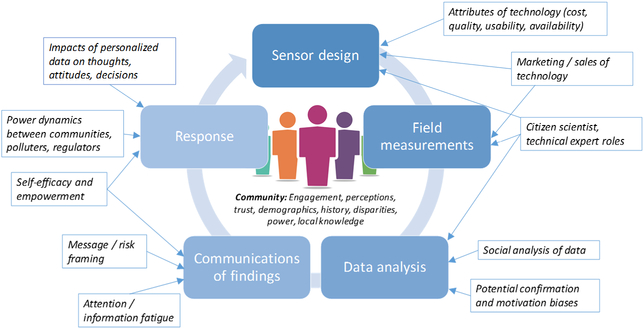
This commentary uses a risk governance/responsible innovation framework to identify opportunities for interdisciplinary research that brings together social scientists with air quality researchers involved in developing, testing, and deploying sensors in communities.
Potential areas for social science research include communities of sensor users; drivers for use of sensors and sensor data; behavioral, socio-political, and ethical implications of introducing sensors into communities; assessing methods for communicating sensor data; and harnessing crowdsourcing capabilities to analyze sensor data.
Social sciences can enhance understanding of perceptions, attitudes, behaviors, and other human factors that drive levels of engagement with and trust in different types of air quality data. New transdisciplinary research bridging social sciences, natural sciences, engineering, and design fields of study, and involving citizen scientists working with professionals from a variety of backgrounds, can increase our understanding of air sensor technology use and its impacts on air quality and public health.
现在,个人和社区都可以使用成本较低的空气质量传感器(几百到几千美元)。这项技术正在迅速发展,但呈现碎片化趋势,导致传感器的数据质量不确定,测量的空气污染物也不同,并且设计属性多种多样。个人和社区选择使用传感器的原因和方式可以说是受到社会背景的影响。例如,社区对环境暴露和健康影响的体验,以及与工业界和政府的相关互动,可能会影响对传统空气质量监测的信任。迄今为止,很少有社会科学研究评估个人和社区使用传感器及其数据的原因和方式,也很少有研究评估传感器的引入如何改变社区与空气质量管理者之间的关系。
本评论文章使用风险治理/负责任创新框架,确定机会,将社会科学家与参与开发、测试和在社区部署传感器的空气质量研究人员联系起来,开展跨学科研究。
社会科学研究的潜在领域包括传感器使用者社区;使用传感器和传感器数据的驱动因素;将传感器引入社区的行为、社会政治和伦理影响;评估传感器数据交流方法;利用众包能力分析传感器数据。
社会科学可以增强对不同类型空气质量数据的参与度和信任度的感知、态度、行为和其他人为因素的理解。新的跨学科研究将社会科学、自然科学、工程和设计领域的研究联系起来,并让公民科学家与来自不同背景的专业人员合作,可以提高我们对空气传感器技术使用及其对空气质量和公共健康的影响的理解。