Tamblyn J A, Jenkinson C, Larner D P, Hewison M, Kilby M D
Institute of Metabolism and Systems Research (IMSR)College of Medical and Dental Sciences, University of Birmingham, Birmingham, UK.
Birmingham Women's Foundation HospitalEdgbaston, Birmingham, UK.
Endocr Connect. 2018 Jan;7(1):199-210. doi: 10.1530/EC-17-0308. Epub 2017 Dec 7.
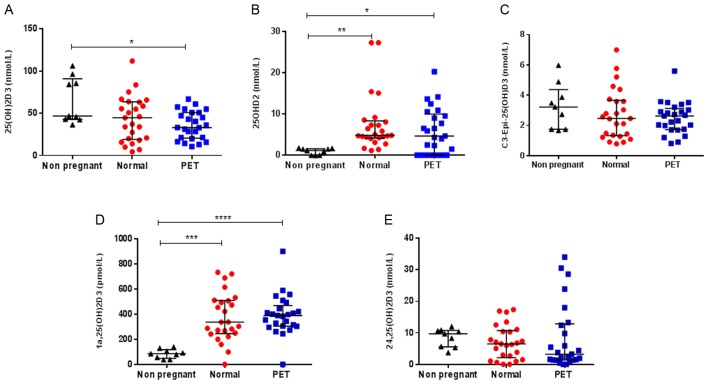
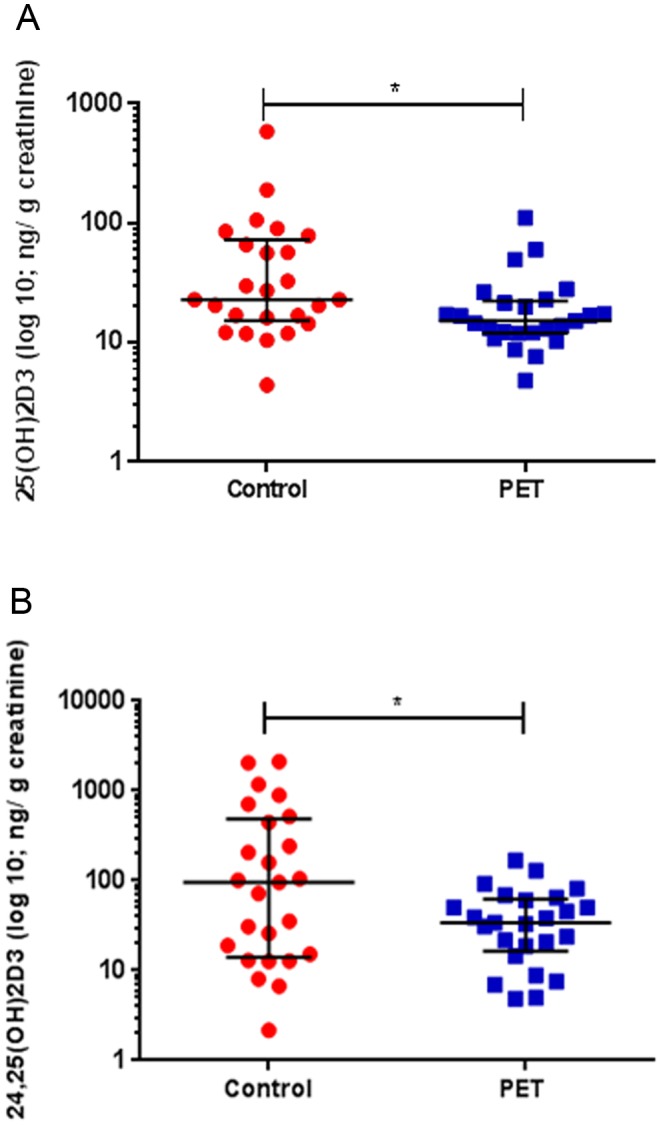
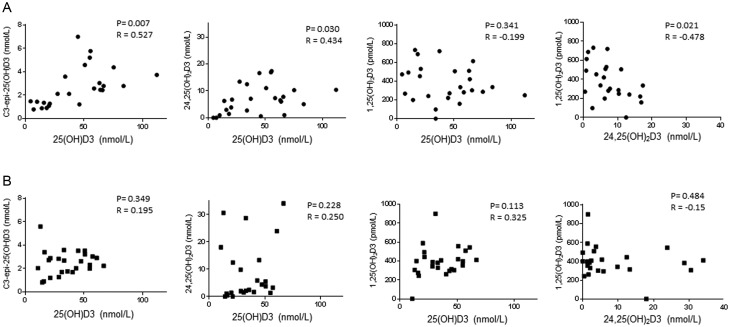
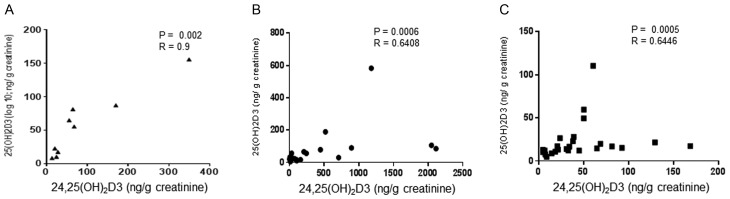
Vitamin D deficiency is common in pregnant women and may contribute to adverse events in pregnancy such as preeclampsia (PET). To date, studies of vitamin D and PET have focused primarily on serum concentrations vitamin D, 25-hydroxyvitamin D3 (25(OH)D3) later in pregnancy. The aim here was to determine whether a more comprehensive analysis of vitamin D metabolites earlier in pregnancy could provide predictors of PET. Using samples from the SCOPE pregnancy cohort, multiple vitamin D metabolites were quantified by liquid chromatography-tandem mass spectrometry in paired serum and urine prior to the onset of PET symptoms. Samples from 50 women at pregnancy week 15 were analysed, with 25 (50%) developing PET by the end of the pregnancy and 25 continuing with uncomplicated pregnancy. Paired serum and urine from non-pregnant women ( = 9) of reproductive age were also used as a control. Serum concentrations of 25(OH)D3, 25(OH)D2, 1,25(OH)D3, 24,25(OH)D3 and 3-epi-25(OH)D3 were measured and showed no significant difference between women with uncomplicated pregnancies and those developing PET. As previously reported, serum 1,25(OH)D3 was higher in all pregnant women (in the second trimester), but serum 25(OH)D2 was also higher compared to non-pregnant women. In urine, 25(OH)D3 and 24,25(OH)D3 were quantifiable, with both metabolites demonstrating significantly lower ( < 0.05) concentrations of both of these metabolites in those destined to develop PET. These data indicate that analysis of urinary metabolites provides an additional insight into vitamin D and the kidney, with lower urinary 25(OH)D3 and 24,25(OH)D3 excretion being an early indicator of a predisposition towards developing PET.
维生素D缺乏在孕妇中很常见,可能会导致孕期不良事件,如先兆子痫(PET)。迄今为止,关于维生素D与PET的研究主要集中在妊娠后期血清维生素D、25-羟基维生素D3(25(OH)D3)的浓度上。本研究的目的是确定在妊娠早期对维生素D代谢物进行更全面的分析是否能提供PET的预测指标。利用SCOPE妊娠队列中的样本,在PET症状出现之前,通过液相色谱-串联质谱法对配对的血清和尿液中的多种维生素D代谢物进行定量分析。分析了妊娠第15周时50名女性的样本,其中25名(50%)在妊娠结束时发生了PET,25名继续妊娠且无并发症。来自育龄非妊娠女性(n = 9)的配对血清和尿液也用作对照。测量了血清中25(OH)D3、25(OH)D2、1,25(OH)D3、24,25(OH)D3和3-表-25(OH)D3的浓度,结果显示无并发症妊娠女性与发生PET的女性之间无显著差异。如先前报道,所有孕妇(孕中期)的血清1,25(OH)D3均较高,但与非妊娠女性相比,血清25(OH)D2也较高。在尿液中,25(OH)D3和24,25(OH)D3是可定量的,这两种代谢物在注定要发生PET的女性中的浓度均显著较低(P < 0.05)。这些数据表明,对尿液代谢物的分析为维生素D和肾脏提供了额外的见解,尿液中25(OH)D3和24,25(OH)D3排泄量较低是易发生PET的早期指标。