Wehrmeister Fernando C, da Silva Inácio Crochemore M, Barros Aluisio J D, Victora Cesar G
International Center for Equity in Health, Federal University of Pelotas, Pelotas, Brazil.
BMJ Glob Health. 2017 Oct 31;2(4):e000437. doi: 10.1136/bmjgh-2017-000437. eCollection 2017.
To assess associations between national characteristics, including governance indicators, with a proxy for universal health coverage in reproductive, maternal, newborn and child health (RMNCH).
Ecological analysis based on data from national standardised cross-sectional surveys.
Low-income and middle-income countries with a Demographic and Health Survey or a Multiple Indicator Cluster Survey since 2005.
1 246 710 mothers and 2 129 212 children from 80 national surveys.
Gross domestic product (GDP), country surface area, population, Gini index and six governance indicators (control of corruption, political stability and absence of violence, government effectiveness, regulatory quality, rule of law, and voice and accountability).
Levels and inequality in the composite coverage index (CCI), a weighted average of eight RMNCH interventions. Relative and absolute inequalities were measured through the concentration index (CIX) and slope index of inequality (SII) for CCI, respectively.
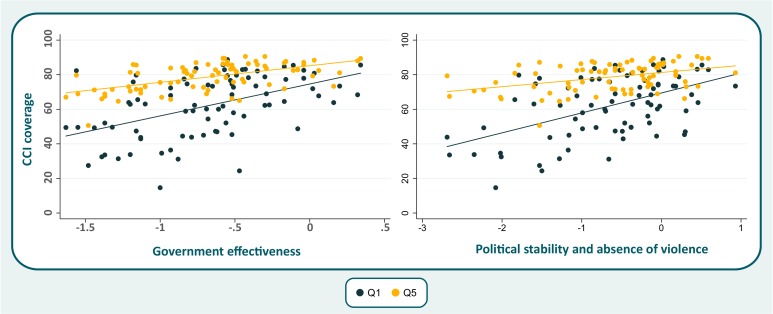
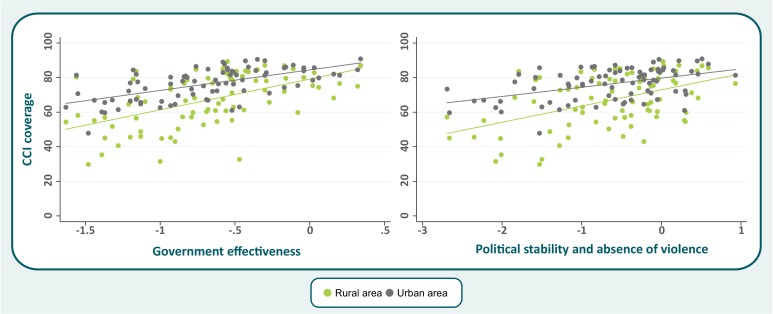
The average values of CCI (70.5% (SD=13.3)), CIX (5.3 (SD=5.1)) and mean slope index (19.8 (SD=14.7)) were calculated. In the unadjusted analysis, all governance variables and GDP were positively associated with the CCI and negatively with inequalities. Country surface showed inverse associations with both inequality indices. After adjustment, among the governance indicators, only political stability and absence of violence was directly related to CCI (β=6.3; 95% CI 3.6 to 9.1; p<0.001) and inversely associated with relative (CIX; β=-1.4; 95% CI -2.4 to -0.4; p=0.007) and absolute (SII; β=-5.3; 95% CI -8.9 to -1.7; p=0.005) inequalities. The strongest associations with governance indicators were found in the poorest wealth quintile. Similar patterns were observed for GDP. Country surface area was inversely related to inequalities on CCI.
Levels and equity in RMNCH interventions are positively associated with political stability and absence of violence, and with GDP, and inversely associated with country surface area.
评估包括治理指标在内的国家特征与生殖、孕产妇、新生儿和儿童健康(RMNCH)方面全民健康覆盖指标之间的关联。
基于国家标准横断面调查数据的生态分析。
2005年以来开展过人口与健康调查或多指标类集调查的低收入和中等收入国家。
来自80项国家调查的1246710名母亲和2129212名儿童。
国内生产总值(GDP)、国家面积、人口、基尼指数以及六项治理指标(控制腐败、政治稳定与无暴力、政府效能、监管质量、法治以及发言权与问责制)。
综合覆盖指数(CCI)的水平和不平等情况,该指数是八项RMNCH干预措施的加权平均值。通过CCI的集中指数(CIX)和不平等斜率指数(SII)分别衡量相对不平等和绝对不平等。
计算出CCI的平均值为70.5%(标准差=13.3),CIX为5.3(标准差=5.1),平均斜率指数为19.8(标准差=14.7)。在未调整分析中,所有治理变量和GDP均与CCI呈正相关,与不平等呈负相关。国家面积与两个不平等指数均呈负相关。调整后,在治理指标中,只有政治稳定与无暴力与CCI直接相关(β=6.3;95%置信区间3.6至9.1;p<0.001),与相对不平等(CIX;β=-1.4;95%置信区间-2.4至-0.4;p=0.007)和绝对不平等(SII;β=-5.3;95%置信区间-8.9至-1.7;p=0.005)呈负相关。在最贫困的财富五分位数中发现与治理指标的关联最强。GDP也观察到类似模式。国家面积与CCI的不平等呈负相关。
RMNCH干预措施的水平和公平性与政治稳定和无暴力以及GDP呈正相关,与国家面积呈负相关。