Department of Psychiatry and Biobehavioral Sciences, University of California Los Angeles, Los Angeles, CA, USA.
Department of Psychiatry and Biobehavioral Sciences, University of California Los Angeles, Los Angeles, CA, USA.
Parkinsonism Relat Disord. 2018 Feb;47:3-7. doi: 10.1016/j.parkreldis.2017.12.006. Epub 2017 Dec 9.
Past studies have shown that a large portion of individuals with Parkinson's disease (PD) and mild cognitive impairment (MCI) will revert to a cognitively intact (CI) status in the future. Aging studies have shown that individuals who revert from MCI to CI are at increased risk for reconverting to MCI or dementia in the future. The current study examined if individuals who revert from PD-mild cognitive impairment (PD-MCI) to CI will be at increased risk for future PD-MCI and Parkinson's disease dementia (PDD).
The study utilized data from the Parkinson's Progression Markers Initiative (PPMI). The sample included 364 newly diagnosed PD participants who were followed annually for up to 4 years. Based on the first and second assessments, we identified individuals who were CI at each assessment (CI-Stable) and individuals who were PD-MCI at baseline but then reverted to CI (Reversion). Analyses examined if participants in the Reversion group were at greater risk, relative to the CI-Stable group, for cognitive impairment at future assessments.
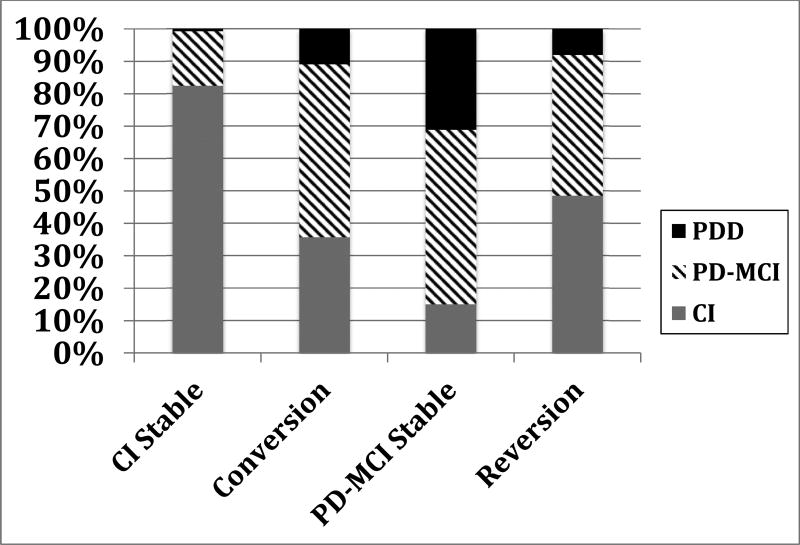
Participants in the Reversion group were at greater risk for future cognitive impairment (PD-MCI or PDD) at the 2nd, 3rd and 4th annual follow-up, relative to the CI-Stable group. The Reversion group continued to be at increased risk for future cognitive impairment when adjusting for age, gender, education, depressive symptoms, and motor severity.
A large proportion of individuals with PD-MCI will not show evidence of cognitive impairment within a year. However, these "reverters" continue to be at risk for future development of cognitive impairment.
过去的研究表明,很大一部分帕金森病(PD)和轻度认知障碍(MCI)患者在未来会恢复到认知正常(CI)状态。衰老研究表明,从 MCI 恢复到 CI 的个体未来患 MCI 或痴呆的风险增加。本研究探讨了从 PD-MCI 恢复到 CI 的个体是否会增加未来 PD-MCI 和帕金森病痴呆(PDD)的风险。
本研究利用了帕金森病进展标志物倡议(PPMI)的数据。样本包括 364 名新诊断的 PD 参与者,他们每年接受一次随访,最长可达 4 年。根据第一和第二次评估,我们确定了每个评估时处于 CI 稳定状态的个体(CI-Stable)和基线时患有 PD-MCI 但随后恢复到 CI 的个体(Reversion)。分析检查了 Reversion 组相对于 CI-Stable 组,在未来评估中是否存在更高的认知障碍风险。
Reversion 组在第 2、3 和 4 年的年度随访中,未来认知障碍(PD-MCI 或 PDD)的风险高于 CI-Stable 组。当调整年龄、性别、教育、抑郁症状和运动严重程度时,Reversion 组仍有较高的未来认知障碍风险。
很大一部分 PD-MCI 患者在一年内不会出现认知障碍的证据。然而,这些“逆转者”仍有未来发生认知障碍的风险。