Datta Sibnarayan, Budhauliya Raghvendra, Das Bidisha, Gopalakrishnan Reji, Sharma Sonika, Chatterjee Soumya, Raju P Srinivas, Veer Vijay
Molecular Virology Laboratory, Biotechnology Division, Defence Research Laboratory (DRL-DRDO), Tezpur, 784 001, India.
Vector Management Division, Defence Research & Development Establishment (DRDE-DRDO), Gwalior, 474 002, India.
Sci Rep. 2017 Dec 12;7(1):17361. doi: 10.1038/s41598-017-17680-9.
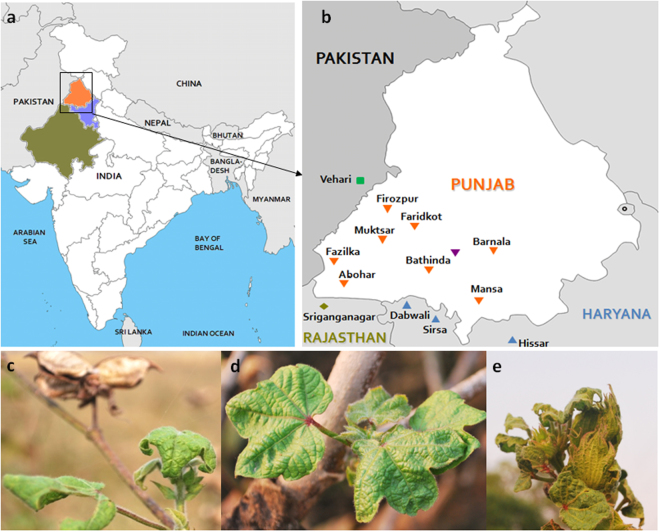
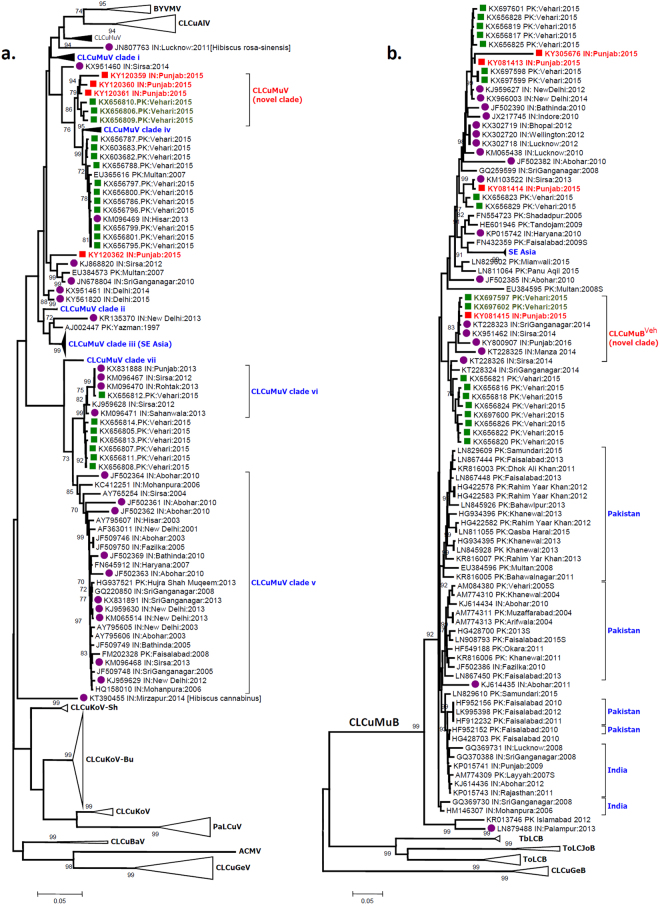
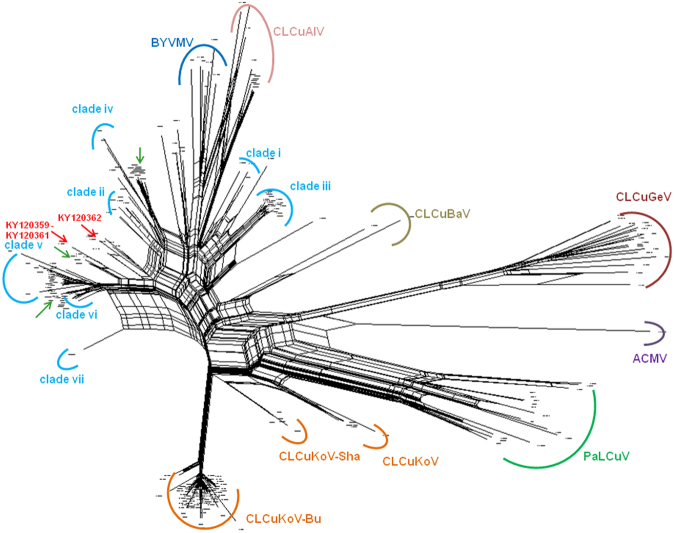
Cotton leaf curl disease (CLCuD) outbreaks caused by CLCuD associated begomoviruses (CABs) significantly constrain cotton production in India and Pakistan. In comparison to the CABs circulating in Pakistan, molecular epidemiology, evolution and recombination patterns of CABs circulating in India are less studied. In this work, we characterized CAB complex sequences obtained from the most recent outbreak (Punjab, India, 2015), and rigorously analyzed them with reference to GenBank sequences, submitted from India, Pakistan and other neighbouring countries, using contemporary bioinformatics approaches. In this manuscript, we illustrate the detection of a recombinant, phylogenetically distinct clade of Cotton leaf curl Multan virus (CLCuMuV), suggesting rebound of CLCuMuV in this region. Interestingly, we could not detect Cotton leaf curl Kokhran virus-Burewala strain (CLCuKoV-Bu), which was prevalent in this region, until now. Our study thus indicates substitution of the 'virulent resistance breaking' CLCuKoV-Bu by the re-emerging CLCuMuV recombinants. Our findings corroborate with that of a very recent study from Pakistan and we here discuss epidemiological links between the CAB complexes reported in these two studies. Taken together, these observations signify a shifting epidemiology of CABs, and seem to correlate with the recent prediction of the 'third epidemic' of CLCuD in the Indian subcontinent.
由棉花曲叶病相关双生病毒(CABs)引起的棉花曲叶病(CLCuD)爆发严重制约了印度和巴基斯坦的棉花生产。与在巴基斯坦传播的CABs相比,对在印度传播的CABs的分子流行病学、进化和重组模式的研究较少。在这项工作中,我们对从最近一次爆发(2015年,印度旁遮普邦)中获得的CAB复合体序列进行了特征分析,并使用当代生物信息学方法,参照从印度、巴基斯坦和其他邻国提交到GenBank的序列对其进行了严格分析。在本手稿中,我们阐述了对一种重组的、系统发育上独特的棉花曲叶木尔坦病毒(CLCuMuV)进化枝的检测,表明该地区CLCuMuV出现反弹。有趣的是,直到现在我们都未能检测到在该地区曾普遍存在的棉花曲叶科赫兰病毒-布勒瓦拉株(CLCuKoV-Bu)。因此,我们的研究表明,重新出现的CLCuMuV重组体取代了“具有毒力且能打破抗性”的CLCuKoV-Bu。我们的研究结果与巴基斯坦最近的一项研究结果相符,并且我们在此讨论了这两项研究中报告的CAB复合体之间的流行病学联系。综上所述,这些观察结果表明CABs的流行病学正在发生变化,并且似乎与印度次大陆最近对CLCuD“第三次流行”的预测相关。