Reder Maren, Kolip Petra
Department of Prevention and Health Promotion, School of Public Health, Bielefeld University, Bielefeld, Germany.
Institute of Psychology, University of Hildesheim, Hildesheim, Germany.
PLoS One. 2017 Dec 13;12(12):e0189148. doi: 10.1371/journal.pone.0189148. eCollection 2017.
Decision aids can support informed choice in mammography screening, but for the German mammography screening programme no systematically evaluated decision aid exists to date. We developed a decision aid for women invited to this programme for the first time based on the criteria of the International Patient Decision Aids Standards Collaboration.
To determine whether a decision aid increases informed choice about mammography screening programme participation.
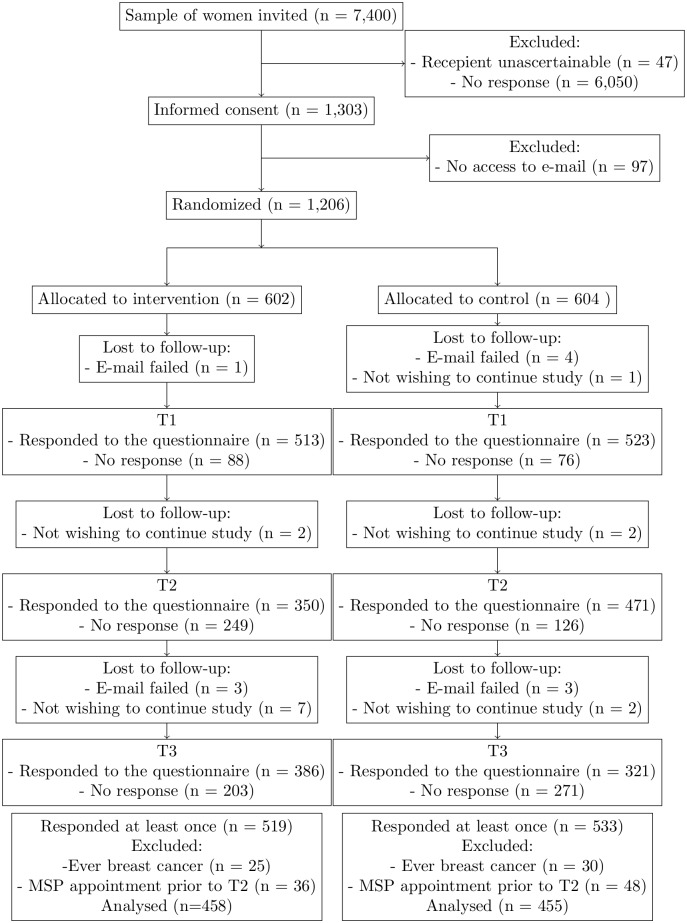
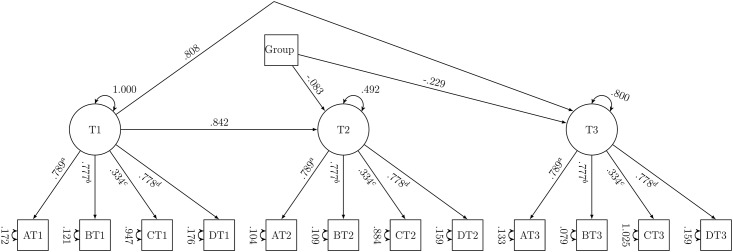
A representative sample of 7,400 women aged 50 was drawn from registration offices in Westphalia-Lippe, Germany. Women were randomised to receive usual care (i.e., the standard information brochure sent with the programme's invitation letter) or the decision aid. Data were collected online at baseline, post-intervention, and 3 months follow-up. The primary outcome was informed choice. Secondary outcomes were the constituents of informed choice (knowledge, attitude, intention/uptake), decisional conflict, decision regret, and decision stage. Outcomes were analysed using latent structural equation models and χ2-tests.
1,206 women participated (response rate of 16.3%). The decision aid increased informed choice. Women in the control group had lower odds to make an informed choice at post-intervention (OR 0.26, 95% CI 0.18-0.37) and at follow-up (OR 0.66, 95% CI 0.46-0.94); informed choices remained constant at 30%. This was also reflected in lower knowledge and more decisional conflict. Post-intervention, the uptake intention was higher in the control group, whereas the uptake rate at follow-up was similar. Women in the control group had a more positive attitude at follow-up than women receiving the decision aid. Decision regret and decision stage were not influenced by the intervention.
This paper describes the first systematic evaluation of a newly developed decision aid for the German mammography screening programme in a randomised controlled trial. Our decision aid proved to be an effective tool to enhance the rate of informed choice and was made accessible to the public.
German Clinical Trials Register DRKS00005176.
决策辅助工具可支持在乳腺钼靶筛查中做出明智选择,但对于德国乳腺钼靶筛查项目,目前尚无经过系统评估的决策辅助工具。我们基于国际患者决策辅助工具标准协作组织的标准,为首次受邀参加该项目的女性开发了一种决策辅助工具。
确定一种决策辅助工具是否能增加关于参与乳腺钼靶筛查项目的明智选择。
从德国威斯特法伦 - 利珀的登记办公室抽取了7400名50岁女性的代表性样本。女性被随机分为接受常规护理组(即随项目邀请信发送的标准信息手册)或决策辅助工具组。在基线、干预后和3个月随访时通过在线方式收集数据。主要结局是明智选择。次要结局是明智选择的构成要素(知识、态度、意图/接受情况)、决策冲突、决策后悔和决策阶段。使用潜在结构方程模型和χ²检验分析结局。
1206名女性参与(应答率为16.3%)。决策辅助工具增加了明智选择。对照组女性在干预后(比值比0.26,95%置信区间0.18 - 0.37)和随访时(比值比0.66,95%置信区间0.46 - 0.94)做出明智选择的几率较低;明智选择率保持在30%不变。这也反映在知识水平较低和决策冲突较多上。干预后,对照组的接受意图较高,而随访时的接受率相似。随访时,对照组女性的态度比接受决策辅助工具的女性更积极。决策后悔和决策阶段不受干预影响。
本文描述了在一项随机对照试验中对德国乳腺钼靶筛查项目新开发的决策辅助工具进行的首次系统评估。我们的决策辅助工具被证明是提高明智选择率的有效工具,并已向公众提供。
德国临床试验注册中心DRKS00005176 。