School of Public Health, Faculty of Medicine and Health, The University of Sydney, Sydney, NSW, Australia.
Wiser Healthcare: A Research Collaboration for Reducing Overdiagnosis and Overtreatment, The University of Sydney, Sydney, NSW, Australia.
J Natl Cancer Inst. 2021 Nov 2;113(11):1523-1530. doi: 10.1093/jnci/djab083.
Supporting well-informed decisions about breast cancer screening requires communicating that inconsequential disease may be detected, leading to overdiagnosis and overtreatment. Having previously shown that telling women about overdetection improved informed choice, we investigated effects on screening knowledge and participation over 2 years.
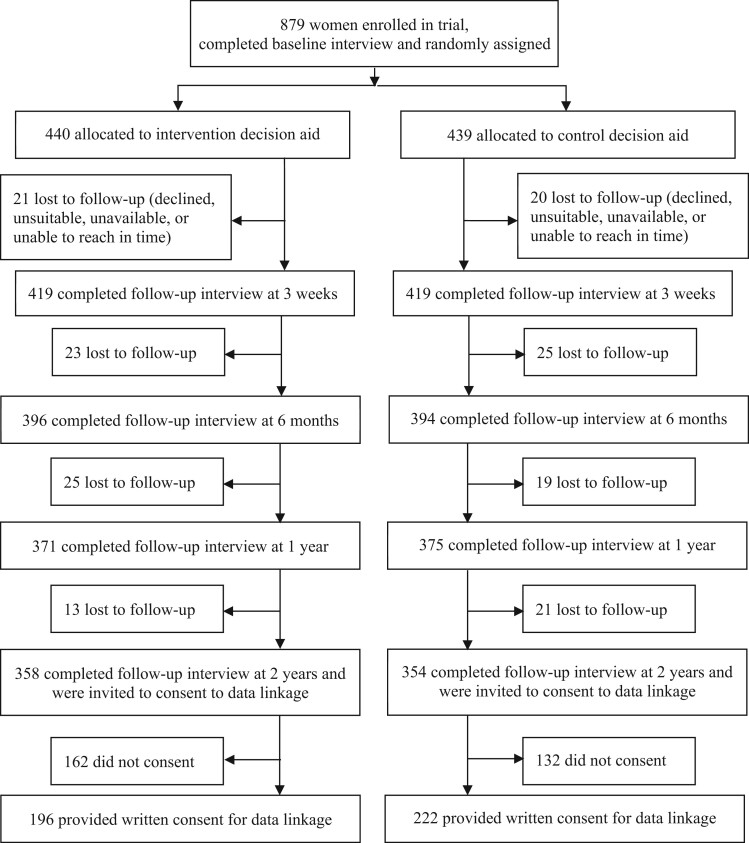
We conducted a community-based, parallel-group, randomized controlled trial in Australia. Participants were women aged 48-50 years, without personal or strong family history of breast cancer, who had not undergone mammography in the past 2 years. We randomly assigned 879 women to receive the intervention decision aid (evidence-based information on overdetection, breast cancer mortality reduction, and false-positives) or control decision aid (identical but without overdetection information). We interviewed 838 women postintervention and recontacted them for follow-up at 6 months and 1 and 2 years. Main outcomes for this report are screening knowledge and participation.
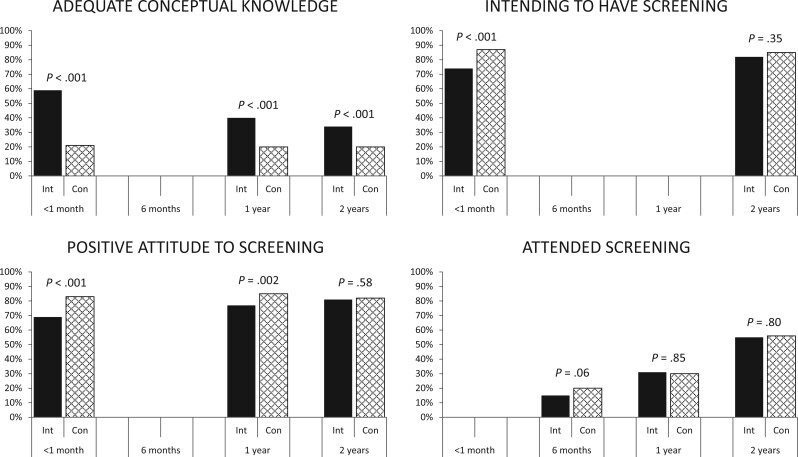
We interviewed 790, 746, and 712 participants at 6 months, 1, and 2 years, respectively. The intervention group demonstrated superior knowledge throughout follow-up. After 2 years, conceptual knowledge was adequate in 123 (34.4%) of 358 women in the intervention group compared with 71 (20.1%) of 354 control participants(odds ratio = 2.04, 95% confidence interval = 1.46 to 2.85). Groups were similar in total screening participation (200 [55.1%] vs 204 [56.0%]; = 0.97, 95% confidence interval = 0.73 to 1.29).
A brief decision aid produced lasting improvement in women's understanding of potential consequences of screening, including overdetection, without changing participation rates. These findings support the use of decision aids for breast cancer screening.
支持有关乳腺癌筛查的知情决策需要说明可能会检测到无足轻重的疾病,从而导致过度诊断和过度治疗。我们之前已经表明,告知女性关于过度检测的信息可以改善知情选择,因此我们在 2 年的时间里研究了其对筛查知识和参与度的影响。
我们在澳大利亚进行了一项基于社区的、平行组、随机对照试验。参与者是年龄在 48-50 岁之间、没有个人或强烈家族乳腺癌病史且过去 2 年内未接受过乳房 X 光检查的女性。我们将 879 名女性随机分配至接受干预决策辅助工具(关于过度检测、乳腺癌死亡率降低和假阳性的循证信息)或对照决策辅助工具(内容相同但不包括过度检测信息)。我们在干预后对 838 名女性进行了访谈,并在 6 个月、1 年和 2 年时对她们进行了随访。本报告的主要结局是筛查知识和参与度。
我们分别在 6 个月、1 年和 2 年时采访了 790、746 和 712 名参与者。在整个随访过程中,干预组表现出更好的知识水平。2 年后,在干预组的 358 名女性中,有 123 名(34.4%)对概念性知识有足够的了解,而在对照组的 354 名女性中,有 71 名(20.1%)(比值比=2.04,95%置信区间=1.46 至 2.85)。两组的总筛查参与率相似(200 [55.1%] 与 204 [56.0%];=0.97,95%置信区间=0.73 至 1.29)。
简短的决策辅助工具使女性对筛查的潜在后果(包括过度检测)的理解得到了持久的改善,而不会改变参与率。这些发现支持使用决策辅助工具进行乳腺癌筛查。