James P. Wilmot Cancer Institute, University of Rochester Medical Center, Rochester, NY, USA.
Cancer Control Center, Department of Surgery, University of Rochester Medical Center, 265 Crittenden Blvd., Box CU 420658, Rochester, NY, 14642, USA.
Support Care Cancer. 2018 Apr;26(4):1019-1028. doi: 10.1007/s00520-017-4013-0. Epub 2017 Dec 14.
Over half of all cancer patients receiving taxane-, platinum-, or vinca alkaloid-based chemotherapy experience chemotherapy-induced peripheral neuropathy (CIPN), which includes numbness, tingling, pain, cold sensitivity, and motor impairment in the hands and feet. CIPN is a dose-limiting toxicity, potentially increasing mortality. There are no FDA-approved drugs to treat CIPN, and behavioral interventions such as exercise are promising yet understudied. This secondary analysis of our nationwide phase III randomized controlled trial of exercise for fatigue examines (1) effects of exercise on CIPN symptoms, (2) factors that predict CIPN symptoms, and (3) factors that moderate effects of exercise on CIPN symptoms.
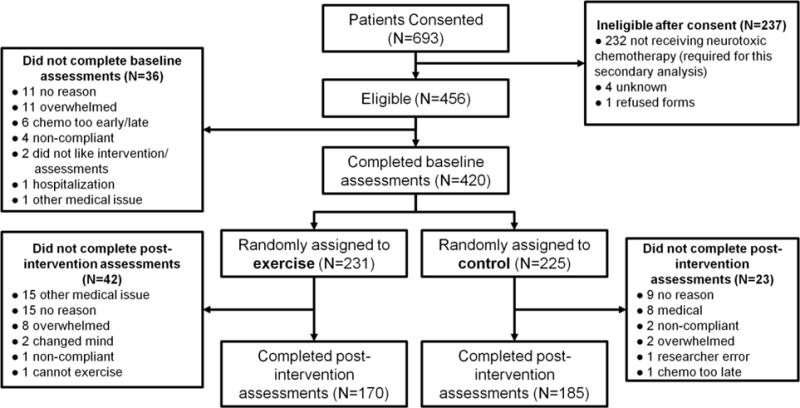
Cancer patients (N = 355, 56 ± 11 years, 93% female, 79% breast cancer) receiving taxane-, platinum-, or vinca alkaloid-based chemotherapy were randomized to chemotherapy or chemotherapy plus Exercise for Cancer Patients (EXCAP©®). EXCAP is a standardized, individualized, moderate-intensity, home-based, six-week progressive walking and resistance exercise program. Patients reported CIPN symptoms of numbness and tingling and hot/coldness in hands/feet (0-10 scales) pre- and post-intervention. We explored baseline neuropathy, sex, age, body mass index, cancer stage, and cancer type as possible factors associated with CIPN symptoms and exercise effectiveness.
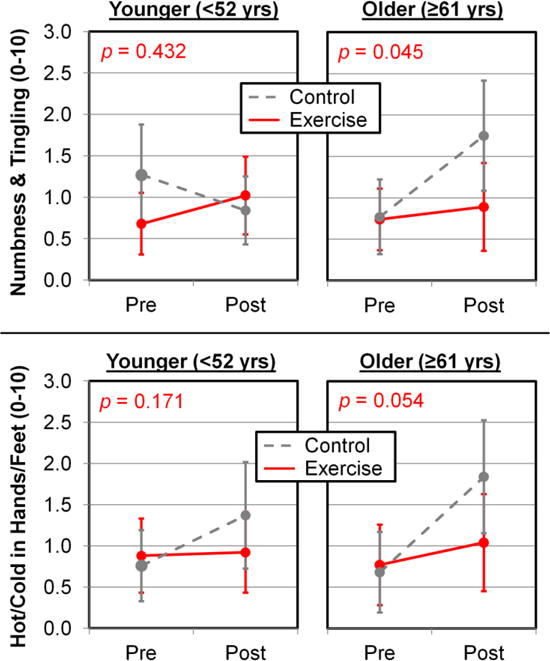
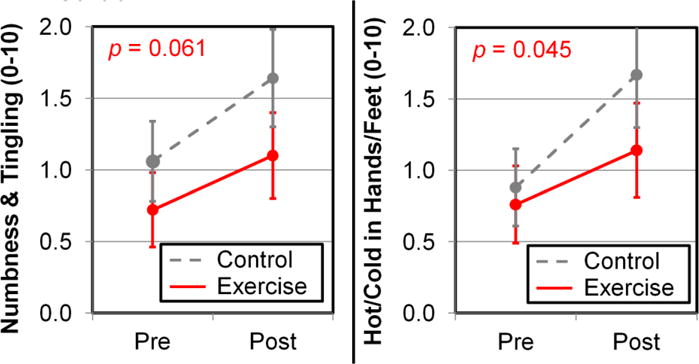
Exercise reduced CIPN symptoms of hot/coldness in hands/feet (-0.46 units, p = 0.045) and numbness and tingling (- 0.42 units, p = 0.061) compared to the control. Exercise reduced CIPN symptoms more for patients who were older (p = 0.086), male (p = 0.028), or had breast cancer (p = 0.076).
Exercise appears to reduce CIPN symptoms in patients receiving taxane-, platinum-, or vinca alkaloid-based chemotherapy. Clinicians should consider prescribing exercise for these patients.
Clinical Trials.gov , # NCT00924651, http://www.clinicaltrials.gov .
超过一半接受紫杉烷、铂类或长春碱类生物碱化疗的癌症患者会出现化疗引起的周围神经病(CIPN),其表现为手脚麻木、刺痛、疼痛、冷感和运动障碍。CIPN 是一种剂量限制毒性,可能会增加死亡率。目前尚无 FDA 批准的药物可治疗 CIPN,而运动等行为干预措施虽然很有前景,但研究不足。本研究对我们全国性的 III 期随机对照试验中关于运动治疗疲劳的二次分析,旨在:(1)研究运动对 CIPN 症状的影响;(2)预测 CIPN 症状的因素;(3)探讨运动对 CIPN 症状影响的调节因素。
接受紫杉烷、铂类或长春碱类生物碱化疗的癌症患者(N=355,56±11 岁,93%为女性,79%为乳腺癌)被随机分配至化疗组或化疗加癌症患者运动(EXCAP©®)组。EXCAP 是一种标准化、个体化、中等强度、基于家庭的六周渐进式步行和抗阻运动方案。患者在干预前后报告手脚麻木和刺痛以及手/脚冷热感(0-10 分)的 CIPN 症状。我们探讨了基线神经病变、性别、年龄、体重指数、癌症分期和癌症类型作为与 CIPN 症状和运动效果相关的可能因素。
与对照组相比,运动降低了 CIPN 症状的手/脚冷热感(-0.46 单位,p=0.045)和麻木和刺痛感(-0.42 单位,p=0.061)。对于年龄较大(p=0.086)、男性(p=0.028)或患有乳腺癌(p=0.076)的患者,运动对 CIPN 症状的改善作用更大。
运动似乎可减轻接受紫杉烷、铂类或长春碱类生物碱化疗的患者的 CIPN 症状。临床医生应为这些患者开具运动处方。
ClinicalTrials.gov,#NCT00924651,http://www.clinicaltrials.gov。