Meuwly Cyrill, Chowdhury Tumul, Gelpi Ricardo, Erne Paul, Rosemann Thomas, Schaller Bernhard
Department of Biomedicine, University Hospital Basel, Basel, Switzerland Department of Anesthesiology and Perioperative Medicine, University of Manitoba, Winnipeg, Canada Department of Pathology, Institute of Cardiovascular Physiopathology, University of Buenos Aires, Buenos Aires, Argentina Department of Primary Care, University of Zurich, Zurich, Switzerland.
Medicine (Baltimore). 2017 Dec;96(49):e9033. doi: 10.1097/MD.0000000000009033.
The trigeminocardiac reflex (TCR) is defined as sudden onset of parasympathetic dysrhythmias including hemodynamic irregularities, apnea, and gastric hypermotility during stimulation of sensory branches of the trigeminal nerve. Since the first description of the TCR 1999, there is an ongoing discussion about a more flexible than the existing clinical definition. Aim of this work was to create a clinical surrogate definition through a systematic review of the literature.
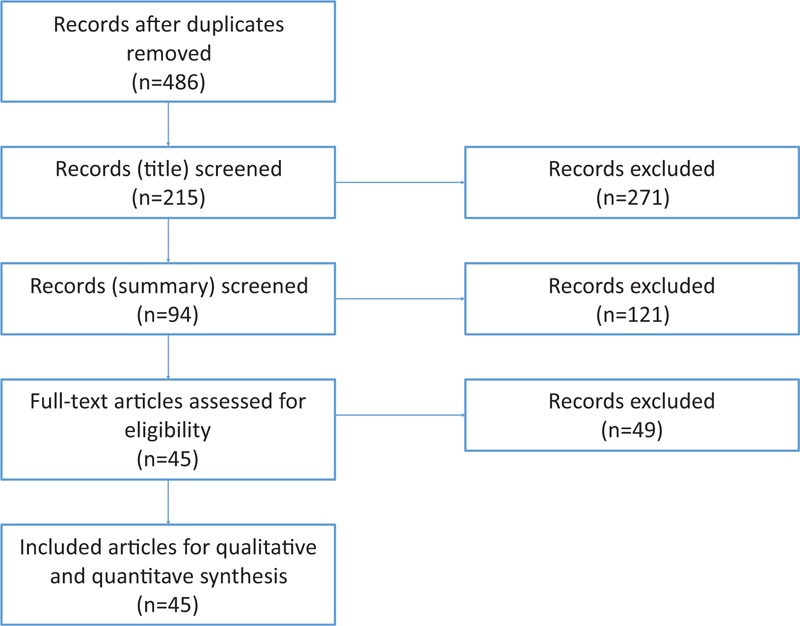
In this meta-analysis study, literature about TCR occurrences was, according to the Preferred Reporting Items for Systematic Reviews and Meta-Analysis statement, systematically identified through various search engines including PubMed (Medline), Embase (Ovid SP), and ISI Web of Sciences databases from January 2005 to August 2015. TCR was defined as a drop of heart rate (HR) below 60 bpm or 20% to the baseline. We extracted detailed data about hemodynamic changes and searched for connections between arterial blood pressure (BP) and HR changes during such episodes.
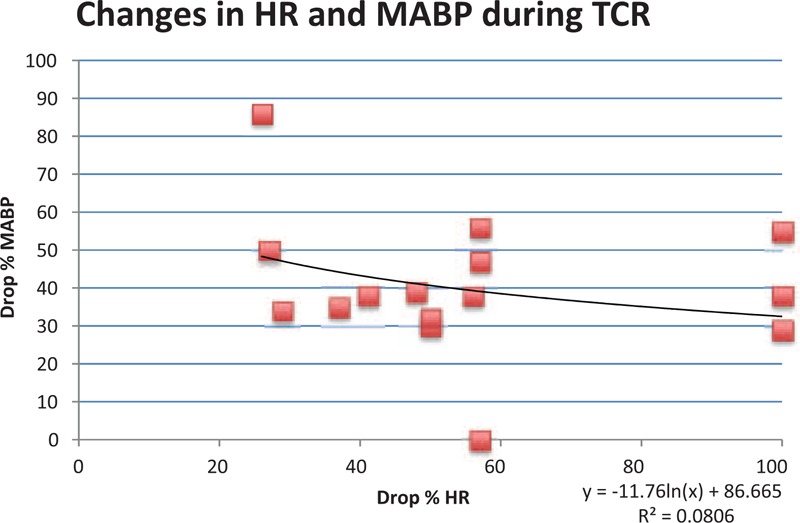
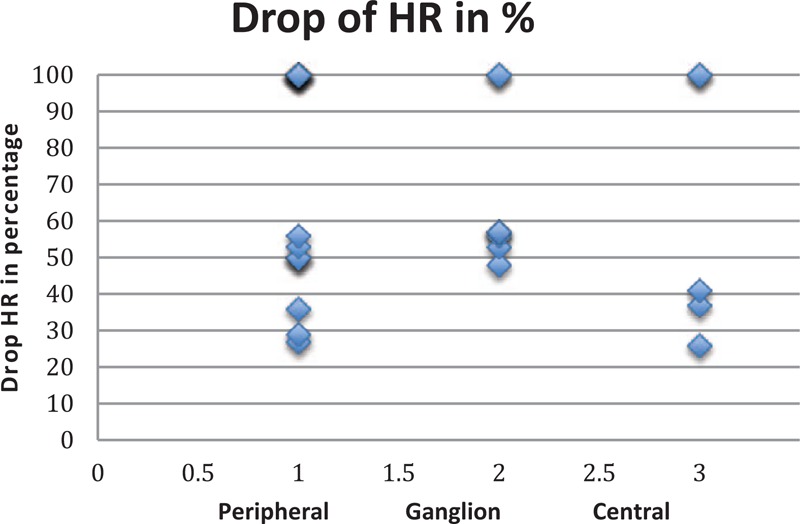
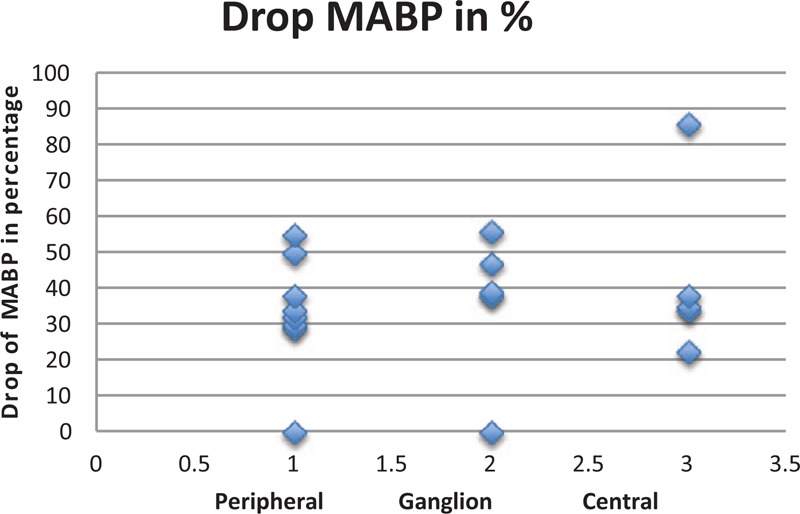
Overall 45 studies harboring 57 patients were included in the study but only 32 patients showed sufficient data for final analyze. HR showed a nonlinear behavior with a "tipping point" phenomena that differs in variance from the central/peripheral (20-30% drop) to ganglion (40-49% drop). BP showed a linear behavior with a "central limit" phenomena not differing in variance in the whole subgroup (30-39% drop). An analyzation of the correlation between BP and HR showed a trend to a linear correlation.
We can show for the first time that HR is the dominant variable in the TCR and present a new surrogate definition model. This model and the role of BP must be better investigated in further studies.
三叉神经心脏反射(TCR)被定义为在刺激三叉神经感觉分支期间突然出现的副交感神经节律失常,包括血流动力学异常、呼吸暂停和胃动力亢进。自1999年首次描述TCR以来,关于其临床定义比现有定义更灵活的讨论一直在进行。本研究的目的是通过对文献的系统综述创建一个临床替代定义。
在这项荟萃分析研究中,根据系统评价和荟萃分析的首选报告项目声明,通过包括PubMed(Medline)、Embase(Ovid SP)和ISI Web of Sciences数据库在内的各种搜索引擎,从2005年1月至2015年8月系统识别有关TCR发生情况的文献。TCR被定义为心率(HR)下降至60次/分以下或比基线下降20%。我们提取了有关血流动力学变化的详细数据,并寻找在此类发作期间动脉血压(BP)和HR变化之间的联系。
该研究共纳入了45项研究中的57例患者,但只有32例患者有足够的数据进行最终分析。HR表现出非线性行为,具有“临界点”现象,其方差在中枢/外周(下降20 - 30%)和神经节(下降40 - 49%)之间有所不同。BP表现出线性行为,具有“中心极限”现象,在整个亚组中的方差没有差异(下降30 - 39%)。对BP和HR之间相关性的分析显示出线性相关趋势。
我们首次表明HR是TCR中的主导变量,并提出了一种新的替代定义模型。该模型以及BP的作用必须在进一步研究中进行更好的探究。