Chen Shicheng, Blom Jochen, Loch Thomas P, Faisal Mohamed, Walker Edward D
Department of Microbiology and Molecular Genetics, Michigan State University, East Lansing, MI, United States.
Bioinformatics and Systems Biology, Justus-Liebig-University, Giessen, Germany.
Front Microbiol. 2017 Nov 30;8:2339. doi: 10.3389/fmicb.2017.02339. eCollection 2017.
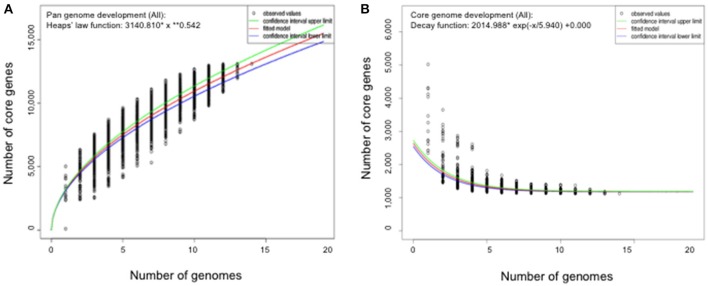
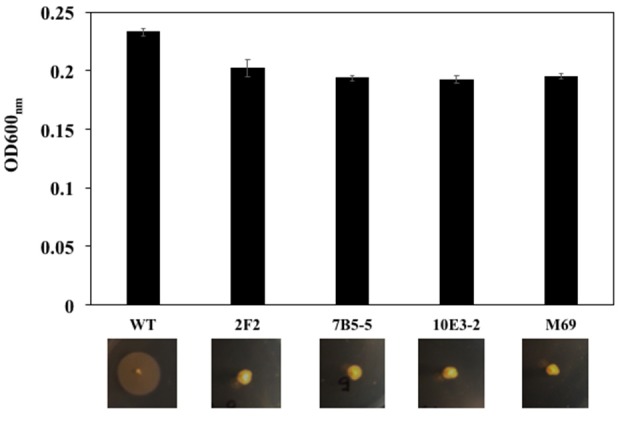
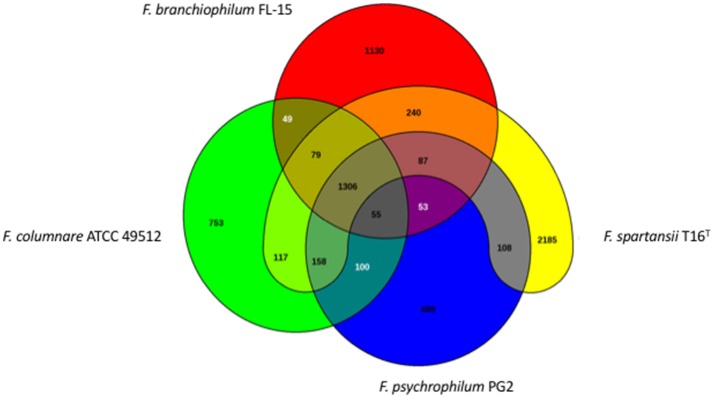
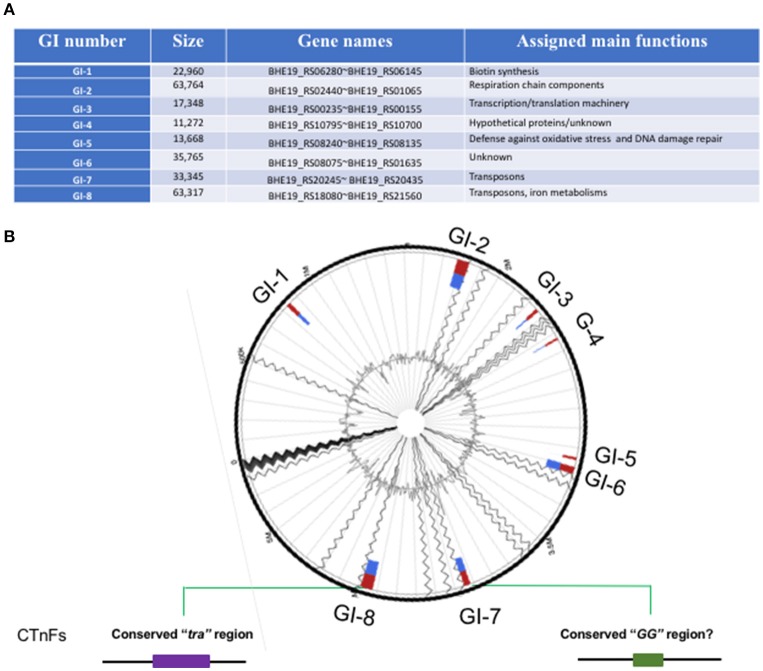
strain T16 was isolated from a disease outbreak in hatchery-reared Chinook salmon () fingerlings. To gain insight into its genomic content, structure and virulence pathogenesis factors, comparative genome analyses were performed using genomes from environmental and virulent strains. shared low average nucleotide identity (ANI) to well-known fish-pathogenic flavobacteria (e.g., , and ), indicating that it is a new and emerging fish pathogen. The genome in T16 had a length of 5,359,952 bp, a GC-content 35.7%, and 4,422 predicted protein-coding sequences. core genome analysis showed that the number of shared genes decreased with the addition of input genomes and converged at 1182 genes. At least 8 genomic islands and 5 prophages were predicted in T16. At least 133 virulence factors associated with virulence in pathogenic bacteria were highly conserved in T16. Furthermore, genes linked to virulence in other bacterial species (e.g., those encoding for a type IX secretion system, collagenase and hemolysin) were found in the genome of T16 and were conserved in most of the analyzed pathogenic . was resistant to ampicillin and penicillin, consistent with the presence of multiple genes encoding diverse lactamases and the penicillin-binding protein in the genome. To allow for future investigations into virulence , a transposon-based random mutagenesis strategy was attempted in T16 using pHimarEm1. Four putative gliding motility deficient mutants were obtained and the insertion sites of pHimarEm1 in the genome of these mutants were characterized. In total, study results clarify some of the mechanisms by which emerging flavobacterial fish pathogens may cause disease and also provide direly needed tools to investigate their pathogenesis.
菌株T16是从孵化场养殖的奇努克鲑鱼()幼鱼的一次疾病爆发中分离出来的。为了深入了解其基因组内容、结构和毒力致病因素,使用来自环境菌株和致病菌株的基因组进行了比较基因组分析。与著名的鱼类致病性黄杆菌(如、和)的平均核苷酸同一性(ANI)较低,表明它是一种新出现的鱼类病原体。T16中的基因组长度为5359952 bp,GC含量为35.7%,预测有4422个蛋白质编码序列。核心基因组分析表明,随着输入基因组的增加,共享基因的数量减少,并在1182个基因处趋于稳定。在T16中预测至少有8个基因组岛和5个原噬菌体。至少133个与病原菌毒力相关的毒力因子在T16中高度保守。此外,在T16的基因组中发现了与其他细菌物种毒力相关的基因(例如,那些编码IX型分泌系统、胶原酶和溶血素的基因),并且在大多数分析的致病菌株中是保守的。T16对氨苄青霉素和青霉素具有抗性,这与基因组中存在多个编码不同β-内酰胺酶和青霉素结合蛋白的基因一致。为了便于未来对T16的毒力进行研究,尝试使用pHimarEm1在T16中采用基于转座子的随机诱变策略。获得了四个假定的滑行运动缺陷突变体,并对这些突变体基因组中pHimarEm1的插入位点进行了表征。总的来说,研究结果阐明了新出现的黄杆菌鱼类病原体可能致病的一些机制,也提供了研究其发病机制急需的工具。