Department of Pharmacology and Toxicology, College of Pharmacy & Arizona Cancer Center, University of Arizona, Tucson, AZ 85724, USA.
Nutrients. 2017 Dec 18;9(12):1371. doi: 10.3390/nu9121371.
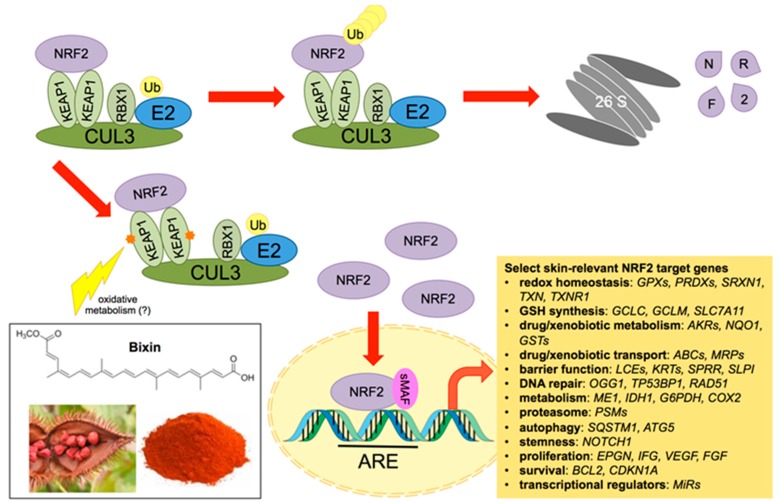
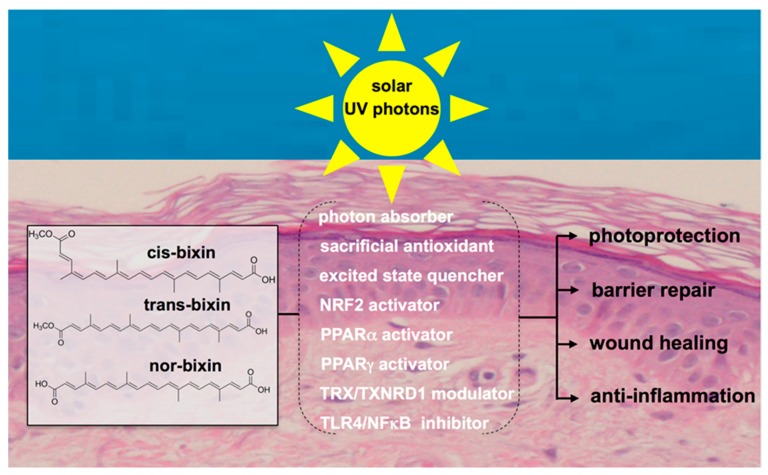
The transcription factor NRF2 (nuclear factor-E2-related factor 2) orchestrates major cellular defense mechanisms including phase-II detoxification, inflammatory signaling, DNA repair, and antioxidant response. Recent studies strongly suggest a protective role of NRF2-mediated gene expression in the suppression of cutaneous photodamage induced by solar UV (ultraviolet) radiation. The apocarotenoid bixin, a Food and Drug Administration (FDA)-approved natural food colorant (referred to as 'annatto') originates from the seeds of the achiote tree native to tropical America, consumed by humans since ancient times. Use of achiote preparations for skin protection against environmental insult and for enhanced wound healing has long been documented. We have recently reported that (i) bixin is a potent canonical activator of the NRF2-dependent cytoprotective response in human skin keratinocytes; that (ii) systemic administration of bixin activates NRF2 with protective effects against solar UV-induced skin damage; and that (iii) bixin-induced suppression of photodamage is observable in but not in SKH-1 mice confirming the NRF2-dependence of bixin-induced antioxidant and anti-inflammatory effects. In addition, bixin displays molecular activities as sacrificial antioxidant, excited state quencher, PPAR (peroxisome proliferator-activated receptor) α/γ agonist, and TLR (Toll-like receptor) 4/NFκB (nuclear factor kappa-light-chain-enhancer of activated B cells) antagonist, all of which might be relevant to the enhancement of skin barrier function and environmental stress protection. Potential skin photoprotection and photochemoprevention benefits provided by topical application or dietary consumption of this ethno-pharmacologically validated phytochemical originating from the Americas deserves further preclinical and clinical examination.
转录因子 NRF2(核因子-E2 相关因子 2)协调主要的细胞防御机制,包括 II 相解毒、炎症信号、DNA 修复和抗氧化反应。最近的研究强烈表明,NRF2 介导的基因表达在抑制太阳紫外线(UV)辐射引起的皮肤光损伤方面发挥着保护作用。阿朴胡萝卜素胭脂树橙,一种美国食品和药物管理局(FDA)批准的天然食用色素(称为“胭脂树橙”),来源于原产于热带美洲的胭脂树种子,自古以来就被人类食用。长期以来,人们一直使用胭脂树制剂来保护皮肤免受环境伤害和促进伤口愈合。我们最近报道:(i)胭脂树橙是人类皮肤角质形成细胞中 NRF2 依赖性细胞保护反应的有效经典激活剂;(ii)系统给予胭脂树橙可激活 NRF2,对太阳 UV 诱导的皮肤损伤具有保护作用;(iii)胭脂树橙诱导的光损伤抑制作用可在但不在 SKH-1 小鼠中观察到,证实了胭脂树橙诱导的抗氧化和抗炎作用依赖于 NRF2。此外,胭脂树橙具有作为牺牲性抗氧化剂、激发态猝灭剂、PPAR(过氧化物酶体增殖物激活受体)α/γ激动剂和 TLR(Toll 样受体)4/NFκB(核因子 kappa-轻链增强子的 B 细胞)拮抗剂的分子活性,所有这些都可能与增强皮肤屏障功能和环境应激保护有关。这种源自美洲的经民族药理学验证的植物化学物质,通过局部应用或饮食摄入,可能提供皮肤光保护和光化学预防益处,值得进一步进行临床前和临床研究。