Silva Vitória Regina Pereira da, Martins Natália Ornelas, Dos Santos Carolina Ramos, Damas Elysa Beatriz de Oliveira, Araujo Paula Lauane, Silva Gabriella de Oliveira, Joanitti Graziella Anselmo, Carneiro Marcella Lemos Brettas
Laboratory of Bioactive Compounds and Nanobiotechnology (LCBNano), Campus Darcy Ribeiro, University of Brasilia, Brasilia 70910-900, Brazil.
Post-Graduate Program in Pharmaceuticals Sciences, Faculty of Health Sciences, Campus Darcy Ribeiro, University of Brasilia, Brasilia 70910-900, Brazil.
Pharmaceutics. 2024 Sep 29;16(10):1275. doi: 10.3390/pharmaceutics16101275.
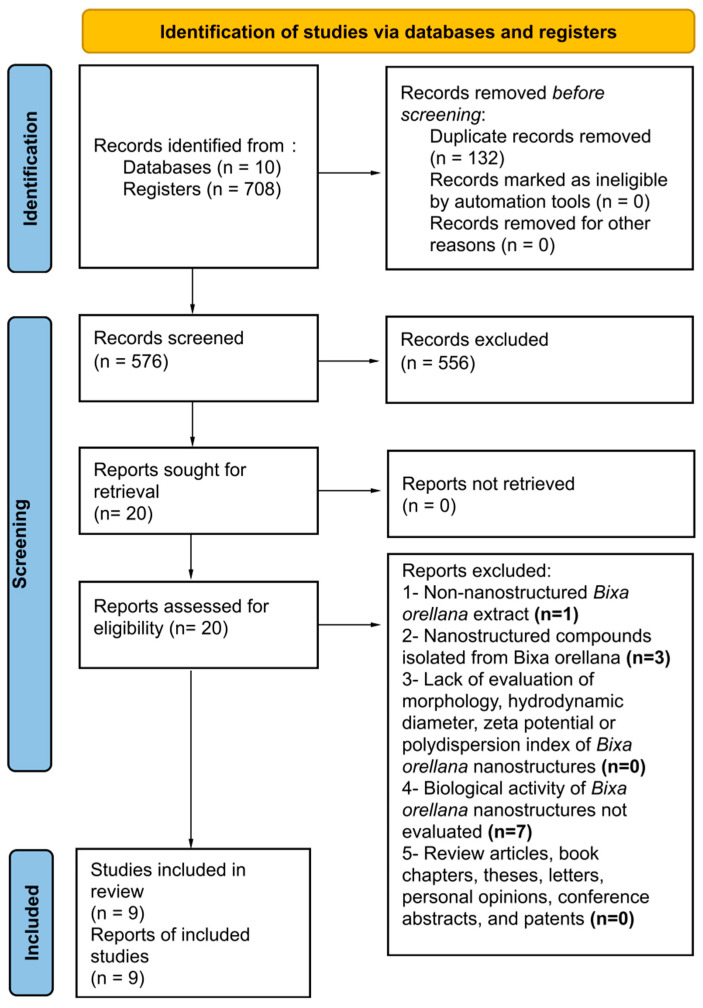
Plants are a source of valuable organic chemical compounds with complex structures rich in therapeutic activities. The encapsulation of compounds in nanostructured systems is an alternative to avoid limitations, such as instability and low solubility, and to promote therapeutic use. The objective of the present review was to summarize the data in the literature on the physicochemical characteristics, biomedical efficacy, and toxicity of nanostructures containing extracts and oils obtained from annatto (). For this, searches were conducted in the CINAHL, LILACS, Embase, FSTA, MEDLINE, ProQuest, PubMed, ScienceDirect, Scopus, and Web of Science databases. Studies that carried out the development, physical-chemical characterization, and evaluation of therapeutic efficacy and/or in vitro, in vivo, or clinical toxicity of nanostructures containing extracts and oils derived from annatto were included in the review. Of the 708 articles found, nine met the inclusion criteria. The included studies developed different nanostructures (nanofibers, nanocochleates, chitosan, lipid, polymeric, and metallic nanoparticles). These nanostructures showed leishmanicidal, photoprotective, antioxidant, antimicrobial, and immunomodulatory efficacy, and tissue regeneration potential with no or low toxic effects in the tested models. Thus, the present work supports the nanostructuring of annatto extracts and oils as a relevant approach to the development of new technologies for biomedical applications.
植物是具有复杂结构且富含治疗活性的有价值有机化合物的来源。将化合物封装在纳米结构系统中是一种避免诸如不稳定性和低溶解度等限制并促进治疗应用的替代方法。本综述的目的是总结文献中关于含有从胭脂树()中提取的提取物和油的纳米结构的物理化学特性、生物医学功效和毒性的数据。为此,在CINAHL、LILACS、Embase、FSTA、MEDLINE、ProQuest、PubMed、ScienceDirect、Scopus和Web of Science数据库中进行了检索。本综述纳入了对含有从胭脂树中提取的提取物和油的纳米结构进行开发、物理化学表征以及治疗功效和/或体外、体内或临床毒性评估的研究。在所发现的708篇文章中,有9篇符合纳入标准。纳入的研究开发了不同的纳米结构(纳米纤维、纳米耳蜗、壳聚糖、脂质、聚合物和金属纳米颗粒)。这些纳米结构在测试模型中显示出抗利什曼原虫、光保护、抗氧化、抗菌和免疫调节功效以及组织再生潜力,且毒性无或很低。因此,本研究支持将胭脂树提取物和油进行纳米结构化,作为开发生物医学应用新技术的一种相关方法。