Department of Neurology, Huashan Hospital, Fudan University, Shanghai, China.
Neurosciences Group, Nuffield Department of Clinical Neurosciences, Weatherall Institute of Molecular Medicine, University of Oxford, Oxford, OX3 9DS, UK.
Orphanet J Rare Dis. 2017 Dec 19;12(1):182. doi: 10.1186/s13023-017-0732-z.
Congenital myasthenic syndrome caused by mutations in AGRN, a gene encoding a protein with a crucial function at the neuromuscular junction, is a rare disorder. There are few studies in this area. We here present two cases with novel mutations of AGRN of which we further investigated possible pathogenesis.
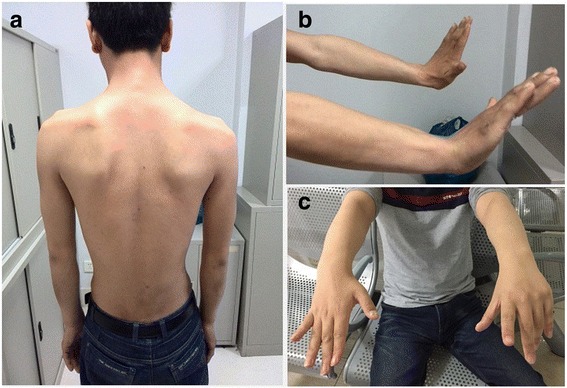
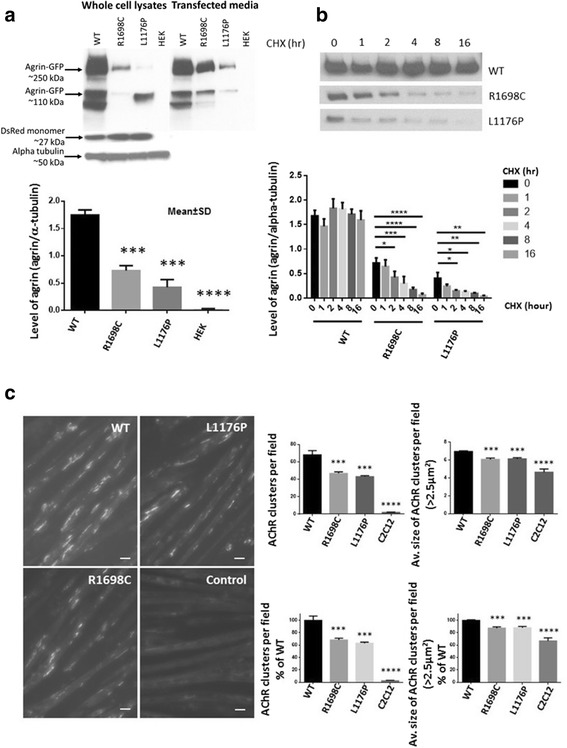
Patient 1 had general limb weakness with fluctuation and deterioration in the afternoon and in hot weather. Patient 2 had early-onset weakness of lower extremities with suspected fluctuation in the early stages, which then progressed to the upper limbs. Both distal and proximal muscles were involved. Repetitive stimulation on EMG in both patients showed decrement in proximal and distal limbs. Patient 2 showed a marked response to salbutamol while Patient 1 did not. By targeted exome sequencing, two novel homozygous missense variants, p.L1176P and p.R1698C, in the SEA and LG2 domain of agrin were identified respectively. Further functional analysis revealed instability of the protein and impaired clustering of the acetylcholine receptor (AChR) by both mutations.
The mutations identified in AGRN in our study may cause congenital myasthenic syndrome by damaging protein stability and interfering with AChR clustering. These results broaden the understandings on the phenotype, genotype and pathogenesis of this rare disorder.
由编码神经肌肉接头关键蛋白的 AGNR 基因突变引起的先天性肌无力综合征是一种罕见疾病。该领域的研究较少。我们在此介绍两例具有新型 AGNR 基因突变的病例,并进一步探讨其可能的发病机制。
患者 1 表现为全身肌无力,下午和炎热天气时波动和恶化。患者 2 表现为下肢早期无力,早期疑似波动,随后进展至上肢。远端和近端肌肉均受累。两位患者的肌电图重复刺激显示近端和远端肌肉均有递减现象。患者 2 对沙丁胺醇有明显反应,而患者 1 则没有。通过靶向外显子组测序,分别在 agrin 的 SEA 和 LG2 结构域中鉴定出两个新型纯合错义变异,p.L1176P 和 p.R1698C。进一步的功能分析表明,这两种突变均导致蛋白不稳定,并损害乙酰胆碱受体(AChR)的聚集。
本研究中在 AGNR 中发现的突变可能通过破坏蛋白稳定性和干扰 AChR 聚集导致先天性肌无力综合征。这些结果拓宽了对这种罕见疾病表型、基因型和发病机制的认识。