College of Nursing, The University of Illinois at Chicago, Chicago, IL, USA.
Department of Spinal Surgery, Changzheng Hospital, Second Military Medical University of China, Shanghai, China.
J Chin Med Assoc. 2018 Mar;81(3):242-247. doi: 10.1016/j.jcma.2017.06.021. Epub 2017 Dec 16.
Sleep disturbance is a major health issue in people with type 2 diabetes (T2DM). The Pittsburgh Sleep Quality Index (PSQI) has been the most widely used instrument to measure subjective sleep disturbance. Nevertheless, its factor structure in the context of T2DM has not been examined. The purpose of the study is to evaluate the factor structure of the PSQI in Chinese adults with T2DM and thereby to facilitate its use in clinical practice and research.
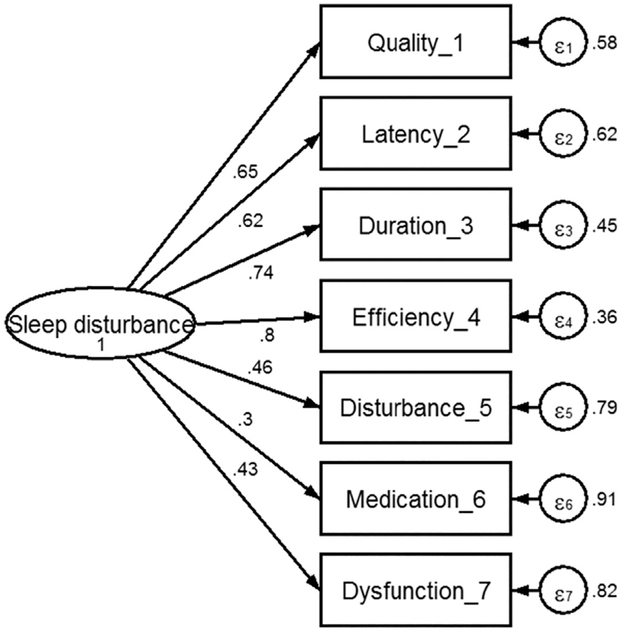
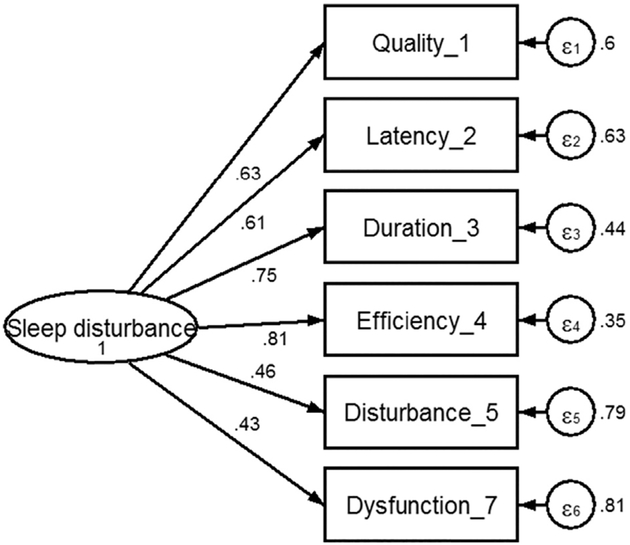
The PSQI (Chinese version) was administered to 240 patients with T2DM. Confirmatory factor analysis was conducted to examine the one-factor, adapted one-factor by removing the component "use of sleep medication", and the three-factor structure of the PSQI. Goodness-of-fit indices were used to evaluate the fit of the model. Construct validity of the resultant model was further examined using contrasted groups. Cronbach's α of the resultant model was obtained to evaluate its internal consistency.
The three-factor model proposed by Cole et al. did not fit the sleep data. Confirmatory factor analysis supported the adapted one-factor model with the PSQI global score as an indicator of overall sleep quality, and the goodness-of-fit indices for the adapted model were better compared to the original one-factor model. As expected, women, older adults, and patients with poor glycemic control had higher adapted PSQI global score (p < 0.01). Cronbach's α of the adapted PSQI was 0.78.
The adapted PSQI was similar to the original PSQI in that only the component "use of sleep medication" was removed from the original scale and the one-factor scoring worked better. In contrast, the three-factor model has limited usefulness in this population.
睡眠障碍是 2 型糖尿病(T2DM)患者的一个主要健康问题。匹兹堡睡眠质量指数(PSQI)是最常用的测量主观睡眠障碍的工具。然而,其在 T2DM 背景下的因子结构尚未得到检验。本研究旨在评估 PSQI 在中国 T2DM 成人中的因子结构,从而促进其在临床实践和研究中的应用。
对 240 例 T2DM 患者进行 PSQI(中文版)测试。采用验证性因子分析来检验 PSQI 的单因子、通过去除“使用睡眠药物”成分的改良单因子以及三因子结构。采用拟合优度指数来评估模型的拟合情况。通过对比组进一步检验所得模型的结构效度。获得所得模型的 Cronbach's α 值,以评估其内部一致性。
Cole 等人提出的三因子模型并不符合睡眠数据。验证性因子分析支持改良的单因子模型,该模型以 PSQI 总分作为整体睡眠质量的指标,且改良模型的拟合优度指数优于原始的单因子模型。正如预期的那样,女性、老年人和血糖控制不佳的患者的改良 PSQI 总分较高(p<0.01)。改良 PSQI 的 Cronbach's α 值为 0.78。
改良的 PSQI 与原始 PSQI 相似,只是从原始量表中去除了“使用睡眠药物”这一成分,并且采用了单因子计分方式,效果更好。相比之下,三因子模型在该人群中的应用价值有限。