Conti Chiara, Lanzara Roberta, Scipioni Mattia, Iasenza Marzia, Guagnano Maria T, Fulcheri Mario
Department of Psychological, Health, and Territorial Sciences, University "G. d'Annunzio" Chieti-Pescara, Chieti, Italy.
Department of Medicine and Aging, University "G. d'Annunzio" Chieti-Pescara, Chieti, Italy.
Front Psychol. 2017 Dec 5;8:2125. doi: 10.3389/fpsyg.2017.02125. eCollection 2017.
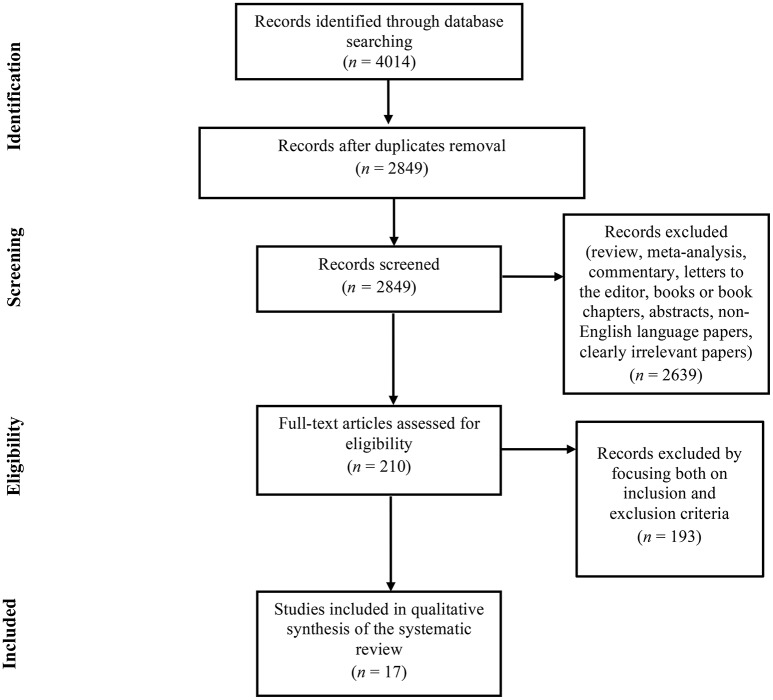
We carried out a systematic review analyzing the relation between binge eating disorder (BED), a recent addition to the eating disorders in DSM-5, and suicidality (i.e., suicidal ideation or attempted and/or committed suicide) by synthesizing the relevant studies' qualitative data. We conducted, according to PRISMA guidelines, a systematic search of the literature on PubMed, Scopus, ISI Web of Science, PsycINFO, Google Scholar, and ScienceDirect. Search terms were "binge eating disorder" combined with the "AND" Boolean operator and "suicid." The initial search identified 4,014 records, of which 17 research reports met the predefined inclusion criteria and were analyzed. BED was found to be significantly associated with a marked increase in suicidal behaviors and suicidal ideation (SI). The presence and severity of BED were found to be relevant predictive factors for suicidality, notably in association with mood disorders and specific psychological features, while a high body mass index (BMI) did not always affect suicidality. BED has usually been associated with suicide risk, particularly when occurring with another psychiatric disorder and/or in an adolescent population. Pursuant to these findings, it is necessary to consider both dysfunctional eating behavior and related psychopathological factors that may induce SI and suicidal behavior in BED, aiming to identify patients and subgroups of patients needing greater clinical psychological attention to most effectively prevent and treat suicidality.
我们进行了一项系统评价,通过综合相关研究的定性数据,分析暴食症(BED,《精神疾病诊断与统计手册》第5版中新增的饮食失调症)与自杀行为(即自杀意念、自杀未遂和/或自杀身亡)之间的关系。我们按照PRISMA指南,在PubMed、Scopus、ISI科学网、PsycINFO、谷歌学术和ScienceDirect上对文献进行了系统检索。检索词为“暴食症”与“AND”布尔运算符以及“自杀”相结合。初步检索共识别出4014条记录,其中17篇研究报告符合预先设定的纳入标准并进行了分析。结果发现,暴食症与自杀行为和自杀意念(SI)的显著增加密切相关。暴食症的存在和严重程度被发现是自杀行为的相关预测因素,特别是与情绪障碍和特定心理特征相关,而高体重指数(BMI)并不总是影响自杀行为。暴食症通常与自杀风险相关,尤其是在与另一种精神疾病同时出现和/或在青少年人群中。根据这些发现,有必要考虑功能失调的饮食行为以及可能导致暴食症患者出现自杀意念和自杀行为的相关精神病理因素,旨在识别出最需要临床心理关注以有效预防和治疗自杀行为的患者及患者亚组。