Fuchsman Clara A, Devol Allan H, Saunders Jaclyn K, McKay Cedar, Rocap Gabrielle
School of Oceanography, University of Washington, Seattle, WA, United States.
Front Microbiol. 2017 Dec 5;8:2384. doi: 10.3389/fmicb.2017.02384. eCollection 2017.
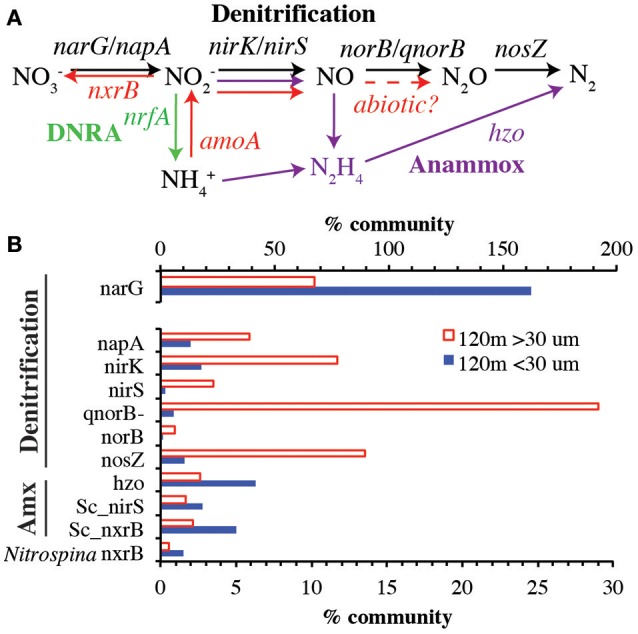
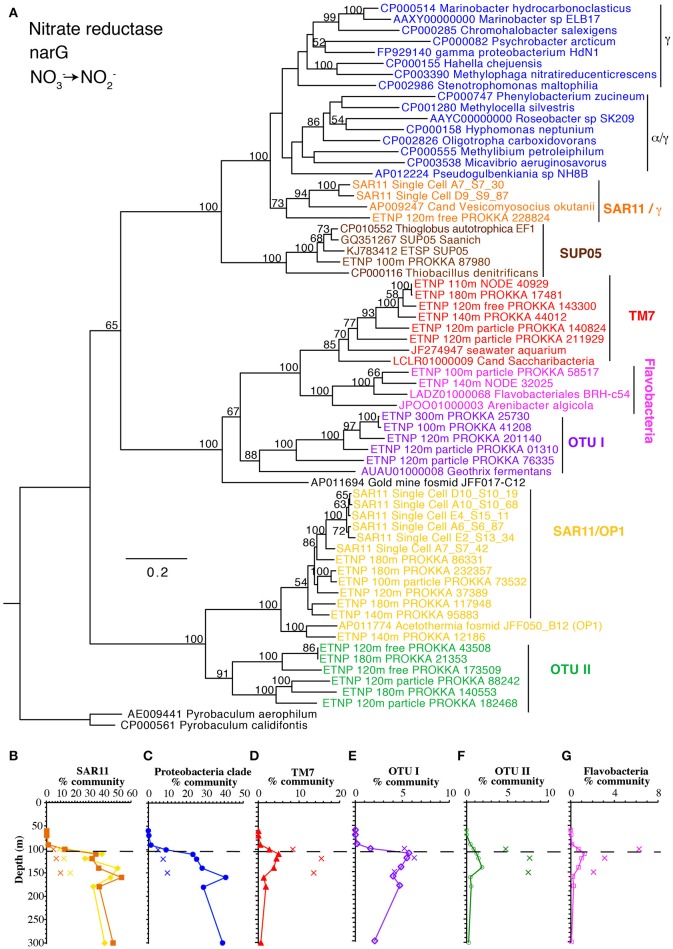
Microbial communities in marine oxygen deficient zones (ODZs) are responsible for up to half of marine N loss through conversion of nutrients to NO and N. This N loss is accomplished by a consortium of diverse microbes, many of which remain uncultured. Here, we characterize genes for all steps in the anoxic N cycle in metagenomes from the water column and >30 μm particles from the Eastern Tropical North Pacific (ETNP) ODZ. We use an approach that allows for both phylogenetic identification and semi-quantitative assessment of gene abundances from individual organisms, and place these results in context of chemical measurements and rate data from the same location. Denitrification genes were enriched in >30 μm particles, even in the oxycline, while anammox bacteria were not abundant on particles. Many steps in denitrification were encoded by multiple phylotypes with different distributions. Notably three NO reductases (), each with no cultured relative, inhabited distinct niches; one was free-living, one dominant on particles and one had a C terminal extension found in autotrophic S-oxidizing bacteria. At some depths >30% of the community possessed nitrite reductase . A OTU linked to SAR11 explained much of this abundance. The only bacterial gene found for NO reduction to NO in the ODZ was a form of related to the previously postulated "nitric oxide dismutase," hypothesized to produce N directly while oxidizing methane. However, similar genes are also found in the published genomes of many bacteria that do not oxidize methane, and here the genes did not correlate with the presence of methane oxidation genes. Correlations with NO concentrations indicate that these genes likely facilitate NO reduction to NO in the ODZ. In the oxycline, genes were not detected in the water column, and estimated NO production rates from ammonia oxidation were insufficient to support the observed oxycline NO maximum. However, both and genes were present within particles in the oxycline, suggesting a particulate source of NO and N. Together, our analyses provide a holistic view of the diverse players in the low oxygen nitrogen cycle.
海洋缺氧区(ODZs)中的微生物群落通过将营养物质转化为一氧化氮(NO)和氮气(N₂),导致了高达一半的海洋氮损失。这种氮损失是由多种不同的微生物共同完成的,其中许多微生物仍未被培养。在这里,我们对东热带北太平洋(ETNP)ODZ水柱和大于30μm颗粒的宏基因组中缺氧氮循环所有步骤的基因进行了表征。我们采用了一种方法,既可以对个体生物体的基因丰度进行系统发育鉴定和半定量评估,又能将这些结果与同一地点的化学测量和速率数据相结合。反硝化基因在大于30μm的颗粒中富集,即使在氧化跃层也是如此,而厌氧氨氧化细菌在颗粒上并不丰富。反硝化的许多步骤由具有不同分布的多个系统发育型编码。值得注意的是,三种一氧化氮还原酶(),每种都没有可培养的亲缘种,占据着不同的生态位;一种是自由生活的,一种在颗粒上占主导地位,还有一种具有在自养硫氧化细菌中发现的C末端延伸。在某些深度,超过30%的群落拥有亚硝酸盐还原酶。一个与SAR11相关的OTU解释了这种丰度的大部分原因。在ODZ中发现的唯一将NO还原为NO₂的细菌基因是一种与先前假定的“一氧化氮歧化酶”相关的形式,据推测它在氧化甲烷时直接产生N₂。然而,在许多不氧化甲烷的细菌的已发表基因组中也发现了类似的基因,在这里这些基因与甲烷氧化基因的存在没有相关性。与NO浓度的相关性表明,这些基因可能有助于在ODZ中将NO还原为NO₂。在氧化跃层中,水柱中未检测到基因,并且从氨氧化估计的NO产生速率不足以支持观察到的氧化跃层NO最大值。然而,氧化跃层颗粒中同时存在和基因,这表明颗粒是NO和N₂的来源。总之,我们的分析提供了低氧氮循环中不同参与者的整体视图。