Pasqua Martina, Michelacci Valeria, Di Martino Maria Letizia, Tozzoli Rosangela, Grossi Milena, Colonna Bianca, Morabito Stefano, Prosseda Gianni
Istituto Pasteur Italia, Department of Biology and Biotechnology "C. Darwin", Sapienza Università di Roma, Rome, Italy.
European Union Reference Laboratory for Escherichia coli, Department of Veterinary Public Health and Food Safety, Istituto Superiore di Sanità, Rome, Italy.
Front Microbiol. 2017 Dec 5;8:2390. doi: 10.3389/fmicb.2017.02390. eCollection 2017.
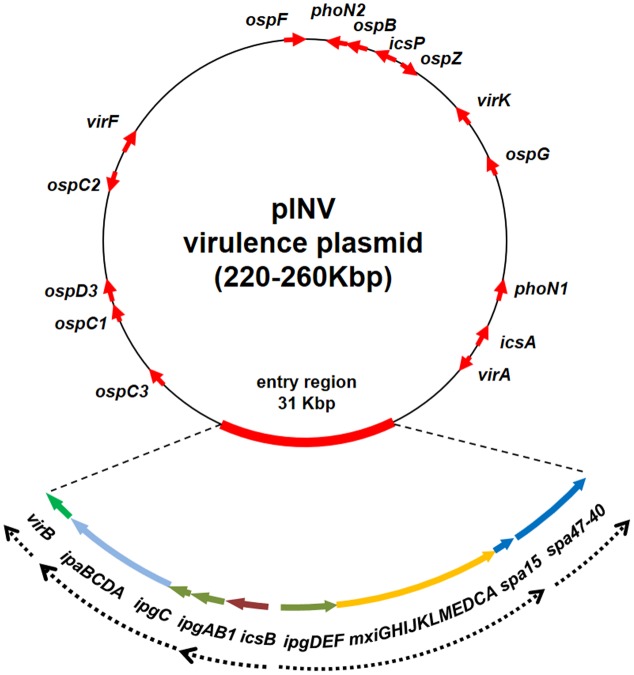
Among the intestinal pathogenic , enteroinvasive (EIEC) are a group of intracellular pathogens able to enter epithelial cells of colon, multiplicate within them, and move between adjacent cells with a mechanism similar to , the ethiological agent of bacillary dysentery. Despite EIEC belong to the same pathotype of , they neither have the full set of traits that define nor have undergone the extensive gene decay observed in . Molecular analysis confirms that EIEC are widely distributed among phylogenetic groups and correspond to bioserotypes found in many serogroups. Like , also in EIEC the critical event toward a pathogenic life-style consisted in the acquisition by horizontal gene transfer of a large F-type plasmid (pINV) containing the genes required for invasion, intracellular survival, and spreading through the intestinal mucosa. In , the ample gain in virulence determinants has been counteracted by a substantial loss of functions that, although important for the survival in the environment, are redundant or deleterious for the life inside the host. The pathoadaptation process that has led to modify its metabolic profile and increase its pathogenic potential is still in infancy in EIEC, although maintenance of some features typical of might favor their emerging relevance as intestinal pathogens worldwide, as documented by recent outbreaks in industrialized countries. In this review, we will discuss the evolution of EIEC toward -like invasive forms going through the epidemiology, including the emergence of new virulent strains, their genome organization, and the complex interactions they establish with the host.
在肠道致病菌中,肠侵袭性大肠杆菌(EIEC)是一类细胞内病原体,能够侵入结肠上皮细胞,在细胞内繁殖,并通过类似于志贺氏菌(细菌性痢疾的病原体)的机制在相邻细胞间移动。尽管EIEC与志贺氏菌属于同一致病型,但它们既不具备定义志贺氏菌的全套特征,也未经历志贺氏菌中观察到的广泛基因衰退。分子分析证实,EIEC广泛分布于多个系统发育组中,对应于许多血清群中发现的生物血清型。与志贺氏菌一样,EIEC致病生活方式的关键事件也是通过水平基因转移获得一个大型F型质粒(pINV),该质粒包含侵袭、细胞内存活以及通过肠黏膜扩散所需的基因。在志贺氏菌中,毒力决定因素的大量增加被功能的大量丧失所抵消,这些功能虽然对在环境中生存很重要,但对宿主内的生存是多余的或有害的。导致志贺氏菌改变其代谢谱并增加其致病潜力的致病适应过程在EIEC中仍处于起步阶段,尽管维持一些志贺氏菌特有的特征可能有利于它们在全球范围内作为肠道病原体的新出现的相关性,工业化国家最近的疫情爆发就证明了这一点。在这篇综述中,我们将通过流行病学来讨论EIEC向志贺氏菌样侵袭形式的演变,包括新的毒力菌株的出现、它们的基因组组织以及它们与宿主建立的复杂相互作用。